Flexible Compressor Coupling

In modern industrial power transmission systems, compressor equipment serves as a core power source for gas compression, medium transportation and energy conversion, covering diverse operating scenarios from light-duty ventilation systems to heavy-duty industrial pressurization units. The stable operation of compressors relies heavily on reliable shaft connection components, among which flexible compressor couplings stand out as indispensable transmission accessories. Unlike rigid connecting structures that pursue absolute positional fixation, flexible compressor couplings are professionally optimized for the complex dynamic operating characteristics of compressor equipment, focusing on balancing efficient torque transmission, dynamic displacement compensation and operating vibration attenuation. They connect the driving shaft of power components and the driven shaft of compressor hosts, ensuring continuous and stable power output while adapting to various subtle deformations and displacements generated during long-term equipment operation, which effectively avoids mechanical failure risks caused by rigid structural constraints.
The essential value of flexible compressor couplings originates from the inherent operating characteristics of compressor equipment. During the start-up, steady operation and shutdown cycles of compressors, the entire transmission system will produce complex dynamic changes. The instantaneous torque impact generated by equipment start-up, the torsional vibration formed by cyclic operation, and the thermal expansion and contraction of metal components caused by long-time high-load operation will lead to different degrees of relative displacement between the driving shaft and driven shaft. Such displacements include axial telescopic deviation, radial offset and angular deflection, which are unavoidable in mechanical operation. Rigid connection structures cannot adapt to these dynamic changes, and long-term operation will cause excessive stress concentration at shaft connection parts, resulting in shaft body wear, bearing damage, gear meshing failure and even equipment shutdown. Flexible compressor couplings solve this industry pain point through ingenious structural design and flexible material characteristics, utilizing the elastic deformation of internal components to absorb and compensate various shaft misalignments, and maintain the stability of the power transmission process in dynamic working conditions.
The working mechanism of flexible compressor couplings follows the basic principles of mechanical power transmission and elastic mechanics. In the operating state, the driving end drives the coupling assembly to rotate synchronously, and torque is evenly transmitted to the driven end through the flexible intermediate structure, thereby driving the compressor host to operate stably. When relative displacement occurs between the two connected shafts, the flexible components inside the coupling produce micro elastic deformation including tension, compression and shear. This controllable deformation does not affect the overall torque transmission efficiency, but can effectively offset the position deviation between the shafts, avoid rigid friction and extrusion between shaft bodies, and disperse the concentrated mechanical stress on the connection parts. In terms of vibration damping, the elastic structure of the coupling can form a buffer barrier in the transmission path. It can absorb the high-frequency vibration generated by the power source and the periodic vibration of the compressor during operation, prevent vibration energy from transmitting bidirectionally along the shaft system, reduce the overall vibration amplitude of the equipment unit, and weaken the noise generated by mechanical resonance. This dual capability of misalignment compensation and vibration damping constitutes the core working advantage of flexible compressor couplings.
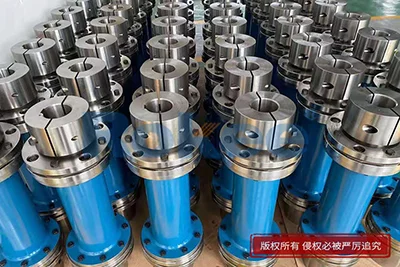
In terms of structural design, flexible compressor couplings adopt diversified modular structures adapted to different compressor types and working loads, but all follow the design logic of combining rigid limit support and flexible buffer transmission. The main body is usually composed of symmetric hub structures and intermediate flexible transmission components. The hubs on both sides are stably fixed with the driving shaft and driven shaft respectively through fastening structures, providing rigid support for overall rotation and torque transmission. The intermediate flexible components are the core functional parts, which are made of high-elasticity and fatigue-resistant polymer materials or special metal elastic structures. Different from general industrial couplings, the flexible parts of compressor-specific couplings are optimized for the frequent start-stop and cyclic load characteristics of compressors, with enhanced torsional stiffness and elastic recovery performance. This design ensures that the coupling can maintain stable torque output under high-load operating conditions without torsional deformation and power loss, and can quickly recover its original state after eliminating displacement and vibration interference, realizing long-cycle stable operation.
Material selection is a key factor determining the service performance and service life of flexible compressor couplings. The hub parts need to have high structural strength, rigidity and wear resistance to cope with long-term high-speed rotation and load impact, so high-strength alloy materials with good mechanical properties and structural stability are mostly adopted. Such materials can resist structural deformation and surface wear under high-load operation, ensuring the positioning accuracy and connection stability of the shaft system. The intermediate flexible components bear repeated elastic deformation and vibration buffer work, so the material selection focuses on elastic recovery performance, fatigue resistance and environmental adaptability. Common elastic materials have excellent shear resistance and compression resilience, and can maintain stable elastic performance after millions of repeated deformations. In addition, for compressors operating in special environments such as high temperature, low temperature and humid industrial sites, the flexible materials are optimized with temperature resistance and aging resistance to avoid performance degradation caused by environmental factors, ensuring that the coupling can maintain consistent working performance in complex working conditions.
Flexible compressor couplings have extremely high working adaptability, covering almost all types of compressor equipment in industrial production. For small and medium-sized low-pressure compressors with frequent start-stop and light-load operation, flexible couplings with compact structure and sensitive deformation response are usually matched. Such couplings have small installation space requirements and excellent low-load vibration damping performance, which can effectively eliminate the start-up impact of small equipment and improve the smoothness of low-speed operation. For large-scale high-pressure compressors, screw compressors and centrifugal compressors with continuous high-load operation, high-torsional-stiffness flexible couplings are adopted. These products are optimized in structural strength and torque transmission capacity, can withstand long-term continuous load operation, and compensate the thermal displacement generated by the equipment after long-time heating operation, avoiding shaft system jitter and transmission failure caused by thermal expansion. Whether it is intermittent operating compressors in batch production lines or continuous operating compressor units in centralized energy supply systems, flexible couplings can form matched transmission solutions.
In actual industrial operation, the application value of flexible compressor couplings is reflected in equipment protection and operating cost optimization. The most direct function is to protect the core components of the compressor unit. The vibration and impact generated during equipment operation will be buffered and absorbed by the coupling, which greatly reduces the wear of precision components such as compressor bearings, sealing parts and transmission gears. It avoids equipment failure caused by long-term vibration fatigue and shaft misalignment, and effectively extends the overall service life of the compressor unit. At the same time, stable power transmission ensures the consistent operating state of the compressor, makes the gas compression ratio and medium transportation volume maintain stable standard values, avoids output fluctuation caused by unstable transmission, and improves the operating accuracy and working efficiency of the entire production system.
In addition to equipment protection and efficiency improvement, flexible compressor couplings also have prominent advantages in installation and daily operation and maintenance. The integrated modular structure makes the overall assembly process simpler and more convenient. The reasonable structural tolerance design allows certain installation deviation during assembly, reducing the precision requirements for shaft alignment in the installation process, lowering the difficulty of on-site construction and improving installation efficiency. In terms of daily maintenance, the structural design of no lubrication and no complex auxiliary accessories is adopted for most flexible compressor couplings. Compared with traditional transmission components that need regular oil injection maintenance and wear part replacement, it greatly reduces daily maintenance workload and maintenance cost. The elastic components have strong fatigue resistance and long service cycle, which can maintain stable performance for a long time after one-time installation, reducing the frequency of equipment shutdown maintenance and improving the continuous operation rate of industrial production lines.
With the continuous upgrading of industrial production towards high efficiency, energy saving and intelligence, the performance requirements for flexible compressor couplings are also constantly improving. Modern industrial production puts forward higher standards for the stability, energy-saving performance and environmental adaptability of transmission components. The optimized flexible compressor coupling design further balances flexibility and rigidity, not only maintains excellent misalignment compensation and vibration damping capabilities, but also reduces torsional energy loss during power transmission, realizing energy-saving operation of the transmission system. At the same time, the improved material formula and structural process enhance the corrosion resistance, aging resistance and extreme working condition adaptability of the product, enabling it to operate stably in harsh industrial environments such as chemical corrosion, dust pollution and high and low temperature alternation. In the intelligent operation and maintenance system of modern equipment, the stable operating state of flexible couplings also provides basic guarantee for the real-time monitoring of equipment operating parameters, helping the intelligent system accurately judge the operating state of the compressor unit.
In the entire industrial transmission system, flexible compressor couplings are small but core components, undertaking the important task of connecting power and stabilizing operation. Its working performance directly affects the operating stability, failure rate and service life of compressor equipment. Excellent flexible coupling products can eliminate various dynamic interference factors in the compressor operating process, realize efficient and stable power transmission, create a stable operating environment for compressor units, and provide reliable basic support for the stable operation of the entire industrial production system. In the future industrial development process, with the continuous progress of mechanical design technology and new material technology, flexible compressor couplings will develop towards higher precision, stronger durability and wider adaptability, continuously meet the increasingly complex industrial operating demands, and play a more important role in the field of industrial fluid power transmission.
Rokee is a professional manufacturer of industrial couplings in china, designing and customizing a wide range of drive shaft coupling products for customers worldwide. Submit your coupling drawings or technical specifications, and we can customize coupling products for you.
Coupling Categories



Links:
- Calibration Weight
- Digital Viscometer
- Carpas Industriales
- Exhibition Tent
- Industrial Cardan Shaft
- PU Sandwich Panel Machine
- PIR Sandwich Panel Line
- Sandwich Panel Machine
- Sandwich Panel Production Line
- PU Sandwich Panel Line
- Sandwich Panel Line
- Flexible Couplings Manufacturer In China
- Elastic Couplings Manufacturer In China