Flexible Coupling Helps PUR Sandwich Panel Production Line Achieve Efficient And Continuous Production

The modern manufacturing industry of building insulation materials is gradually moving toward high automation, continuous operation and stable production efficiency, and PUR sandwich panels, as one of the core composite materials for energy-saving buildings, cold storage facilities and industrial enclosures, have seen a steadily rising market demand in recent years. The production process of PUR sandwich panels involves multiple interconnected mechanical procedures, including raw material feeding, continuous foaming, surface layer pressing, fixed-length cutting and finished product conveying. Each processing link relies on precise power transmission and coordinated operation of mechanical components to ensure the continuity of the production flow. In such an integrated production line, subtle mechanical vibration, axis displacement and transmission deviation often become hidden dangers that restrict production efficiency, cause equipment wear and trigger production interruption. As a key connecting component in mechanical transmission systems, flexible coupling has gradually become an indispensable core part of PUR sandwich panel production lines by virtue of its unique vibration damping, displacement compensation and stable torque transmission capabilities. It effectively solves various transmission problems in the continuous operation of production equipment, thereby helping the entire production line realize long-term efficient and continuous production.
The production structure of the PUR sandwich panel production line determines the stringent requirements for the stability of the transmission system. Different from discrete processing equipment, the PUR sandwich panel production line adopts an integrated assembly line layout, where multiple sets of driving motors, transmission shafts and processing mechanical structures are closely connected in sequence. In the raw material pretreatment stage, mechanical equipment needs to stably transport polyurethane raw materials and metal sheet substrates to the processing station at a constant speed; during the foaming and composite molding stage, the pressing roller set maintains continuous and uniform pressure to ensure the consistent thickness and compact internal structure of the sandwich panel; in the subsequent cutting and shaping stage, the cutting equipment needs to maintain precise rotational speed control to avoid dimensional errors of finished products. In the whole production cycle, any abnormal fluctuation of power transmission will lead to inconsistent material feeding speed, uneven foaming density and deviation of panel cutting size, which not only reduces the qualification rate of finished products but also causes frequent shutdown adjustments and seriously hinders the continuous production rhythm. In addition, the long-term high-load operation of the production line will inevitably generate mechanical vibration, and thermal expansion and cold contraction of metal structures will produce tiny axis displacement between connecting shafts. These invisible mechanical changes will gradually amplify the running loss of rigid transmission parts, resulting in increased equipment failure rate and shortened service life if there is no effective compensation and buffering measure.
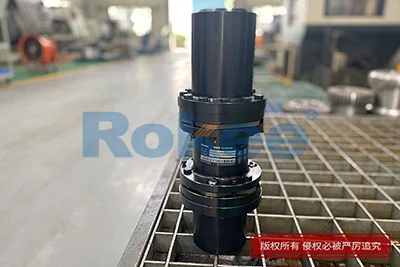
Flexible coupling is a mechanical connecting component composed of metal frameworks and elastic intermediate parts, which is specially designed to connect driving shafts and driven shafts in mechanical transmission systems. Its internal elastic components can produce reversible compression, stretching and shearing deformation during operation, forming a flexible transmission mode different from rigid coupling. This structural characteristic endows flexible coupling with three core performance advantages suitable for industrial continuous production: axis deviation compensation, vibration and impact buffering, and stable torque transmission. In the actual operation of PUR sandwich panel production lines, tiny parallel, angular and axial displacements are common between adjacent transmission shafts due to installation errors, equipment aging and thermal deformation. The elastic structure of flexible coupling can automatically adapt to these displacements without generating additional mechanical stress, avoiding the friction and abrasion caused by shaft misalignment. At the same time, the elastic intermediate parts can absorb the vibration energy generated by motor startup, load fluctuation and mechanical operation, convert the instantaneous impact load into elastic potential energy and release it slowly, so as to reduce the vibration amplitude of the entire transmission system and maintain the stable operating state of the equipment. Moreover, the internal structural design of flexible coupling can ensure uniform torque transmission, avoid torque loss in the power transmission process, and maintain the synchronization of rotational speed among multiple groups of linked equipment, which lays a solid foundation for the continuous and consistent operation of the assembly line.
In each key processing section of the PUR sandwich panel production line, flexible coupling plays an irreplaceable auxiliary role to optimize production efficiency. In the raw material conveying link, the feeding equipment needs to maintain a constant low-speed and stable operating state to ensure the accurate proportion of polyurethane composite raw materials and the uniform laying of metal substrates. The traditional rigid connecting structure is prone to rotational speed jitter under long-term operation, resulting in intermittent material feeding and local accumulation of raw materials. After adopting flexible coupling, the vibration generated by the motor during operation is isolated, and the tiny displacement of the transmission shaft caused by equipment operation is compensated in real time. The feeding roller set can maintain a stable rotational speed within a long running cycle, ensuring the continuous and uniform transportation of raw materials and effectively avoiding material waste and processing defects caused by unstable feeding. In the foaming and composite pressing stage, the production line requires the pressing equipment to maintain constant pressure and uniform operating speed to make the polyurethane foam fit closely with the metal surface layer and form a dense and stable internal cellular structure. The flexible connection performance of flexible coupling can weaken the mechanical resonance generated by the high-speed operation of the pressing roller set, reduce the pressure fluctuation on the surface of the sandwich panel during molding, and ensure the flatness and structural uniformity of the finished panel surface. This optimization effect not only improves the overall quality of the product but also reduces the defective rate caused by mechanical vibration.
In the fixed-length cutting and finished product conveying section of the production line, the precise transmission performance of flexible coupling is more prominent. The cutting equipment of PUR sandwich panels has extremely high requirements for rotational speed synchronization. Once the transmission shaft has deviation or vibration, the cutting blade will have position offset and rotational speed fluctuation, leading to uneven cutting sections and inconsistent product length. Flexible coupling can eliminate the transmission error caused by shaft misalignment, keep the cutting tool running at a constant and accurate speed, and ensure that the dimensional error of each batch of finished panels is controlled within a tiny range. For the finished product conveying mechanism at the rear end of the production line, the continuous operation of the conveying roller group requires stable power output. The elastic buffering performance of flexible coupling can reduce the mechanical impact during equipment startup and shutdown, avoid the jitter of the conveying platform, and ensure that the molded sandwich panels are smoothly transported to the stacking area without surface scratches or structural deformation. The coordinated operation of flexible coupling in each link realizes the seamless connection of all processes in the production line, eliminates production stagnation caused by transmission failure, and greatly improves the continuity of the production process.
In addition to optimizing the production stability of a single process, flexible coupling also effectively reduces the operation and maintenance cost of the PUR sandwich panel production line and prolongs the service life of mechanical equipment. In industrial production equipment, rigid transmission structures are prone to stress concentration at the shaft connection. Long-term unbalanced force will cause serious wear of shaft heads, bearings and other parts, and even produce metal fatigue cracks, resulting in frequent equipment failure and shutdown maintenance. The elastic deformation ability of flexible coupling can disperse the concentrated mechanical stress during power transmission, reduce the friction loss between connecting parts, and slow down the aging and wear speed of key transmission components. Under the same operating conditions, the production line equipped with flexible coupling has lower component replacement frequency and fewer unexpected shutdown times. For the continuous production mode of sandwich panels that pursues large-batch and uninterrupted processing, the reduction of maintenance downtime means the improvement of effective production time. Meanwhile, the stable transmission state optimized by flexible coupling can reduce the power consumption caused by mechanical resistance and vibration energy loss, realizing energy saving and consumption reduction in the production process and further improving the economic benefits of production operations.
With the continuous upgrading of building material production technology, the PUR sandwich panel production line is developing in the direction of higher automation, larger production capacity and more compact structural layout. The compact equipment layout makes the spatial distance between transmission shafts shorter, and the mutual interference of mechanical vibration becomes more obvious, which puts forward higher requirements for the deviation compensation and vibration reduction performance of connecting components. The structural design of flexible coupling is constantly optimized to adapt to the high-intensity operating environment of modern production lines. The diversified elastic intermediate materials can adapt to different temperature and load conditions in the production workshop, maintaining stable buffering and compensation performance in long-term continuous operation. The simple and compact overall structure is convenient for installation and daily inspection without occupying excessive equipment space, which is compatible with the integrated layout characteristics of sandwich panel production lines. In the high-load continuous production scenario, flexible coupling can still maintain excellent transmission stability, avoid performance attenuation caused by long-term fatigue operation, and provide reliable mechanical guarantee for the long-term uninterrupted operation of the production line.
In the actual industrial production application of PUR sandwich panels, the application value of flexible coupling is reflected in the comprehensive improvement of production efficiency, product quality and equipment stability. Many production lines have realized uninterrupted cyclic operation for a long time after replacing and optimizing the transmission connecting components with flexible coupling. The production rhythm is no longer restricted by frequent mechanical failures and transmission fluctuations, and the single-batch production capacity of the production line is significantly improved. The vibration reduction and noise reduction effect brought by flexible coupling also optimizes the on-site production environment, reduces the noise pollution generated by mechanical friction and vibration, and meets the environmental protection operation standards of modern processing workshops. Moreover, the stable transmission state effectively reduces the defective products generated in the processing process, improves the utilization rate of raw materials, and forms a green and efficient production mode. It is undeniable that as a small but key mechanical component, flexible coupling has become an important technical support for the iterative upgrading of PUR sandwich panel production lines.
To sum up, the efficient and continuous production of PUR sandwich panel production lines cannot be separated from the stable operation of the internal mechanical transmission system. Flexible coupling makes up for many inherent defects of rigid transmission structures through its unique displacement compensation, vibration buffering and stable torque transmission capabilities. It solves various mechanical transmission problems such as shaft misalignment, operational vibration and impact load in the continuous operation of the production line, realizes the seamless connection of all processing links, and effectively improves the production efficiency and product qualification rate. At the same time, it reduces equipment wear and maintenance costs, extends the service life of production equipment, and creates stable and reliable operating conditions for long-term uninterrupted production. With the continuous development of the building insulation material industry, the market has higher requirements for the production capacity and product quality of PUR sandwich panels. The popularization and application of flexible coupling will further promote the intelligent and high-efficiency upgrading of sandwich panel production lines, provide stronger technical support for the sustainable development of the building material manufacturing industry, and realize the dual improvement of production economic benefits and operational stability in the industrial production chain.



Links:
- Calibration Weight
- Digital Viscometer
- Carpas Industriales
- Exhibition Tent
- Industrial Cardan Shaft
- PU Sandwich Panel Machine
- PIR Sandwich Panel Line
- Sandwich Panel Machine
- Sandwich Panel Production Line
- PU Sandwich Panel Line
- Sandwich Panel Line
- Flexible Couplings Manufacturer In China
- Elastic Couplings Manufacturer In China