Servo Motor Diaphragm Coupling

In modern precision motion control systems, the seamless coordination between servo motors and driven mechanical components determines the overall operational accuracy, stability, and service life of automated equipment. As a core connecting component in transmission systems, the servo motor diaphragm coupling undertakes the critical task of torque transmission, displacement compensation, and vibration isolation, serving as an indispensable link that bridges power output and mechanical execution. Unlike traditional coupling structures that rely on elastic rubber elements or gear meshing for transmission, the diaphragm coupling adopts an all-metal flexible structure based on elastic deformation mechanics, perfectly matching the high-response, high-precision, and high-stability operational characteristics of servo motors, and has become the preferred transmission accessory for high-end industrial automation, precision processing, and intelligent motion equipment.
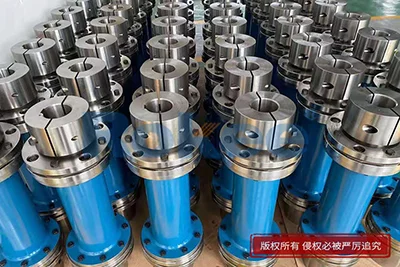
The basic structural composition of the servo motor diaphragm coupling is simple and rigorous, mainly consisting of metal diaphragm groups, connecting bolts, and left and right hubs. The core functional component is the stacked metal diaphragm group, which is composed of multiple ultra-thin high-strength stainless steel sheets laminated together. These diaphragm sheets are precisely punched and formed with uniform bolt holes at the edges, and are alternately fixed to the driving hub connected to the servo motor shaft and the driven hub connected to the load equipment through high-precision bolts. This structural design realizes the functional separation of rigid torque transmission and flexible displacement compensation, fundamentally solving the operational defects of traditional couplings such as easy deformation, large backlash, and poor high-speed stability.
The working principle of the diaphragm coupling centers on the elastic deformation of metal diaphragms during operation. When the servo motor starts, runs stably, or performs frequent forward and reverse rotation and positioning actions, the torque output by the motor shaft is stably transmitted to the driven equipment through the rigid connection of bolts and the diaphragm group. During the transmission process, inevitable installation errors, mechanical vibration, thermal deformation of equipment components caused by long-term operation, and micro-displacement generated by load changes will lead to slight axial, radial, and angular misalignment between the motor shaft and the load shaft. At this time, the metal diaphragm group will produce regular micro elastic deformation with the rotation of the shaft system, automatically absorbing and compensating for various shaft misalignments. This elastic compensation method will not produce additional mechanical stress on the motor shaft, bearing and load equipment, nor will it cause friction and wear between transmission components, ensuring the continuous and stable operation of the entire motion system.
One of the most prominent performance advantages of servo motor diaphragm couplings is zero backlash transmission and high torsional stiffness. In precision servo control scenarios such as precise positioning, repeated feeding, and synchronous linkage, tiny transmission backlash will be amplified into obvious positioning errors and motion deviations, seriously affecting the processing accuracy and operation consistency of equipment. The all-metal integrated transmission structure of the diaphragm coupling eliminates the gap and elastic hysteresis phenomenon existing in elastomeric couplings and gear couplings. The high torsional stiffness characteristics enable the coupling to respond instantly to the speed and torque changes of the servo motor, accurately feeding back the motor’s power output to the load end, realizing synchronous start, stop, and commutation actions, and fully meeting the high-precision positioning and high dynamic response requirements of servo systems.
In terms of environmental adaptability and operational stability, servo motor diaphragm couplings show far superior performance to traditional flexible couplings. The metal diaphragm material has excellent temperature resistance, corrosion resistance and structural stability, and can maintain stable mechanical properties in a wide temperature range, avoiding aging, deformation and failure problems of rubber and plastic elastic elements in high-temperature, low-temperature or long-term continuous operation environments. Meanwhile, the all-metal structure does not require lubricating oil or grease for auxiliary operation, completely eliminating equipment failures and environmental pollution risks caused by lubricant deterioration, leakage and aging. This maintenance-free operational feature not only reduces the daily maintenance workload of equipment but also ensures long-term stable operation in high-cleanliness working environments such as precision electronics manufacturing, food processing and pharmaceutical production.
Vibration damping and noise reduction are also key functional characteristics of diaphragm couplings adapted to servo motor operation. Servo equipment often involves high-speed rotation, frequent acceleration and deceleration, and reciprocating motion, which is prone to generate mechanical vibration and operating noise during operation. The multi-layer stacked diaphragm structure can effectively absorb and attenuate high-frequency vibration generated by motor operation and load impact, buffer the instantaneous torque impact during equipment start-stop and commutation, reduce the vibration amplitude of the shaft system, and avoid resonance interference between the motor and the load equipment. While optimizing the operating environment, it effectively reduces the fatigue wear of mechanical parts such as motor bearings and load transmission shafts, significantly extending the overall service life of servo equipment.
The excellent displacement compensation capability further consolidates the application value of servo motor diaphragm couplings in complex industrial scenarios. In actual equipment assembly and operation, absolute coaxiality between the motor shaft and the load shaft cannot be achieved due to manual installation errors, equipment assembly accuracy limitations, and thermal expansion and contraction of metal parts after temperature changes. Slight axial stretching, radial offset and angular deflection will continuously generate additional load on the transmission system. The diaphragm group can flexibly adapt to these three-dimensional displacement deviations through elastic deformation, with small reaction force during deformation, which will not cause extrusion wear of the shaft system or increase the operating load of the servo motor. This powerful compensation ability greatly reduces the assembly accuracy requirements of equipment, improves the fault tolerance of system installation, and avoids equipment operation failure and accuracy attenuation caused by minor alignment errors.
In high-speed operating conditions, the operational advantages of servo motor diaphragm couplings are more prominent. The lightweight and compact structural design reduces the moment of inertia of the transmission system, enabling the coupling to adapt to the high-speed rotation and frequent dynamic adjustment characteristics of servo motors. Compared with gear couplings and chain couplings, the diaphragm coupling has no meshing friction and mechanical collision during high-speed operation, with extremely low operating noise and stable torque transmission, no power fluctuation or jitter phenomenon. Even in long-term continuous high-speed operation, it can maintain consistent transmission accuracy and structural stability, without fatigue failure or performance attenuation, fully adapting to the efficient and continuous production requirements of modern industrial automation equipment.
Servo motor diaphragm couplings are widely applied in various high-precision motion control fields, covering industrial automation, precision machinery, intelligent equipment and other core industries. In CNC precision machining equipment, it is used to connect servo motors and screw rods, ensuring the precise feeding and positioning of machine tools, and improving the dimensional accuracy and surface finish of processed workpieces. In robotic automation equipment, it serves the joint drive and walking transmission system of industrial robots, realizing flexible and accurate angle conversion and displacement transmission, ensuring the stability and precision of robot grabbing, handling and precision operation actions. In automated packaging, printing and textile equipment, the coupling realizes synchronous linkage of multiple groups of servo shafts, maintaining the consistency of batch production actions and improving production efficiency and product qualification rate.
In addition, in precision testing instruments, aerospace auxiliary motion mechanisms, medical intelligent equipment and other high-precision and high-reliability fields, servo motor diaphragm couplings also play an irreplaceable role. These fields put forward extremely strict requirements on transmission accuracy, operational stability and equipment safety, and the zero-backlash, low-vibration, maintenance-free and high-stability characteristics of diaphragm couplings can fully meet the rigorous operating conditions. Compared with other types of couplings, it balances precision, stability and durability, avoiding the frequent replacement and maintenance problems caused by easy aging and wear of traditional couplings, and reducing the overall operating cost of equipment while ensuring equipment accuracy.
In terms of long-term operation and service life, the all-metal fatigue-resistant structure of servo motor diaphragm couplings determines their excellent durability. The metal diaphragm undergoes special heat treatment and precision processing, with uniform internal stress and strong fatigue resistance, and can withstand millions of frequent start-stop, commutation and vibration impacts without structural failure or performance degradation. There are no vulnerable parts in the overall structure, and no daily maintenance and lubrication are required. Compared with elastomeric couplings that need regular replacement of elastic components and gear couplings that need regular lubrication and gap adjustment, it has lower long-term operating costs and higher operational reliability, which is more in line with the efficient and low-consumption operation concept of modern industrial equipment.
With the continuous upgrading of industrial automation towards high precision, high efficiency and high intelligence, the performance requirements for servo transmission systems are constantly improving, and servo motor diaphragm couplings are also continuously optimized in structural design and material technology. The continuous improvement of high-strength fatigue-resistant metal materials further enhances the torque bearing capacity and deformation stability of the diaphragm group. The optimized laminated structure and bolt distribution design make the displacement compensation more uniform and the torque transmission more stable, which can adapt to more complex working conditions and higher-precision motion control scenarios. As a key basic transmission component, servo motor diaphragm couplings will continue to support the high-quality operation of modern precision automation equipment and become an important guarantee for improving industrial production accuracy and efficiency.


Links:
- Calibration Weight
- Digital Viscometer
- Carpas Industriales
- Exhibition Tent
- Industrial Cardan Shaft
- PU Sandwich Panel Machine
- PIR Sandwich Panel Line
- Sandwich Panel Machine
- Sandwich Panel Production Line
- PU Sandwich Panel Line
- Sandwich Panel Line
- Flexible Couplings Manufacturer In China
- Elastic Couplings Manufacturer In China