Diaphragm Coupling Empowers PU Sandwich Panel Production Line To Reduce Cost And Increase Efficiency

In the modern manufacturing industry, the pursuit of cost reduction and efficiency improvement has become an inevitable trend for enterprises to maintain competitiveness, especially in the field of PU sandwich panel production. PU sandwich panels, with their excellent thermal insulation, mechanical strength, and durability, have been widely used in construction, cold chain logistics, transportation, and other fields, driving the continuous upgrading of their production lines. As a key component in the transmission system of production equipment, the diaphragm coupling plays an irreplaceable role in optimizing the operation efficiency of PU sandwich panel production lines, reducing energy consumption, and cutting down maintenance costs. Unlike traditional coupling devices, the diaphragm coupling relies on the elastic deformation of metal diaphragms to transmit torque and compensate for displacement deviations, which not only ensures stable power transmission but also brings significant economic benefits to enterprises through its unique structural advantages and performance characteristics. This article will elaborate on how diaphragm couplings empower PU sandwich panel production lines to achieve cost reduction and efficiency improvement, combining the working principle of diaphragm couplings, the operational characteristics of PU sandwich panel production lines, and practical application effects.
To understand the role of diaphragm couplings in PU sandwich panel production lines, it is first necessary to clarify the core process and operational requirements of PU sandwich panel production. The production of PU sandwich panels is a complex continuous process that integrates multiple links such as raw material unwinding, feeding, mixing, foaming, lamination, curing, and cutting. Each link relies on the stable operation of power transmission systems to ensure the synchronization and accuracy of the production process. The main equipment in the production line includes unwinding machines, feeding systems, high-pressure foaming machines, laminating conveyors, curing ovens, cutting machines, and automatic palletizing equipment. These devices are connected through transmission components to form a continuous production chain. Any instability in the transmission system will directly affect the production efficiency, product quality, and operational costs of the entire line. For example, if the transmission component has large energy loss, it will increase the power consumption of the equipment; if the displacement compensation capacity is insufficient, it will lead to equipment wear and tear, frequent failures, and increased maintenance costs; if the transmission accuracy is not up to standard, it will cause defects such as uneven panel thickness, poor bonding, and incorrect cutting length, resulting in material waste and reduced product qualification rate. Therefore, choosing a high-performance transmission component is crucial for optimizing the operation of PU sandwich panel production lines.
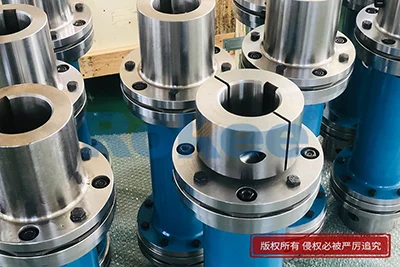
The diaphragm coupling, as a high-performance metal flexible coupling, has gradually replaced traditional coupling devices such as gear couplings and jaw couplings in PU sandwich panel production lines due to its superior performance. Its core structure consists of left and right diaphragms, input and output shafts, and an intermediate shaft (for long-distance transmission), with the diaphragm as the key elastic component. The working principle of the diaphragm coupling is relatively simple yet efficient: torque is input from the input shaft through circumferentially spaced high-strength bolts, transmitted to the diaphragm assembly, and then output to the output shaft through the same method. During the torque transmission process, the diaphragm undergoes elastic deformation to compensate for axial, angular, and radial displacement deviations between the input and output shafts, which are caused by factors such as manufacturing errors, installation deviations, temperature changes, and equipment vibration. This elastic deformation compensation capability not only ensures the stability of power transmission but also reduces the impact of displacement on connected equipment, thereby extending the service life of the equipment.
One of the key ways that diaphragm couplings empower PU sandwich panel production line to reduce costs and increase efficiency is through their high transmission efficiency, which significantly reduces energy consumption. In the production process of PU sandwich panels, the power transmission system needs to drive multiple pieces of equipment to operate continuously, and the energy loss of the coupling directly affects the overall energy consumption of the production line. Traditional gear couplings have problems such as backlash, friction loss, and the need for regular lubrication, which lead to low transmission efficiency. In contrast, diaphragm couplings adopt a non-lubrication design, eliminating energy loss caused by lubricant friction and leakage. At the same time, the diaphragm is made of high-strength stainless steel thin plates, which have excellent elasticity and toughness. During torque transmission, the deformation of the diaphragm is small and uniform, reducing energy loss caused by elastic hysteresis. According to relevant research and practical application data, the transmission efficiency of high-quality diaphragm couplings can reach more than 99.8%, which is significantly higher than that of traditional couplings. For a PU sandwich panel production line with a daily output of hundreds of square meters, the energy saved by using diaphragm couplings is considerable. Over a long period of operation, the reduction in energy consumption can directly reduce the production costs of enterprises, bringing obvious economic benefits.
In addition to high transmission efficiency, the excellent displacement compensation capability of diaphragm couplings also plays an important role in reducing equipment maintenance costs and improving production efficiency. In the continuous operation of PU sandwich panel production lines, the equipment will inevitably produce displacement deviations due to factors such as temperature rise, vibration, and load changes. For example, the foaming machine and laminating conveyor will generate a certain amount of thermal expansion during operation, leading to axial displacement of the shaft; the cutting machine will produce vibration during high-speed operation, leading to radial and angular displacement of the transmission shaft. If the coupling cannot effectively compensate for these displacements, it will cause excessive stress on the bearing, shaft, and other components, leading to frequent wear and tear, deformation, and even failure of the equipment. Traditional couplings have limited displacement compensation capabilities, and long-term operation will accelerate equipment damage, resulting in frequent maintenance, prolonged downtime, and increased maintenance costs. The diaphragm coupling, however, can effectively compensate for axial, angular, and radial displacements through the elastic deformation of the diaphragm. The angular displacement compensation capability can reach 1.5° to 2.5°, which is much higher than that of traditional couplings. This compensation capability reduces the stress on the connected equipment, avoids premature wear and failure, and significantly extends the service life of the equipment. At the same time, the diaphragm coupling has a simple structure, no easily damaged parts such as gears or bearings, and does not require regular lubrication and maintenance, which further reduces the maintenance workload and maintenance costs of enterprises. Compared with traditional couplings that require regular oil change, gear replacement, and other maintenance work, diaphragm couplings only need to be inspected regularly for fatigue cracks on the diaphragm, which greatly reduces the maintenance time and costs, ensuring the continuous and stable operation of the production line.
The high transmission precision of diaphragm couplings also helps to improve the product qualification rate of PU sandwich panels, reducing material waste and further reducing production costs. The production of PU sandwich panels has high requirements for process precision. For example, the mixing ratio of raw materials, the uniformity of foaming, the thickness of the panel, and the accuracy of cutting length all need to be strictly controlled. Any deviation in the transmission system will affect the precision of the equipment, leading to product defects. For example, if the transmission speed is unstable, it will cause uneven foaming of the PU core material, resulting in voids or excessive foam inside the panel; if the cutting machine has low transmission precision, it will lead to incorrect cutting length, resulting in waste of finished products. The diaphragm coupling has the characteristics of zero backlash and high torsional stiffness, which can ensure the accurate transmission of speed and torque, avoiding speed fluctuations and position deviations during the transmission process. This high transmission precision ensures the synchronization and stability of each link in the production line, making the raw material mixing more uniform, the foaming process more stable, the panel thickness more consistent, and the cutting length more accurate. As a result, the product qualification rate of PU sandwich panels is significantly improved, reducing the waste of raw materials and finished products. For enterprises, reducing product waste not only reduces the consumption of raw materials but also reduces the cost of rework and waste treatment, further optimizing the production cost structure.
The excellent environmental adaptability of diaphragm couplings also makes them more suitable for the complex working environment of PU sandwich panel production lines, further ensuring the stability of the production line and reducing potential costs. The production process of PU sandwich panels involves the use of chemical raw materials such as foaming agents, which may produce corrosive gases in the production process. At the same time, the curing link of the production line needs to be carried out at a certain temperature, and the equipment will be in a high-temperature environment for a long time. Traditional couplings are easily corroded by corrosive gases, and their performance will be affected in high-temperature environments, leading to shortened service life and increased failure rates. The diaphragm coupling is usually made of corrosion-resistant stainless steel materials, which can resist the corrosion of acid, alkali, and other corrosive media, and can operate stably in a wide temperature range from -80℃ to 300℃. This excellent environmental adaptability ensures that the diaphragm coupling can maintain stable performance in the complex working environment of PU sandwich panel production lines, avoiding failures caused by environmental factors, reducing downtime, and ensuring the continuous operation of the production line. In addition, the diaphragm coupling has good vibration damping performance. The metal diaphragm can absorb and reduce the vibration generated by the equipment during operation, reducing the noise of the production line and improving the working environment. At the same time, the reduction of vibration also reduces the wear of equipment components, further extending the service life of the equipment and reducing maintenance costs.
Practical application cases have fully verified the role of diaphragm couplings in empowering PU sandwich panel production lines to reduce costs and increase efficiency. A large-scale PU sandwich panel production enterprise once faced problems such as high energy consumption, frequent equipment failures, low product qualification rate, and high maintenance costs. After replacing the traditional gear couplings with diaphragm couplings in the transmission system of the production line, the enterprise achieved significant improvements in multiple aspects. First, the transmission efficiency of the production line was increased by more than 5%, and the daily energy consumption was reduced by about 8%, which significantly reduced the energy cost. Second, the equipment failure rate was reduced by more than 60%, the maintenance frequency was greatly reduced, the annual maintenance cost was saved by nearly 30%, and the downtime of the production line was shortened by more than 40%, effectively improving the production efficiency. Third, the transmission precision of the production line was significantly improved, the product qualification rate was increased from 92% to 98.5%, the waste of raw materials was reduced by about 10%, and the production cost per square meter of PU sandwich panels was reduced by nearly 12%. These data fully show that the application of diaphragm couplings can effectively optimize the operation of PU sandwich panel production lines, achieve the goal of reducing costs and increasing efficiency, and bring significant economic benefits to enterprises.
In addition to the direct effects of reducing energy consumption, maintenance costs, and improving product qualification rate, diaphragm couplings also bring indirect benefits to PU sandwich panel production enterprises. The stable operation of the production line ensures the timely delivery of products, improves customer satisfaction, and enhances the market competitiveness of enterprises. At the same time, the reduction of equipment maintenance and downtime reduces the labor intensity of maintenance personnel, improves work efficiency, and reduces labor costs. In addition, the non-lubrication design of diaphragm couplings avoids environmental pollution caused by lubricant leakage, which is in line with the current concept of green manufacturing and helps enterprises achieve sustainable development. With the continuous improvement of environmental protection requirements and the increasing competition in the market, the advantages of diaphragm couplings in green, efficient, and low-cost operation will become more prominent.
It should be noted that to give full play to the role of diaphragm couplings in reducing costs and increasing efficiency in PU sandwich panel production lines, enterprises need to pay attention to the selection, installation, and daily inspection of diaphragm couplings. In terms of selection, enterprises should choose diaphragm couplings with appropriate torque capacity, displacement compensation capability, and material performance according to the actual working conditions of the production line, such as the power of the equipment, the speed of operation, and the working environment. In terms of installation, it is necessary to ensure the accurate alignment of the input and output shafts, avoid excessive initial displacement deviation, and use a torque wrench to tighten the bolts in stages to ensure the stability of the connection. In terms of daily inspection, it is necessary to regularly check the diaphragm for fatigue cracks, loose bolts, and other problems, and replace the damaged diaphragm in a timely manner to avoid equipment failures caused by coupling damage. Only by doing a good job in these aspects can the diaphragm coupling maintain stable performance for a long time and continuously empower the PU sandwich panel production line to reduce costs and increase efficiency.
With the continuous development of the PU sandwich panel industry, the requirements for production efficiency, product quality, and cost control are getting higher and higher. As a key transmission component, the diaphragm coupling, with its high transmission efficiency, excellent displacement compensation capability, high precision, good environmental adaptability, and low maintenance cost, has become an important guarantee for enterprises to achieve cost reduction and efficiency improvement. In the future, with the continuous progress of material science and manufacturing technology, the performance of diaphragm couplings will be further optimized, and their application in PU sandwich panel production lines will be more extensive. For example, the development of new high-strength, lightweight diaphragm materials will further improve the transmission efficiency and service life of diaphragm couplings; the integration of intelligent monitoring technology will enable real-time monitoring of the operation status of diaphragm couplings, realizing predictive maintenance and further reducing maintenance costs. These improvements will make diaphragm couplings play a more important role in empowering PU sandwich panel production lines, helping enterprises achieve more efficient, low-cost, and green production, and promoting the sustainable development of the PU sandwich panel industry.
In conclusion, the diaphragm coupling, as a high-performance transmission component, has brought significant changes to the operation of PU sandwich panel production lines through its unique structural and performance advantages. It reduces energy consumption through high transmission efficiency, reduces maintenance costs through excellent displacement compensation capability and low maintenance characteristics, improves product qualification rate through high transmission precision, and ensures stable operation through good environmental adaptability. These effects are mutually promoted, forming a comprehensive cost reduction and efficiency improvement system, which provides strong support for the sustainable development of PU sandwich panel production enterprises. In the context of increasing market competition and green manufacturing requirements, the application of diaphragm couplings will become an important choice for PU sandwich panel production enterprises to improve their core competitiveness. Enterprises should fully recognize the role of diaphragm couplings, reasonably select and use them, and give full play to their maximum value, so as to achieve higher economic benefits and social benefits.
Rokee is a professional manufacturer of industrial couplings in china, designing and customizing a wide range of drive shaft coupling products for customers worldwide. Submit your coupling drawings or technical specifications, and we can customize coupling products for you.
Coupling Categories


Links:
- Calibration Weight
- Digital Viscometer
- Carpas Industriales
- Exhibition Tent
- Industrial Cardan Shaft
- PU Sandwich Panel Machine
- PIR Sandwich Panel Line
- Sandwich Panel Machine
- Sandwich Panel Production Line
- PU Sandwich Panel Line
- Sandwich Panel Line
- Flexible Couplings Manufacturer In China
- Elastic Couplings Manufacturer In China