Diaphragm Coupling For CNC Machine

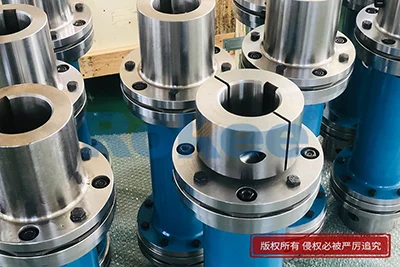
Diaphragm couplings have emerged as a core transmission component indispensable to modern CNC machine tools, serving as a critical connecting medium between servo motors, ball screws, spindles and other core motion components. Unlike traditional flexible couplings that rely on elastic rubber or gear structures, diaphragm couplings adopt high-strength metal diaphragm elastic deformation to transmit torque, perfectly balancing high torsional rigidity and flexible misalignment compensation capabilities. In high-precision CNC machining scenarios such as precision milling, grinding and turning, the coupling’s performance directly affects the machine’s positioning accuracy, repeatability and operational stability. It effectively solves common problems of traditional couplings including backlash, elastic fatigue and vibration attenuation failure. With zero-backlash transmission, low rotational inertia and maintenance-free characteristics, it adapts to the high-speed, high-precision and high-stability operating requirements of CNC equipment, becoming the preferred transmission solution for medium and high-end CNC machine tools in industrial precision manufacturing fields.
The structural design of diaphragm couplings is uniquely tailored to the operating characteristics of CNC machine tools, mainly divided into single-diaphragm and double-diaphragm configurations, both constructed from high-strength stainless steel or alloy steel materials with excellent fatigue resistance. The core functional component is the thin metal diaphragm disc, which is fixed with precision bolts between two shaft sleeves to form an integrated transmission structure. The single-diaphragm structure features a compact size and ultra-low inertia, making it suitable for CNC feed axis systems that require extremely sensitive dynamic response and frequent forward and reverse rotation. In contrast, the double-diaphragm design adds an intermediate sleeve, which significantly enhances the compensation ability for parallel, angular and axial misalignment between connected shafts while maintaining high torsional rigidity. This structural advantage effectively offsets the assembly errors, thermal deformation and mechanical wear-induced shaft offset that inevitably occur during the long-term operation of CNC machine tools. All structural parts adopt precision machining and seamless matching technology, eliminating assembly gaps completely and realizing true zero-backlash torque transmission, which lays a solid structural foundation for the precise motion control of CNC equipment.
High torsional rigidity and zero-backlash performance constitute the core competitive advantages of diaphragm couplings in CNC machine tool applications, and are key indicators to ensure machining precision. CNC machining requires ultra-precise synchronization of motor output torque and mechanical shaft motion, and any tiny transmission gap or torsional deformation will be amplified into dimensional errors of processed workpieces. Diaphragm couplings rely on the integral rigid transmission of metal diaphragms, avoiding the elastic hysteresis and gap clearance of rubber and nylon couplings. Under instantaneous torque impact and high-frequency forward and reverse switching, the coupling can maintain stable torsional stiffness without displacement lag or angle deviation. This performance ensures that the servo motor’s command signals can be accurately converted into the linear and rotary motion of the CNC machine tool’s spindle and worktable, effectively improving the positioning accuracy and repeated positioning accuracy of the equipment. Especially in micro-precision machining and complex curved surface processing, the zero-backlash characteristic completely eliminates the positioning deviation caused by transmission gap reversal, greatly improving the yield of high-precision workpieces.
Excellent misalignment compensation capability enables diaphragm couplings to adapt to complex and variable operating environments of CNC machine tools, solving many pain points in equipment operation. During the assembly and long-term service of CNC equipment, various misalignment problems are unavoidable, including axial displacement caused by thermal expansion and contraction of mechanical components, angular offset caused by equipment vibration, and parallel offset caused by mechanical wear and foundation settlement. Traditional rigid couplings will generate huge additional stress under misalignment conditions, leading to shaft deformation, bearing wear and even equipment vibration and noise. Ordinary elastic couplings can compensate for misalignment but sacrifice transmission rigidity and precision. Diaphragm couplings utilize the micro-elastic deformation of metal diaphragms to flexibly absorb various forms of shaft misalignment without producing additional transmission resistance and stress. This flexible and rigid integrated performance not only protects the motor, bearing and screw transmission components of CNC machine tools from fatigue damage, but also maintains long-term consistent transmission precision, reducing equipment failure rates caused by misalignment.
Low vibration and noise suppression performance further optimizes the operating stability and processing quality of CNC machine tools, meeting the stringent requirements of precision manufacturing. High-speed operation and frequent dynamic switching are typical working characteristics of modern CNC equipment, and unstable vibration is the main culprit for workpiece surface roughness defects and tool wear. The metal diaphragm structure of the coupling has uniform stress distribution and excellent dynamic balance performance, which can effectively absorb high-frequency vibration and shock generated during motor start-stop, torque switching and high-speed operation. Different from traditional couplings that easily produce resonance and friction vibration, diaphragm couplings have no friction pairs and elastic wear parts, realizing smooth and silent torque transmission. In high-speed spindle operation and high-frequency feed motion of CNC machine tools, this vibration damping effect stabilizes the equipment’s motion state, avoids tool jitter and workpiece flutter marks, and significantly improves the surface finish of processed products. Meanwhile, low-noise operation also optimizes the industrial processing environment and meets the environmental operation standards of automated production workshops.
Durable material performance and maintenance-free design greatly reduce the operating and maintenance costs of CNC machine tools, improving equipment operation efficiency. Diaphragm couplings are mainly made of high-quality spring steel and stainless steel alloys, which have outstanding fatigue resistance, corrosion resistance and mechanical stability. Metal diaphragm parts can withstand millions of times of high-frequency cyclic deformation without fatigue failure, adapting to the long-term continuous operation mode of industrial CNC machine tools. Unlike elastic couplings that require regular replacement of vulnerable elastic components and gear couplings that need periodic lubrication and oil replacement, diaphragm couplings have no wearable parts and do not require regular lubrication, adjustment and maintenance during the whole service life. This maintenance-free feature avoids equipment downtime caused by regular maintenance and part replacement, effectively improving the continuous operation rate of CNC production equipment. In addition, the material has strong adaptability to temperature changes, and will not deform or age in high-temperature processing environments and low-temperature standby environments, ensuring stable performance output throughout the year.
The lightweight and low-inertia design of diaphragm couplings optimizes the dynamic response speed of CNC machine tools and improves processing efficiency. Modern CNC precision manufacturing puts forward higher requirements for equipment dynamic response, and the rotational inertia of transmission components directly affects the sensitivity of servo system response and the speed of motion switching. Diaphragm couplings adopt a thin-wall lightweight structural design, which greatly reduces the overall weight and rotational inertia on the premise of ensuring torsional rigidity and torque transmission capacity. Low rotational inertia enables the servo motor to complete faster acceleration, deceleration and forward-reverse switching actions, shortening the equipment’s motion response time. In high-efficiency batch processing and complex multi-axis linkage processing scenarios, this performance significantly improves the processing beat and production efficiency of CNC machine tools. At the same time, the lightweight structure reduces the load of the motor and transmission system, reduces energy consumption during equipment operation, and realizes energy-saving and efficient operation of CNC equipment while ensuring processing precision.
With the continuous upgrading of CNC machine tool precision and intelligent manufacturing technology, diaphragm couplings are becoming more widely applied and technically optimized in the precision transmission field. Traditional transmission components can no longer meet the ultra-precision and high-dynamic operating requirements of new-generation CNC equipment, while diaphragm couplings perfectly match the development trend of CNC machine tools with their integrated advantages of high precision, high stability, low energy consumption and maintenance-free performance. At present, diaphragm couplings have become standard matching components for high-precision CNC milling machines, grinding machines, drilling and tapping machines and multi-axis linkage processing equipment. With the continuous innovation of material technology and structural design, the performance of diaphragm couplings is further improved in terms of higher speed resistance, stronger fatigue resistance and more precise transmission control, providing more reliable core transmission support for the intelligent and high-precision development of modern CNC manufacturing industry.



Links:
- Calibration Weight
- Digital Viscometer
- Carpas Industriales
- Exhibition Tent
- Industrial Cardan Shaft
- PU Sandwich Panel Machine
- PIR Sandwich Panel Line
- Sandwich Panel Machine
- Sandwich Panel Production Line
- PU Sandwich Panel Line
- Sandwich Panel Line
- Flexible Couplings Manufacturer In China
- Elastic Couplings Manufacturer In China