Elastic Coupling Adapts To Polyurethane Sandwich Panel Machine To Improve Transmission Stability

In the field of modern industrial manufacturing, the polyurethane sandwich panel machine plays an irreplaceable role in the production of building insulation materials, cold storage equipment enclosures, and integrated house components, thanks to its efficient production capacity and stable product quality. The core of the polyurethane sandwich panel machine lies in its transmission system, which is responsible for transmitting power from the motor to each functional component, including the unwinding system, foaming system, laminating conveyor, and cutting machine. The stability of the transmission system directly determines the production efficiency, product precision, and service life of the entire equipment. However, in the actual operation process, the polyurethane sandwich panel machine often faces various challenges that affect transmission stability, such as equipment vibration, shaft misalignment, load fluctuations, and harsh working environments. These problems not only lead to reduced production efficiency and unqualified product quality but also accelerate the wear of key components, increasing maintenance costs and downtime. As a key connecting component in the transmission system, the elastic coupling has gradually become an important solution to improve the transmission stability of polyurethane sandwich panel machines due to its unique flexible transmission characteristics, which can effectively compensate for shaft deviations, absorb vibrations, and buffer impact loads.
Before delving into the adaptation relationship between elastic couplings and polyurethane sandwich panel machine, it is necessary to first understand the working principle and transmission system characteristics of the polyurethane sandwich panel machine, as well as the core functions and structural advantages of elastic couplings. Polyurethane sandwich panels are composite materials with excellent thermal insulation, sound insulation, and waterproof performance, composed of a polyurethane foam core and upper and lower surface layers (such as color steel plates, aluminum plates, or non-metallic plates). The production process of polyurethane sandwich panels involves multiple continuous links, including raw material mixing, pouring, foaming, curing, laminating, and cutting, which requires the coordinated operation of various components of the machine, and the transmission system is the key to ensuring the synchronization and stability of these links. The transmission system of the polyurethane sandwich panel machine is usually composed of a motor, reducer, coupling, transmission shaft, and various transmission rollers. The motor provides the original power, which is transmitted to the reducer through the coupling to adjust the speed and increase the torque, and then transmitted to each functional component through the transmission shaft and rollers to drive the operation of the entire production line. In this process, the coupling, as a connecting part between the motor and the reducer, and between the reducer and the transmission shaft, undertakes the important task of transmitting torque and compensating for shaft deviations. Unlike rigid couplings that adopt forced synchronous connection, elastic couplings realize flexible transmission through built-in elastic components, which can effectively solve the problems existing in the transmission process of polyurethane sandwich panel machines and improve the stability and reliability of the entire transmission system.
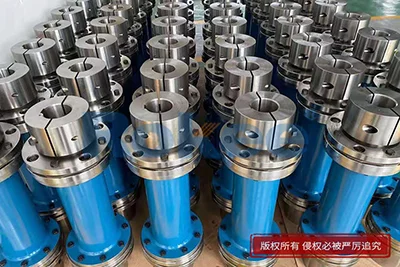
Elastic couplings are mechanical components that transmit torque and compensate for relative displacement between two shafts through elastic elements. Their core structure usually includes a hub, elastic element, and connecting bolts. The hub is connected to the motor shaft, reducer shaft, or transmission shaft through interference fit or keyway connection to ensure the firmness of power transmission; the elastic element is the core part of the elastic coupling, usually made of rubber, polyurethane, engineering plastics, or metal elastic materials, which can generate elastic deformation under the action of torque, vibration, or displacement, thereby playing the roles of buffering, shock absorption, and deviation compensation; the connecting bolts are used to fix the two hubs and the elastic element, ensuring the integrity of the coupling structure. According to the type of elastic element, elastic couplings can be divided into rubber elastic couplings, polyurethane elastic couplings, metal elastic couplings, etc., among which polyurethane elastic couplings and rubber elastic couplings are widely used in polyurethane sandwich panel machines due to their excellent flexibility, wear resistance, and adaptability to harsh working environments. The working principle of elastic couplings is based on the deformation characteristics of elastic elements: when the motor transmits torque to the coupling, the elastic element deforms under the action of torque, and then transmits the torque to the driven shaft through the deformation recovery force, realizing flexible power transmission; when there is misalignment (radial, angular, or axial) between the driving shaft and the driven shaft, the elastic element can absorb the stress caused by the misalignment through its own deformation, avoiding the generation of additional torque and vibration, thus protecting the motor, reducer, and other components; at the same time, when the equipment starts, stops, or the load fluctuates, the elastic element can absorb the impact energy, buffer the impact load, reduce the vibration amplitude of the transmission system, and ensure the stable operation of the equipment.
The polyurethane sandwich panel machine has obvious characteristics in the transmission process, which puts forward specific requirements for the performance of the coupling. On the one hand, the production process of polyurethane sandwich panels is continuous, requiring the transmission system to maintain a stable speed and torque output for a long time, and the coupling must have high torque transmission efficiency and stability to ensure that each functional component operates synchronously. For example, in the foaming and curing link, the speed of the double crawler laminated conveyor must be kept uniform, otherwise, it will lead to uneven thickness of the polyurethane foam core, affecting the thermal insulation performance and flatness of the sandwich panel; in the cutting link, the cutting speed must be synchronized with the conveying speed of the panel, otherwise, it will cause irregular cutting edges and waste of materials. On the other hand, the polyurethane sandwich panel machine will generate a lot of vibration during operation: the high-pressure foaming machine will produce vibration when mixing raw materials, the motor and reducer will generate vibration during operation, and the transmission rollers will also produce vibration due to uneven stress during the conveying process. These vibrations will be transmitted along the transmission shaft, affecting the stability of the entire equipment and accelerating the wear of bearings, shafts, and other components. In addition, due to factors such as installation accuracy, foundation settlement, and thermal deformation of equipment during long-term operation, it is inevitable that there will be misalignment between the driving shaft and the driven shaft of the transmission system. If the misalignment cannot be effectively compensated, it will lead to increased vibration, increased noise, and even damage to the coupling and other components. In addition, the working environment of the polyurethane sandwich panel machine is often accompanied by dust, foam residues, and occasional oil pollution, which requires the coupling to have certain wear resistance, corrosion resistance, and dust-proof performance to ensure long-term stable operation.
Against this background, elastic couplings show unique adaptation advantages in matching with polyurethane sandwich panel machines, which can effectively solve the problems existing in the transmission system and improve transmission stability. The first advantage is the excellent deviation compensation ability, which can effectively solve the problem of shaft misalignment in the transmission system of polyurethane sandwich panel machines. In the installation and operation process of the polyurethane sandwich panel machine, due to factors such as installation errors, foundation settlement, and thermal expansion of the equipment, the driving shaft and the driven shaft are likely to have radial misalignment (the central axes of the two shafts are parallel but not coincident), angular misalignment (the central axes of the two shafts intersect at a certain angle), or axial misalignment (the central axes of the two shafts coincide but have relative axial displacement). If a rigid coupling is used, the misalignment will cause forced stress between the two shafts, leading to vibration, noise, and accelerated wear of bearings and shafts. In contrast, the elastic element of the elastic coupling can generate corresponding elastic deformation according to the type and degree of misalignment, absorb the stress caused by misalignment, and ensure the smooth transmission of torque. For example, the helical elastic coupling can effectively compensate for angular misalignment and radial misalignment through the spiral elastic beam structure, while the elastic pin coupling can compensate for a certain degree of axial misalignment through the elastic deformation of the pin sleeve. This deviation compensation ability reduces the requirements for installation accuracy of the polyurethane sandwich panel machine, reduces the difficulty of equipment installation and debugging, and at the same time reduces the additional wear of components caused by misalignment, extending the service life of the transmission system.
The second advantage is the excellent buffering and shock absorption performance, which can effectively reduce the impact of vibration on the transmission system of the polyurethane sandwich panel machine. As mentioned earlier, the polyurethane sandwich panel machine will generate a lot of vibration during operation, which will not only affect the stability of the transmission system but also affect the quality of the product. The elastic element of the elastic coupling can absorb the impact energy generated during the start-up, stop, and load fluctuation of the equipment, and convert the impact energy into the elastic potential energy of the elastic element, thereby reducing the impact load on the motor, reducer, and transmission shaft. At the same time, the elastic element can also isolate the vibration generated by the motor and reducer, prevent the vibration from being transmitted to the functional components such as the foaming system and cutting machine, ensure the stable operation of these components, and improve the product quality. For example, when the high-pressure foaming machine starts to work, it will generate a sudden impact load, and the elastic coupling can buffer this impact load through the deformation of the elastic element, avoiding the damage to the reducer and transmission shaft caused by the impact; during the continuous operation of the equipment, the elastic element can absorb the high-frequency vibration generated by the motor and reducer, reduce the noise of the equipment, and create a more stable working environment. In addition, the buffering and shock absorption performance of the elastic coupling can also reduce the fatigue damage of the transmission components, extend the service life of the components, and reduce the maintenance cost of the equipment.
The third advantage is the good torque transmission stability, which can ensure the synchronous operation of each functional component of the polyurethane sandwich panel machine. The production of polyurethane sandwich panels requires the coordinated operation of multiple components, and the stability of torque transmission directly determines the synchronization of each component. Elastic couplings have high torque transmission efficiency, which can transmit the torque output by the motor to the driven shaft stably and without loss, ensuring that the speed and torque of each component meet the production requirements. Unlike some multi-piece rigid couplings that have backlash, many elastic couplings (such as beam couplings) are made of a single piece of material, which does not have backlash, ensuring the accuracy of torque transmission and avoiding the impact on transmission stability caused by backlash. At the same time, the elastic element of the elastic coupling has a certain torsional stiffness, which can maintain the stability of torque transmission under different load conditions, avoid the phenomenon of speed fluctuation caused by load changes, and ensure the uniform operation of the production line. For example, in the laminating link of the polyurethane sandwich panel machine, the transmission rollers need to maintain a stable speed to ensure that the surface layer and the foam core are closely bonded. The elastic coupling can transmit the torque stably, ensuring that the speed of the transmission rollers does not fluctuate, thus improving the bonding quality of the sandwich panel.
In addition to the above core advantages, elastic couplings also have the characteristics of simple structure, easy installation and maintenance, and strong adaptability to the working environment, which are well adapted to the working needs of polyurethane sandwich panel machines. The structure of elastic couplings is relatively simple, usually composed of a few parts such as hubs, elastic elements, and connecting bolts, which is easy to manufacture and install. During the installation process, it is only necessary to connect the two hubs to the driving shaft and the driven shaft respectively, and fix them with bolts, which reduces the installation time and labor cost. In terms of maintenance, elastic couplings do not require complex lubrication systems, and only need to regularly check the wear of the elastic elements and replace them in time when they are damaged, which is convenient and fast. At the same time, the elastic elements of elastic couplings can be made of different materials according to the working environment. For example, in the working environment with more dust and foam residues, elastic elements made of wear-resistant and corrosion-resistant materials (such as polyurethane) can be selected to ensure that the coupling can maintain stable performance for a long time. In addition, elastic couplings have a wide range of torque and speed adaptation, which can be selected according to the power and speed requirements of different types of polyurethane sandwich panel machines, whether it is a small intermittent production line or a large continuous production line, elastic couplings can provide stable transmission support.
The practical application effect of elastic couplings in polyurethane sandwich panel machines has been fully verified in actual production. Taking a continuous polyurethane sandwich panel production line as an example, before the use of elastic couplings, the transmission system of the production line often had problems such as severe vibration, loud noise, and frequent wear of components. The vibration generated during the operation of the motor and reducer was transmitted to the foaming system and cutting machine, resulting in uneven thickness of the polyurethane foam core, irregular cutting edges of the sandwich panel, and a product qualification rate of only about 85%. At the same time, due to the lack of deviation compensation capacity, the bearings and transmission shafts of the transmission system wore quickly, requiring frequent maintenance and replacement, which not only increased the maintenance cost but also affected the production efficiency. After replacing the rigid coupling with an elastic coupling (polyurethane elastic pin coupling), the vibration amplitude of the transmission system was significantly reduced, the noise was reduced by more than 30%, and the problem of shaft misalignment was effectively solved. The transmission torque was more stable, the speed of each functional component was synchronized, the product qualification rate was increased to more than 98%, and the wear of bearings, transmission shafts, and other components was significantly reduced. The maintenance cycle was extended from once a month to once every three months, and the maintenance cost was reduced by nearly 50%. In addition, the elastic coupling also improved the adaptability of the production line to load fluctuations. When the production load changed (such as adjusting the thickness of the sandwich panel), the elastic coupling could buffer the load impact, ensure the stable operation of the transmission system, and avoid production interruptions caused by load changes.
To ensure that the elastic coupling can better adapt to the polyurethane sandwich panel machine and maintain long-term stable transmission performance, reasonable selection, correct installation, and regular maintenance are essential. In terms of selection, it is necessary to comprehensively consider the power, speed, torque, and working environment of the polyurethane sandwich panel machine, and select the appropriate type and specification of the elastic coupling. First, the rated torque of the coupling should be greater than the maximum torque output by the motor to ensure that the coupling can bear the load during operation without damage; second, the deviation compensation capacity of the coupling should match the possible misalignment of the transmission system of the equipment, and for the transmission system with large possible misalignment, a coupling with strong deviation compensation capacity (such as a beam coupling) should be selected; third, the material of the elastic element should be selected according to the working environment. For example, in the environment with high temperature, humidity, or oil pollution, elastic elements made of high-temperature resistant, corrosion-resistant materials should be selected; finally, the installation size of the coupling should match the diameter of the motor shaft and reducer shaft to ensure firm connection. In terms of installation, it is necessary to ensure the accuracy of the installation position, adjust the coaxiality of the driving shaft and the driven shaft as much as possible, reduce the initial misalignment, and avoid the additional stress caused by incorrect installation. At the same time, the connecting bolts should be tightened according to the specified torque to ensure the firmness of the connection and prevent the coupling from loosening during operation. In terms of maintenance, it is necessary to regularly check the working status of the elastic coupling, including the wear of the elastic element, the tightness of the connecting bolts, and the presence of cracks or deformations in the hub. If the elastic element is found to be worn, aged, or damaged, it should be replaced in time to avoid affecting the transmission stability; the connecting bolts should be checked regularly and tightened if they are loose; the surface of the coupling should be kept clean to avoid the accumulation of dust and foam residues affecting the operation of the coupling. In addition, during the operation of the equipment, it is necessary to avoid overloading the transmission system, which can prevent the elastic element from being damaged due to excessive deformation.
With the continuous development of industrial automation and the increasing demand for high-quality polyurethane sandwich panels, the requirements for the transmission stability of polyurethane sandwich panel machines are also increasing. Elastic couplings, as a key component to improve the transmission stability of the equipment, will play a more important role in the future. With the progress of material science and manufacturing technology, the performance of elastic couplings will be further optimized. For example, the use of high-performance composite materials (such as carbon fiber-reinforced polyurethane) can improve the torque transmission capacity and fatigue life of elastic elements; the integration of intelligent monitoring technology can realize real-time monitoring of the working status of elastic couplings, predict potential faults, and improve the reliability of the transmission system. At the same time, the design of elastic couplings will be more targeted, and according to the specific working characteristics of different types of polyurethane sandwich panel machines, customized elastic couplings will be developed to better meet the transmission needs of the equipment. In addition, with the concept of energy conservation and environmental protection being deeply rooted in the hearts of the people, the design of elastic couplings will also tend to be lightweight and energy-saving, reducing the energy consumption of the transmission system while ensuring transmission stability.
In conclusion, the elastic coupling has excellent adaptability to the polyurethane sandwich panel machine, and its unique deviation compensation, buffering, shock absorption, and stable torque transmission capabilities can effectively solve the problems existing in the transmission system of the polyurethane sandwich panel machine, such as vibration, shaft misalignment, and load fluctuation. By selecting the appropriate elastic coupling, ensuring correct installation and regular maintenance, the transmission stability of the polyurethane sandwich panel machine can be significantly improved, the product quality and production efficiency can be enhanced, the wear of components can be reduced, and the maintenance cost and downtime can be decreased. In the process of industrial production, the reasonable application of elastic couplings is of great significance for promoting the efficient, stable, and sustainable development of the polyurethane sandwich panel production industry. As the technology continues to progress, elastic couplings will be more closely integrated with polyurethane sandwich panel machines, bringing more benefits to industrial production.


Links:
- Calibration Weight
- Digital Viscometer
- Carpas Industriales
- Exhibition Tent
- Industrial Cardan Shaft
- PU Sandwich Panel Machine
- PIR Sandwich Panel Line
- Sandwich Panel Machine
- Sandwich Panel Production Line
- PU Sandwich Panel Line
- Sandwich Panel Line
- Flexible Couplings Manufacturer In China
- Elastic Couplings Manufacturer In China