Elastic Coupling For Motor Shaft

Elastic couplings serve as indispensable transitional components in motor shaft transmission systems, functioning as a flexible connection bridge between motor drive shafts and driven mechanical shafts. Unlike rigid coupling structures that enforce absolute fixed connection, this component relies on the elastic deformation of internal flexible materials to achieve efficient torque transmission while resolving common operational problems in mechanical transmission. In actual motor operation, minor shaft misalignment, vibration impact, and torque fluctuation are inevitable due to installation deviations, operational thermal expansion, and long-term mechanical wear. Elastic couplings effectively buffer these adverse mechanical effects, protect core motor and transmission equipment from rigid friction and overload damage, and significantly improve the stability and service life of the entire transmission system. Their unique flexible transmission characteristics make them widely applicable in various mechanical scenarios driven by motors, covering low-speed heavy-load and high-speed stable operation environments.
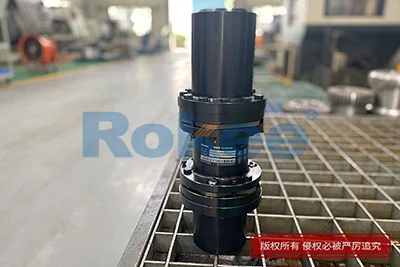
The core structural composition of motor shaft elastic couplings determines their flexible transmission performance and functional advantages in mechanical operation. The overall structure mainly consists of two rigid metal hubs and intermediate elastic deformation components, where the rigid hubs are respectively fixed on the motor driving shaft and the matching driven shaft to undertake positioning and connection tasks. The middle elastic parts are mostly made of high-elasticity polymer materials or special elastic alloys with excellent toughness and fatigue resistance, which are the core functional units supporting torque transmission and deformation buffering. During the motor startup and continuous operation process, the rotation of the motor shaft drives the active hub to operate synchronously, and torque is stably transmitted to the driven hub and the connected mechanical equipment through the micro torsional, axial and radial deformation of the elastic components. This structural design completely abandons the rigid collision and hard friction of traditional connecting parts, realizing flexible power transmission. Moreover, the detachable assembly structure of the coupling greatly facilitates daily inspection, maintenance and replacement, avoiding complex disassembly of the entire motor transmission system and effectively reducing the operational maintenance cost of mechanical equipment in long-term use.
The working principle of elastic couplings for motor shafts is based on controllable elastic deformation and energy damping, which fundamentally optimizes the dynamic transmission state of motor power. When the motor starts, stops or operates with variable load, the transmission system will generate instantaneous torque impact and mechanical vibration due to changes in operating state. At this time, the internal elastic elements of the coupling will produce mild and reversible elastic deformation following the torque change, which can instantly absorb and release the instantaneous impact energy generated by power transmission. For the common shaft misalignment problems in motor assembly and operation, including radial offset, axial gap deviation and angular deflection, the flexible characteristics of elastic materials can adaptively compensate for these deviations. This adaptive compensation effect avoids additional bending stress and shear stress on the motor shaft and bearing caused by misalignment, ensuring that the motor shaft always operates in a relatively balanced stress state. In continuous high-speed operation, the elastic structure can also continuously dampen the high-frequency vibration generated by motor rotation and mechanical friction, reduce the resonance probability of the entire transmission system, and maintain the smooth and continuous output of motor power.
Elastic couplings bring remarkable equipment protection effects for motor shaft transmission systems, becoming a key barrier to extend the service life of motor and matching mechanical components. In the traditional rigid connection mode, any tiny misalignment or load fluctuation in the transmission process will be directly converted into rigid friction and alternating stress on the motor shaft, bearings and gear components. Long-term accumulation of such stress will cause shaft wear, bearing aging, gear tooth fatigue damage and other problems, leading to reduced motor operation accuracy and frequent equipment failures. After adopting elastic couplings, all abnormal mechanical stress in the transmission process is buffered and decomposed by the elastic medium, so that the motor shaft can avoid excessive concentrated load and repeated impact wear during operation. In particular, in frequent startup, shutdown and variable-load working conditions, the coupling can effectively isolate the instantaneous overload torque, prevent motor burnout and transmission component fracture caused by sudden load changes. This protective performance greatly reduces the failure rate of motor transmission equipment, prolongs the service cycle of core components, and improves the overall operational reliability of mechanical equipment.
The vibration damping and noise reduction performance of elastic couplings significantly optimizes the operating environment of motor transmission equipment and improves mechanical operation quality. Mechanical vibration and operating noise are inevitable by-products of motor shaft rotation and power transmission, and excessive vibration will not only affect the operating accuracy of precision mechanical equipment, but also accelerate the aging of equipment structures, while harsh noise will affect the on-site operating environment. The special elastic materials used in elastic couplings have excellent vibration energy absorption and damping characteristics, which can effectively weaken and eliminate the vibration generated by motor rotation, meshing friction and load impact. Different from rigid structures that transmit vibration energy synchronously, elastic couplings can cut off the transmission path of high-frequency vibration between the motor and the driven equipment, avoid vibration superposition and system resonance. At the same time, the flexible contact transmission mode eliminates the rigid collision noise between metal components in traditional connection structures, significantly reducing the overall operating noise of the equipment. In long-term continuous operation scenarios, stable vibration damping and noise reduction effects can maintain the stability of the mechanical operating state, avoid equipment parameter deviation caused by vibration, and create a more stable and low-consumption operating condition for the motor system.
Elastic couplings exhibit excellent environmental adaptability and operational stability in diverse motor working scenarios, meeting the differentiated operation requirements of various mechanical transmission systems. In low-speed and heavy-load working environments, the elastic components can bear large torsional deformation, stably transmit high torque, and buffer the heavy-load impact generated by equipment startup and operation, ensuring the stable output of motor power. In high-speed and precision operation scenarios, the coupling can rely on its precise flexible compensation ability to correct tiny shaft deviations, maintain the high-precision synchronous operation of the motor and driven equipment, and avoid operation errors caused by shaft displacement. In complex working environments with temperature changes and minor structural deformation of equipment, the elastic materials can adapt to the micro changes of equipment structure, always maintain a stable connection state, and will not produce connection failure or transmission jitter due to environmental changes. In addition, high-quality elastic coupling materials have good aging resistance and fatigue resistance, and can maintain stable elastic performance and transmission efficiency after long-term repeated deformation and cyclic operation, avoiding performance attenuation and functional failure in the whole service cycle.
The installation and use characteristics of motor shaft elastic couplings make them have high practical value and promotion value in industrial mechanical transmission. The overall structural design of the coupling is compact and reasonable, with small occupied space, which is suitable for various compact motor assembly spaces and will not cause structural interference with surrounding equipment. The assembly process is simple and efficient, requiring no complex debugging procedures. After aligning the motor shaft and the driven shaft, the coupling can be quickly fixed and positioned, effectively improving the equipment assembly efficiency. In the daily use process, the coupling has low failure rate and simple maintenance work, only needing regular visual inspection of the elastic components for aging, cracking and wear, without frequent disassembly and debugging. When local damage occurs to the elastic parts, only the flexible components need to be replaced instead of the whole set of equipment, which greatly reduces the equipment maintenance difficulty and operating cost. This convenient installation, stable operation and low-maintenance feature make elastic couplings the preferred connecting component for most motor transmission systems.
With the continuous upgrading of mechanical transmission technology, the application advantages and development potential of motor shaft elastic couplings are further highlighted in modern mechanical equipment. Traditional transmission connection components can no longer meet the current high-precision, high-stability and low-loss mechanical operation requirements, while elastic couplings perfectly adapt to the development trend of modern motor transmission systems by virtue of flexible compensation, vibration damping and equipment protection performance. At present, elastic couplings have been widely used in various motor-driven mechanical equipment, realizing efficient and stable power transmission in different working conditions. In the future, with the continuous innovation of elastic materials and structural design technology, the comprehensive performance of elastic couplings will be further optimized, with stronger deformation adaptability, higher transmission efficiency and longer service life. It will continue to play a core role in motor shaft transmission systems, provide more reliable basic support for the stable operation of modern mechanical equipment, and promote the continuous optimization and upgrading of mechanical transmission technology.




Links:
- Calibration Weight
- Digital Viscometer
- Carpas Industriales
- Exhibition Tent
- Industrial Cardan Shaft
- PU Sandwich Panel Machine
- PIR Sandwich Panel Line
- Sandwich Panel Machine
- Sandwich Panel Production Line
- PU Sandwich Panel Line
- Sandwich Panel Line
- Flexible Couplings Manufacturer In China
- Elastic Couplings Manufacturer In China