Flexible Coupling Solves Transmission Offset Problem Of PU Sandwich Panel Line
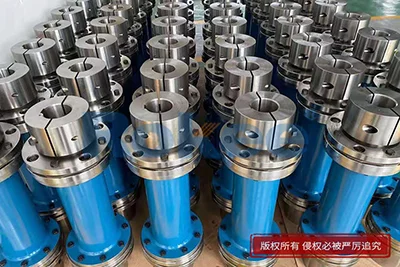
In the field of modern industrial production, the continuous and stable operation of production lines is crucial to ensuring product quality, improving production efficiency, and reducing operational costs. Among various industrial production lines, the PU sandwich panel line plays an important role in the construction, refrigeration, and packaging industries due to its ability to produce high-performance, energy-saving, and environmentally friendly sandwich panels. However, during the long-term operation of the PU sandwich panel line, transmission offset has always been a prominent problem that plagues enterprises. This problem not only affects the accuracy of product dimensions and the stability of the production process but also accelerates the wear of mechanical components, increases maintenance frequency and costs, and even leads to unexpected shutdowns in severe cases, causing significant economic losses to enterprises. In response to this challenge, flexible coupling has emerged as an effective solution, relying on its unique structural design and excellent performance to effectively solve the transmission offset problem of the PU sandwich panel line, ensuring the smooth operation of the production line and providing reliable support for the high-quality development of enterprises.
To understand how flexible coupling solves the transmission offset problem of the PU sandwich panel line, it is first necessary to clarify the causes and harms of transmission offset in the PU sandwich panel line. The PU sandwich panel production process involves multiple links, including uncoiling of face sheets, foaming of PU core material, compounding, pressing, cutting, and stacking. Each link is equipped with corresponding transmission mechanisms, such as motors, reducers, rollers, and conveyors, which are connected through coupling components to realize power transmission and speed regulation. Due to the long length of the PU sandwich panel line, the large number of transmission components, and the complex working environment, transmission offset is prone to occur during operation. The main causes of transmission offset include installation errors, thermal expansion and contraction of components, mechanical vibration, wear of parts, and uneven stress during operation. Installation errors are one of the most common causes; during the installation of the production line, if the axes of the motor and reducer, or between the reducer and the roller, are not aligned accurately, it will lead to initial offset, which will gradually increase during operation. Thermal expansion and contraction of components are also inevitable; during the production process, the motor, reducer, and other components will generate heat due to long-term operation, resulting in thermal expansion, which changes the relative position of the axes and causes transmission offset. In addition, the mechanical vibration generated during the operation of the production line will cause the transmission components to deviate from their original positions, and the wear of parts such as bearings and shafts will also lead to changes in the axis position, further exacerbating the transmission offset problem.
The harm of transmission offset to the PU sandwich panel line is multifaceted. On the one hand, it affects product quality. The PU sandwich panel requires high precision in the compounding and pressing links; if there is transmission offset, the face sheets and core material will not be aligned accurately, resulting in uneven thickness of the sandwich panel, deviation in size, and even defects such as delamination and warpage, which reduce the product qualification rate. On the other hand, it accelerates the wear of mechanical components. Transmission offset will cause additional torque and stress on the coupling, bearing, shaft, and other components, leading to increased friction and wear between parts, shortening the service life of the components. For example, the misaligned coupling will cause uneven force on the bearing, leading to premature damage of the bearing; the offset between the roller and the conveyor will cause the conveyor belt to deviate, increasing the wear of the conveyor belt and the roller. In addition, transmission offset will generate abnormal noise and vibration during the operation of the production line, affecting the working environment, and in severe cases, it will cause the transmission mechanism to fail, leading to production shutdowns. The shutdown of the production line not only affects the production progress but also increases the maintenance cost, and the waste of raw materials caused by shutdowns further increases the economic burden of enterprises. Therefore, solving the transmission offset problem is an urgent task for enterprises using PU sandwich panel lines.
Flexible coupling, as a key component in the mechanical transmission system, is different from rigid coupling. It has a certain degree of flexibility and compensation capacity, which can effectively absorb and compensate for the transmission offset generated during the operation of the production line, thereby solving the problems caused by offset. The core advantage of flexible coupling lies in its ability to compensate for axial, radial, and angular offsets between two connected shafts while transmitting power, which is precisely the key to solving the transmission offset problem of the PU sandwich panel line. Unlike rigid coupling, which requires strict alignment of the two shafts and cannot compensate for any offset, flexible coupling achieves offset compensation through its own structural design, ensuring the stable transmission of power even when there is a certain offset between the shafts.
The working principle of flexible coupling in solving transmission offset is closely related to its structural composition. Generally, flexible coupling is composed of two half-couplings connected to the driving shaft and the driven shaft, and an elastic element or a flexible component between them. The elastic element is usually made of rubber, polyurethane, metal bellows, or spring, which has good elasticity and deformation capacity. When transmission offset occurs between the driving shaft and the driven shaft, the elastic element will generate corresponding deformation to absorb the offset, so that the power can be transmitted stably between the two shafts. For example, when there is a radial offset between the two shafts, the elastic element will bend and deform to adapt to the offset distance; when there is an angular offset, the elastic element will twist and deform to compensate for the angle difference; when there is an axial offset, the elastic element will stretch or compress to absorb the axial displacement. In addition, some flexible couplings are designed with sliding structures, which can further improve the compensation capacity for offset through the relative sliding between components. This unique working principle enables flexible coupling to effectively cope with various types of transmission offsets generated in the PU sandwich panel line, ensuring the smooth operation of the transmission system.
Different types of flexible couplings have different structural characteristics and compensation capabilities, and enterprises can choose the appropriate type according to the actual working conditions of the PU sandwich panel line. Common types of flexible couplings include jaw coupling, diaphragm coupling, bellows coupling, and tire coupling. Jaw coupling is composed of two metal claw disks and a plum-shaped elastic body. It has the advantages of simple structure, easy installation, and good shock absorption performance, and can compensate for a certain degree of radial and angular offset. It is suitable for the transmission links with small offset and low load in the PU sandwich panel line, such as the transmission of the uncoiling mechanism. Diaphragm coupling uses a metal diaphragm as the elastic element, which has high torsional stiffness and transmission accuracy, and can compensate for axial, radial, and angular offsets. It is suitable for high-speed and high-precision transmission links in the PU sandwich panel line, such as the transmission of the pressing roller. Bellows coupling uses a metal bellows as the flexible component, which has good high-temperature resistance and corrosion resistance, and can compensate for large axial and angular offsets. It is suitable for the transmission links in the PU sandwich panel line that are exposed to high temperatures, such as the transmission of the foaming mechanism. Tire coupling is composed of two half-couplings and a tire-shaped elastic element. It has strong elasticity and large offset compensation capacity, and can effectively absorb vibration and shock. It is suitable for the transmission links with large load and large offset in the PU sandwich panel line, such as the transmission of the conveyor.
In the actual application of the PU sandwich panel line, flexible coupling not only solves the transmission offset problem but also brings a series of additional benefits, further improving the operational efficiency and stability of the production line. First of all, flexible coupling has good shock absorption and vibration reduction performance. During the operation of the PU sandwich panel line, the motor, reducer, and other components will generate vibration, which will be transmitted to the entire transmission system and affect the stability of the production line. The elastic element in the flexible coupling can absorb the vibration energy, reduce the transmission of vibration between components, and reduce the noise generated during the operation of the production line, improving the working environment. Secondly, flexible coupling can reduce the additional stress on the transmission components. When there is transmission offset, rigid coupling will transmit the offset force directly to the shaft, bearing, and other components, causing additional stress and accelerating wear. Flexible coupling, through the deformation of the elastic element, absorbs the offset force, reduces the additional stress on the transmission components, prolongs the service life of the components, and reduces the maintenance frequency and cost. Thirdly, flexible coupling has strong adaptability to the working environment. The PU sandwich panel line may work in harsh environments such as high temperature, humidity, and dust. The flexible coupling can be made of different materials according to the working environment to ensure its stable performance. For example, the bellows coupling made of stainless steel has good corrosion resistance and can adapt to the humid and corrosive working environment. Finally, flexible coupling is easy to install and maintain. Compared with rigid coupling, flexible coupling has lower requirements on installation accuracy, which can reduce the installation time and difficulty. At the same time, the elastic element of the flexible coupling is easy to replace, which can reduce the maintenance time and cost when a failure occurs.
To better play the role of flexible coupling in solving the transmission offset problem of the PU sandwich panel line, enterprises need to pay attention to the selection, installation, and daily maintenance of flexible coupling. In terms of selection, enterprises should comprehensively consider the working conditions of the production line, such as the transmission power, speed, offset type, and offset amount, and select the appropriate type and specification of flexible coupling. For example, in the transmission link with large offset, a tire coupling with large compensation capacity should be selected; in the transmission link with high precision requirements, a diaphragm coupling with high transmission accuracy should be selected. In terms of installation, although flexible coupling has a certain compensation capacity for offset, enterprises should still try to ensure the alignment of the driving shaft and the driven shaft during installation, reduce the initial offset, and avoid excessive offset exceeding the compensation range of the flexible coupling, which will affect its service life. At the same time, attention should be paid to the installation torque to ensure that the connection between the half-coupling and the shaft is firm and reliable, and there is no looseness. In terms of daily maintenance, enterprises should regularly inspect the flexible coupling, check the wear of the elastic element, the connection tightness of the half-coupling, and whether there is abnormal noise or vibration. If the elastic element is found to be worn, aged, or damaged, it should be replaced in time to avoid affecting the transmission effect. In addition, regular lubrication of the flexible coupling (for types that require lubrication) can reduce the friction between components and prolong its service life.
The application of flexible coupling in the PU sandwich panel line has been verified by a large number of practical cases. Many enterprises engaged in the production of PU sandwich panels have solved the long-standing transmission offset problem by replacing rigid coupling with flexible coupling, achieving significant economic and social benefits. For example, a enterprise producing PU sandwich panels once faced serious transmission offset problems in its production line, which led to frequent deviations in the size of the sandwich panels, a product qualification rate of only 85%, and frequent damage to bearings and other components, resulting in monthly maintenance costs of tens of thousands of yuan and frequent production shutdowns. After the enterprise replaced the rigid coupling in each transmission link with a suitable flexible coupling, the transmission offset problem was effectively solved. The product qualification rate increased to 98% or more, the wear of components was significantly reduced, the maintenance frequency was reduced by 70%, the monthly maintenance cost was reduced by more than half, and the production line achieved continuous and stable operation, greatly improving production efficiency and reducing economic losses. This case fully shows that flexible coupling can effectively solve the transmission offset problem of the PU sandwich panel line and bring obvious benefits to enterprises.
With the continuous development of industrial technology, the performance requirements of the PU sandwich panel line for the transmission system are getting higher and higher. Flexible coupling, as an important component that solves the transmission offset problem, is also constantly developing and improving. In the future, with the advancement of material science and manufacturing technology, the performance of flexible coupling will be further optimized. For example, the development of new high-performance elastic materials will improve the elasticity, wear resistance, and high-temperature resistance of flexible coupling, making it more suitable for the harsh working environment of the PU sandwich panel line. The application of intelligent technology will also enable flexible coupling to realize real-time monitoring of offset, wear, and other parameters, timely remind enterprises to carry out maintenance, and further improve the reliability and stability of the transmission system. In addition, the integration of flexible coupling with other transmission components will form a more efficient and stable transmission system, providing stronger support for the high-quality development of the PU sandwich panel production industry.
In conclusion, transmission offset is a major problem affecting the stable operation of the PU sandwich panel line, which brings serious harm to enterprises in terms of product quality, production efficiency, and maintenance costs. Flexible coupling, relying on its unique structural design and excellent offset compensation capacity, can effectively solve the transmission offset problem, absorb vibration and shock, reduce the wear of components, improve the stability and reliability of the transmission system, and bring significant economic benefits to enterprises. Enterprises should pay full attention to the role of flexible coupling, select, install, and maintain it scientifically, give full play to its performance advantages, and ensure the continuous and stable operation of the PU sandwich panel line. With the continuous progress of technology, flexible coupling will play a more important role in the PU sandwich panel production industry, promoting the sustainable development of the industry.
Rokee is a professional manufacturer of industrial couplings in china, designing and customizing a wide range of drive shaft coupling products for customers worldwide. Submit your coupling drawings or technical specifications, and we can customize coupling products for you.
Coupling Categories


Links:
- Calibration Weight
- Digital Viscometer
- Carpas Industriales
- Exhibition Tent
- Industrial Cardan Shaft
- PU Sandwich Panel Machine
- PIR Sandwich Panel Line
- Sandwich Panel Machine
- Sandwich Panel Production Line
- PU Sandwich Panel Line
- Sandwich Panel Line
- Flexible Couplings Manufacturer In China
- Elastic Couplings Manufacturer In China