High Torque Membrane Coupling

High torque membrane coupling is a high-performance flexible transmission component designed to meet the heavy-load and high-precision operation demands of modern industrial mechanical systems. Distinguished from ordinary flexible couplings, it integrates ultra-high torsional rigidity with excellent misalignment compensation capability, relying on the elastic deformation of high-strength metal membrane groups to achieve stable torque transmission between driving and driven shafts. This core structural feature enables the coupling to maintain precise and backlash-free power output under extreme heavy torque conditions, while effectively buffering the adverse effects of shaft displacement, vibration and mechanical impact generated during equipment operation. Widely adaptable to high-speed, heavy-duty and high-precision mechanical scenarios, it avoids the wear, aging and failure defects of traditional elastic coupling accessories. As a key connecting part of mechanical transmission systems, it greatly improves the operational stability, service life and comprehensive working efficiency of industrial equipment, becoming an indispensable core component in advanced mechanical transmission fields.
The working mechanism of high torque membrane coupling is based on the elastic deformation principle of metal materials, which realizes flexible and efficient torque transmission without relying on any vulnerable elastic accessories. The core transmission process starts from the driving end, where rotational torque is evenly transmitted to the stacked metal membrane groups through high-precision connecting bolts. When the equipment operates stably, the membrane groups produce micro and reversible elastic deformation under torque load, and stably transfer rotational power and torque to the driven shaft, ensuring synchronous operation of the entire transmission system. In actual industrial operation, installation deviation, equipment thermal expansion and mechanical vibration will inevitably cause angular, parallel and axial misalignment between the two connected shafts. The membrane structure of the coupling can adaptively adjust its deformation state according to different misalignment types, effectively absorbing and compensating for various shaft displacements. This adaptive compensation will not interfere with the normal torque transmission function, nor will it produce additional mechanical stress or transmission resistance, ensuring continuous and stable power output even when the shaft system has slight offset errors. Compared with rigid couplings that are prone to stress concentration and shaft damage, it fundamentally optimizes the stress state of the transmission system and reduces mechanical loss.
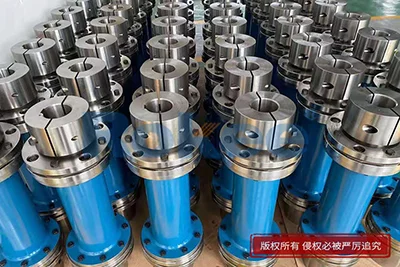
The structural design of high torque membrane coupling is the core foundation of its superior high-torque performance, adopting an integrated and optimized combination structure composed of high-strength metal membrane groups, symmetric flange assemblies and high-precision fastening bolt sets. Different from ordinary membrane couplings with thin single-layer membranes, high-torque models adopt multi-layer stacked thickened membrane structures, which are made of premium high-toughness stainless steel materials with excellent fatigue resistance and tensile strength. The membrane groups are arranged in a staggered and uniform distribution mode, which can evenly disperse heavy torque load on each membrane unit, avoiding local stress overload and structural deformation failure. The symmetric flange design ensures balanced stress on both the driving and driven ends during operation, effectively reducing rotational vibration and torque fluctuation. All connecting bolts adopt high-precision matching process, with consistent fastening force and uniform stress distribution, which eliminates the problem of loose connection under long-term heavy-load operation. The overall structure abandons rubber, spring and other easily aging flexible parts, realizing an all-metal durable structure. This scientific structural layout not only greatly improves the torque bearing capacity of the coupling, but also enhances its structural stability and environmental adaptability in complex working conditions.
High torque membrane coupling boasts outstanding comprehensive performance advantages in heavy-load transmission scenarios, breaking through the performance limitations of traditional couplings in torque bearing, precision and stability. Its most prominent advantage is the ultra-high torsional rigidity, which can maintain nearly rigid transmission accuracy under maximum torque load, completely eliminating transmission backlash and ensuring zero-error synchronous rotation of the shaft system. This feature makes it far superior to elastic couplings in precision transmission scenarios. Meanwhile, it retains the excellent flexible compensation capability of membrane couplings, which can cope with multiple forms of shaft misalignment and effectively offset mechanical vibration and impact load generated by equipment start-stop and load fluctuation. In terms of high-speed operation performance, the all-metal structure has low inertia and high dynamic balance, which can adapt to long-term high-speed rotating operation without vibration and noise amplification. In addition, the coupling has excellent fatigue resistance and deformation resistance, and can withstand frequent variable load and impact load working conditions for a long time without structural damage or performance attenuation. It also has good temperature adaptability, maintaining stable working performance in a wide temperature range, and is not affected by environmental temperature changes, dust and slight humidity in conventional industrial environments.
The load adaptation characteristics of high torque membrane coupling make it highly compatible with diverse heavy-duty industrial working conditions, solving many pain points of traditional couplings in heavy-load transmission. It is specially optimized for low-speed and high-torque operating environments, and can stably bear continuous heavy torque impact generated by large mechanical equipment during start-up, acceleration and full-load operation. Different from ordinary couplings that are easy to deform and slip under heavy load, its multi-layer membrane stress dispersion structure can evenly decompose instantaneous impact torque and long-term static torque, avoiding transmission failure caused by local overload. In variable load working scenarios with frequent load changes, the coupling can quickly adapt to torque fluctuation through micro elastic deformation, stabilize the transmission state, and prevent equipment jitter and power loss. Moreover, it has strong adaptability to unbalanced load operation, and can still maintain stable transmission accuracy when the shaft system has slight unbalanced operation caused by equipment aging or load deviation. This excellent load adaptation enables it to be applied to various heavy-duty mechanical equipment that requires long-term continuous operation, effectively reducing transmission failure rates and improving the overall operation reliability of mechanical systems.
High torque membrane coupling shows unique environmental adaptability and anti-interference performance in complex industrial working conditions, which expands its application scope in harsh production environments. Benefiting from the all-metal sealed structure and high-strength material characteristics, it can operate stably in dusty, slightly corrosive and high-vibration industrial environments without performance degradation. Unlike rubber couplings that are prone to aging, cracking and deformation in harsh environments, metal membrane groups will not be affected by conventional industrial corrosive substances, dust accumulation and mechanical vibration, maintaining stable structural and transmission performance for a long time. In high-temperature working environments generated by long-term equipment operation, the coupling will not produce thermal deformation or elastic fatigue, and its torsional rigidity and compensation capability remain stable, avoiding transmission accuracy deviation caused by temperature changes. In addition, its compact structural design effectively saves installation space, and the standardized assembly mode is compatible with various shaft diameter specifications and installation forms. It can adapt to horizontal, vertical and inclined installation working conditions, with strong installation flexibility, and can meet the layout requirements of different mechanical equipment transmission systems.
The later operation and maintenance advantages of high torque membrane coupling further highlight its application value in modern industrial production, helping enterprises reduce equipment operation costs and improve production continuity. Due to the all-metal integrated structure without vulnerable wearing parts, the coupling basically realizes maintenance-free operation in the whole service cycle under normal working conditions, eliminating the frequent replacement and maintenance work of traditional elastic accessories. Its excellent fatigue resistance and structural stability ensure long-term service life, avoiding frequent equipment shutdown maintenance caused by coupling failure. During daily operation, the coupling has low mechanical loss and will not produce additional friction loss and noise, which effectively reduces equipment energy consumption and operation noise pollution. When the equipment needs inspection and maintenance, the standardized assembly structure allows workers to quickly disassemble and check the coupling state, with simple and efficient operation. In the long-term industrial operation process, it can effectively reduce the downtime loss and maintenance labor cost of mechanical equipment, improve the overall operating efficiency of the production line, and create stable economic benefits for industrial production.
With the continuous upgrading of modern industrial mechanical equipment towards high power, high precision and high stability, high torque membrane coupling has become a core supporting component of advanced transmission systems by virtue of its superior comprehensive performance. It perfectly balances high torsional rigidity, heavy torque bearing capacity and flexible misalignment compensation, realizing the organic combination of rigid transmission accuracy and flexible operation stability. In various heavy-duty, high-precision and complex industrial working conditions, it solves many technical problems such as easy failure, low precision and short service life of traditional couplings. Its reliable operation performance, low maintenance cost and strong environmental adaptability make it widely recognized in the field of mechanical transmission. With the continuous progress of industrial manufacturing technology, the structural design and material performance of high torque membrane coupling will be further optimized, and its application scope will be more extensive, providing more stable and efficient power transmission guarantee for modern industrial mechanical systems.



Links:
- Calibration Weight
- Digital Viscometer
- Carpas Industriales
- Exhibition Tent
- Industrial Cardan Shaft
- PU Sandwich Panel Machine
- PIR Sandwich Panel Line
- Sandwich Panel Machine
- Sandwich Panel Production Line
- PU Sandwich Panel Line
- Sandwich Panel Line
- Flexible Couplings Manufacturer In China
- Elastic Couplings Manufacturer In China