Metal Diaphragm Coupling Helps PUR Sandwich Panel Production Line Achieve Precise Transmission

In the modern manufacturing industry, the production of PUR sandwich panels has become an important part of the construction and industrial insulation fields due to their excellent thermal insulation, sound insulation, and structural stability. The continuous PUR sandwich panel production line, as the core equipment for large-scale and high-efficiency production, relies heavily on precise transmission systems to ensure the consistency and quality of each link from raw material processing to finished product forming. Among all the transmission components, the metal diaphragm coupling stands out with its unique structural advantages and stable performance, becoming a key factor in helping the production line achieve high-precision transmission, reduce operational faults, and improve production efficiency. Unlike traditional coupling types, the metal diaphragm coupling avoids the defects of lubrication requirements, easy wear, and poor deviation compensation, providing a reliable transmission guarantee for the complex and high-demand operation of the PUR sandwich panel production line.
To understand the role of metal diaphragm couplings in PUR sandwich panel production lines, it is first necessary to clarify the operational characteristics and transmission requirements of the production line itself. A typical continuous PUR sandwich panel production line integrates multiple functional units, including metal coil unwinding, surface pretreatment, roll forming, PUR foaming, laminating, curing, fixed-length cutting, and automatic stacking. Each unit is closely connected, and the transmission of power and motion between them requires extremely high precision—any slight transmission error or speed fluctuation may lead to serious quality problems. For example, in the metal coil unwinding link, unstable transmission speed will cause uneven tension of the metal panel, resulting in wrinkles or deformation of the panel surface; in the PUR foaming and laminating process, inconsistent transmission synchronization between the foaming system and the laminating machine will lead to uneven foaming density, poor bonding between the core material and the surface panel, and even delamination of the finished sandwich panel. In addition, the production line usually operates continuously for a long time, and the transmission components need to withstand high torque, frequent start-stop impacts, and harsh working environments such as high temperature and slight corrosion from foaming raw materials, which puts forward strict requirements on the durability, stability, and adaptability of the coupling.
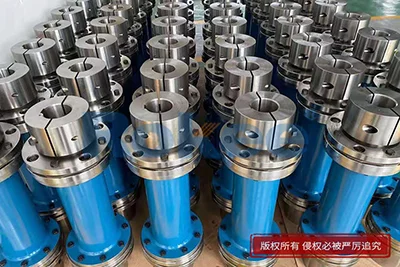
The metal diaphragm coupling, as a high-performance metal flexible coupling, is composed of a laminated diaphragm group made of stainless steel thin plates, high-strength bolts, and two half-couplings. Its core working principle is to transmit torque through the metal diaphragm while compensating for axial, radial, and angular displacements between the driving shaft and the driven shaft through the elastic deformation of the diaphragm. This structural design fundamentally solves the problems existing in traditional couplings such as gear couplings and elastic sleeve pin couplings. Unlike gear couplings that require regular lubrication and are prone to wear and backlash, the metal diaphragm coupling adopts a non-lubrication design, which not only avoids the pollution of lubricating oil to the production environment and raw materials but also reduces maintenance workload and costs. The all-metal structure ensures that it has excellent high-temperature resistance, corrosion resistance, and load-bearing capacity, which can adapt to the working environment of the PUR sandwich panel production line where the temperature in the foaming and curing area is relatively high and there may be slight chemical corrosion.
One of the key advantages of the metal diaphragm coupling in the PUR sandwich panel production line is its high transmission precision and zero backlash. In the production process of PUR sandwich panels, especially in the roll forming and fixed-length cutting links, the requirement for transmission precision is extremely strict. The roll forming unit needs to gradually deform the flat metal coil into the designed plate shape through multiple rolling processes, and the consistency of the forming shape directly depends on the stability of the transmission speed and the accuracy of torque transmission. The metal diaphragm coupling has no relative sliding between components during operation, and the torque transmission efficiency can reach up to 99.86%, ensuring that the power output by the motor is accurately transmitted to the roll forming equipment without any loss. At the same time, the zero backlash characteristic avoids the cumulative error caused by the gap between components, making the rotation speed of the forming rollers highly consistent, thus ensuring that the cross-sectional shape, thickness, and flatness of the metal panel meet the design requirements. In the fixed-length cutting link, the metal diaphragm coupling drives the flying saw system to operate synchronously with the production line. The precise transmission ensures that the cutting length error is controlled within a very small range, generally not exceeding ±1mm, which greatly reduces the waste of raw materials and improves the qualification rate of finished products.
Another important role of the metal diaphragm coupling is its strong ability to compensate for shaft misalignment, which is crucial for the stable operation of the PUR sandwich panel production line. Due to factors such as manufacturing errors, installation deviations, bearing deformation, and temperature rise during operation, the driving shaft and driven shaft of each functional unit in the production line are often prone to axial, radial, and angular misalignments. If these misalignments are not effectively compensated, they will cause additional stress on the transmission shaft, bearings, and other components, leading to increased wear, reduced service life, and even equipment failure. The metal diaphragm coupling can effectively compensate for these misalignments through the elastic deformation of the diaphragm. According to the number of diaphragms, it can be divided into single diaphragm and double diaphragm types. The single diaphragm coupling is suitable for mild deviation compensation, with an angular deviation of no more than 1.5°, while the double diaphragm coupling can compensate for multi-directional deviations through the collaborative deformation of two sets of diaphragms, with stronger load-bearing capacity and deviation compensation ability. This makes the metal diaphragm coupling particularly suitable for the transmission between equipment with large installation distances or easy misalignment in the PUR sandwich panel production line, such as the transmission between the foaming machine and the laminating machine, and between the laminating machine and the cutting system.
The vibration reduction and noise reduction performance of the metal diaphragm coupling also provides important support for improving the operational stability of the PUR sandwich panel production line. The production line involves multiple high-power motors and rotating equipment, and the vibration generated during operation will not only affect the transmission precision but also accelerate the aging of equipment components and affect the working environment. The metal diaphragm, as an elastic element, can flexibly absorb the vibration generated during the operation of the equipment, reduce the transmission of vibration between the driving end and the driven end, and thus reduce the load on the bearings and other components. Compared with gear couplings, the metal diaphragm coupling can reduce noise by more than 90%, creating a quieter and more stable working environment. In addition, the vibration reduction performance can also reduce the impact of equipment vibration on the PUR foaming process—unstable vibration will cause uneven mixing of foaming raw materials and uneven foaming density, while the stable operation brought by the metal diaphragm coupling ensures that the foaming reaction is carried out uniformly, improving the thermal insulation performance and structural strength of the sandwich panel core material.
The compact and lightweight structure of the metal diaphragm coupling also brings great convenience to the layout and operation of the PUR sandwich panel production line. The combination of aluminum alloy wheel hubs and stainless steel diaphragms makes the weight of the metal diaphragm coupling 30% to 50% lighter than that of traditional couplings, which not only reduces the load on the transmission shaft and bearings but also saves installation space. For the continuous PUR sandwich panel production line, which is usually 45 to 100 meters long and integrates multiple functional units, the compact structure of the metal diaphragm coupling allows for more flexible equipment layout, making full use of the production site space. At the same time, the simple structure of the metal diaphragm coupling also facilitates installation and disassembly—some types with intermediate shafts can be assembled and disassembled without moving the main equipment, which greatly reduces the maintenance time and improves the operational efficiency of the production line.
In the actual application process, the metal diaphragm coupling also shows excellent durability and reliability, which is particularly important for the continuous operation of the PUR sandwich panel production line. The metal diaphragm is made of high-quality stainless steel, which has good fatigue resistance and wear resistance. After long-term use, it is not easy to deform or break, and the service life is much longer than that of non-metallic elastic couplings. In addition, the metal diaphragm coupling has no easily worn parts such as gears or bushings, and the maintenance work is mainly limited to regular inspection of bolt tightness and diaphragm deformation. Generally, it is only necessary to check for loose bolts and diaphragm deformation every 500 hours of operation, and shut down for calibration if there is any abnormal vibration. This simple maintenance requirement reduces the downtime of the production line and ensures the continuity of production. For example, in a large-scale PUR sandwich panel production line with a daily output of more than 5,000 square meters, the use of metal diaphragm couplings can reduce equipment failure rate by more than 30% compared with traditional couplings, greatly improving production efficiency and reducing production costs.
The application of metal diaphragm couplings also helps to improve the energy efficiency of the PUR sandwich panel production line. Due to its high transmission efficiency and no energy loss caused by friction or backlash, the metal diaphragm coupling can make full use of the power output by the motor, reducing energy consumption. In the long-term continuous operation of the production line, even a small improvement in transmission efficiency can bring significant energy savings. For example, the torque transmission efficiency of the metal diaphragm coupling is 99.86%, while the transmission efficiency of traditional gear couplings is usually around 95% to 98%. Over a year of continuous operation, the energy saved by using metal diaphragm couplings can account for 2% to 5% of the total energy consumption of the production line, which is of great significance for reducing the production cost of enterprises and achieving energy conservation and emission reduction.
It is worth noting that the selection and installation of metal diaphragm couplings in the PUR sandwich panel production line also need to be carried out according to the actual working conditions. When selecting, it is necessary to determine the number of diaphragm groups based on the torque and speed of the transmission system—for medium torque scenarios, single diaphragm couplings can be selected, while for high-power and large-deviation scenarios, double diaphragm couplings are more suitable. In terms of installation, the bolts need to be tightened in stages in a diagonal order: first tighten to 1/4 torque, then to 1/2 torque, and finally to full torque. At the same time, the gap between the diaphragm and the flange should be controlled between 0.2 and 0.3 mm, and the axial deviation should not exceed 1 mm. These installation specifications ensure that the metal diaphragm coupling can play its best performance and avoid faults caused by improper installation.
In the context of the increasing demand for high-quality PUR sandwich panels in the market, the requirements for the precision and stability of the production line are constantly improving. The metal diaphragm coupling, with its high transmission precision, strong deviation compensation ability, good vibration reduction performance, and long service life, has become an indispensable key component in the continuous PUR sandwich panel production line. It not only solves the problems of low transmission precision, high maintenance cost, and frequent faults of traditional couplings but also provides a reliable guarantee for the production of high-quality, high-efficiency, and energy-saving PUR sandwich panels. With the continuous development of manufacturing technology, the structure and performance of metal diaphragm couplings will be further optimized, and their application in the PUR sandwich panel production line will be more extensive, contributing more to the development of the sandwich panel manufacturing industry.
In summary, the metal diaphragm coupling plays an irreplaceable role in the precise transmission of the PUR sandwich panel production line. Its unique structural design and excellent performance meet the strict requirements of the production line for transmission precision, stability, and durability. From the unwinding of metal coils to the cutting of finished products, every link benefits from the reliable transmission of the metal diaphragm coupling. It not only improves the quality and qualification rate of finished products but also reduces production costs, improves production efficiency, and promotes the sustainable development of the PUR sandwich panel manufacturing industry. As a high-performance transmission component, the metal diaphragm coupling will continue to help the PUR sandwich panel production line move towards a more precise, efficient, and stable direction in the future.
Rokee is a professional manufacturer of industrial couplings in china, designing and customizing a wide range of drive shaft coupling products for customers worldwide. Submit your coupling drawings or technical specifications, and we can customize coupling products for you.
Coupling Categories



Links:
- Calibration Weight
- Digital Viscometer
- Carpas Industriales
- Exhibition Tent
- Industrial Cardan Shaft
- PU Sandwich Panel Machine
- PIR Sandwich Panel Line
- Sandwich Panel Machine
- Sandwich Panel Production Line
- PU Sandwich Panel Line
- Sandwich Panel Line
- Flexible Couplings Manufacturer In China
- Elastic Couplings Manufacturer In China