High-quality Flexible Coupling is Secret Of Efficient Operation Of PU Sandwich Panel Line

The continuous and efficient operation of PU sandwich panel production lines underpins the stable output and consistent quality of lightweight building insulation materials, which are widely adopted in modern construction, cold chain logistics and industrial enclosure manufacturing. As a typical continuous automated production system, the PU sandwich panel line integrates multiple sequential processes including raw material unwinding, precise glue spreading, core material compounding, high-pressure laminating, constant-temperature curing, fixed-length cutting and finished product conveying. Every production link is closely interconnected, and the overall operational efficiency of the entire line depends on the precise coordination and stable power transmission of each mechanical unit. In the long-term high-load continuous production process, tiny transmission deviations, mechanical vibration and shaft misalignment problems will gradually accumulate, leading to speed inconsistency between front and rear equipment, unstable processing accuracy, increased equipment wear and frequent production stagnation. While most production operators focus on the performance of core processing equipment such as laminating machines and curing systems, the flexible coupling, a seemingly inconspicuous key transmission component, actually serves as the core guarantee for eliminating transmission defects, maintaining equipment synchronization and unlocking the long-term efficient operation potential of the entire production line.
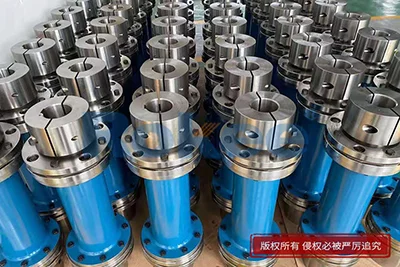
Different from rigid connecting parts that adopt fixed connection structures and lack adaptive adjustment capabilities, high-quality flexible couplings are designed with flexible transmission mechanisms and excellent structural adaptability, which perfectly fits the complex operating characteristics of PU sandwich panel line. In the daily operation of PU sandwich panel lines, equipment will inevitably produce subtle shaft displacement, angular deviation and axial offset due to long-term vibration, thermal expansion and contraction caused by continuous high-temperature curing, and slight structural deformation after long-load operation. Rigid transmission connections cannot compensate for these subtle deviations, which will directly cause uneven torque transmission, periodic speed jitter and additional mechanical stress on transmission shafts, bearings and reducers. These hidden problems will not only reduce the synchronization accuracy of each production process, resulting in inconsistent glue coating thickness, uneven composite pressing force and dimensional deviation of finished panels, but also accelerate the aging and wear of core transmission components, increase equipment failure frequency and greatly shorten the stable operation cycle of the production line. High-quality flexible couplings completely solve these industry pain points through their unique flexible compensation performance, realizing flexible connection and precise power transmission between driving and driven shafts under complex working conditions.
The core value of high-quality flexible couplings in PU sandwich panel production lines is reflected in their all-round optimization of transmission stability and operational continuity. In the raw material feeding and unwinding stage, stable and uniform torque output ensured by flexible couplings avoids intermittent tension fluctuation of metal sheets and PU core materials, preventing material deviation and wrinkling in the feeding process. This stable feeding state lays a solid foundation for the subsequent uniform glue spreading and precise composite lamination, effectively reducing the defective rate of semi-finished products caused by unstable material transmission. In the core composite pressing and curing stage, the production line operates at a constant high speed with continuous load changes, and the flexible structure of the coupling can effectively absorb mechanical vibration and impact force generated during equipment operation. It buffers the instantaneous load impact caused by equipment start-stop and load switching, protects precision transmission components from fatigue damage caused by alternating stress, and maintains the consistent operating speed of the pressing system. This ensures that the lamination pressure and curing time of each PU sandwich panel remain uniform, realizing stable product quality batch consistency.
Precise speed synchronization is another key advantage of high-quality flexible couplings that empowers efficient production of PU sandwich panels. The entire production line is a linked automated system, where the operating speed of cutting equipment must be highly synchronized with the conveying speed of front-end composite and curing equipment. Once speed deviation occurs, it will lead to inaccurate fixed-length cutting, irregular panel edges and even material waste caused by cutting errors. Traditional transmission connection structures are prone to speed delay and synchronization deviation after long-term operation due to transmission resistance and component wear. High-quality flexible couplings maintain zero-delay torque and speed transmission through optimized structural design, realizing real-time synchronization of the operating state of front and rear equipment. Even in long-term uninterrupted high-speed operation, they can always maintain consistent transmission accuracy, effectively avoid product size deviation and processing defects, and greatly improve the finished product qualification rate of the production line. At the same time, accurate synchronous operation eliminates repeated start-stop and speed adjustment actions of the equipment, effectively reduces invalid energy consumption in the production process, and realizes energy-saving and efficient production.
Long-term operational stability and low maintenance loss are important factors for production enterprises to improve comprehensive production efficiency, and high-quality flexible couplings play an irreplaceable role in extending the service life of PU sandwich panel line equipment and reducing operational costs. In industrial continuous production scenarios, most equipment failures are derived from cumulative wear of transmission systems and fatigue damage caused by uncompensated shaft misalignment. Rigid connections will cause long-term eccentric wear of transmission shafts and bearings due to uncompensated subtle deviations, leading to frequent equipment faults such as shaft jamming and bearing damage, which require frequent shutdown maintenance and component replacement, seriously affecting production continuity. High-quality flexible couplings can automatically compensate for axial, radial and angular misalignment generated during equipment operation, eliminate additional mechanical stress on transmission components, and reduce abrasive wear and fatigue damage of shafts, bearings and reducers. This greatly extends the service life of the entire transmission system and core equipment, reduces the frequency of equipment failure and shutdown maintenance, and effectively improves the overall operating rate of the production line.
The adaptive performance of high-quality flexible couplings also enables PU sandwich panel lines to adapt to diversified production demands and complex working condition changes. In actual production, enterprises often need to adjust production speed and processing parameters according to different product specifications, such as different panel thicknesses and core material densities, resulting in frequent changes in equipment operating load and speed. High-quality flexible couplings have excellent load adaptability and speed tolerance, which can maintain stable transmission performance under variable load and variable speed working conditions, without transmission jitter or power loss due to working condition adjustments. This flexible adaptability enables the production line to realize rapid switching of different production specifications, improves the flexible production capacity of the equipment, and avoids production efficiency decline and product quality fluctuation caused by working condition changes. In addition, the durable structural design of high-quality flexible couplings can adapt to the high-temperature and slightly humid operating environment of PU sandwich panel workshops, resist slight environmental corrosion and structural aging, and maintain stable mechanical performance in long-term harsh industrial working conditions.
From the perspective of overall production efficiency improvement, the application of high-quality flexible couplings forms a benign cycle for the operation of PU sandwich panel production lines. Stable transmission accuracy reduces product defective rates and material waste, lowering the unit production cost of finished products. Low failure rate and long maintenance cycle reduce manual maintenance investment and equipment downtime loss, maximizing effective production time. Accurate equipment synchronization and stable operating state improve the overall production speed and batch production capacity of the line. Many production enterprises only pay attention to the parameter upgrading of large-scale processing equipment in the process of optimizing production lines, but ignore the transformation and optimization of basic transmission components. In fact, the efficient operation of automated production lines lies in the optimization of every transmission link and every mechanical connection point. The performance gap of small transmission components will eventually be amplified into obvious gaps in production efficiency and product quality of the entire line.
In the increasingly competitive lightweight building material manufacturing industry, the stable and efficient operation of production lines has become a core competitive advantage for enterprises. The subtle transmission optimization brought by high-quality flexible couplings can bring continuous and stable efficiency improvement and quality upgrading to PU sandwich panel production. It eliminates various hidden troubles in equipment operation, makes the entire production line operate in a stable, efficient and low-consumption state for a long time, and provides a solid technical guarantee for enterprises to realize large-scale, high-quality and low-cost production. In conclusion, as the key basic component to stabilize transmission, compensate deviation and reduce wear, high-quality flexible couplings are the indispensable core secret to realize long-term efficient and stable operation of modern PU sandwich panel production lines, and play a vital supporting role in the sustainable and high-quality development of the entire industry.


Links:
- Calibration Weight
- Digital Viscometer
- Carpas Industriales
- Exhibition Tent
- Industrial Cardan Shaft
- PU Sandwich Panel Machine
- PIR Sandwich Panel Line
- Sandwich Panel Machine
- Sandwich Panel Production Line
- PU Sandwich Panel Line
- Sandwich Panel Line
- Flexible Couplings Manufacturer In China
- Elastic Couplings Manufacturer In China