The Production Capacity Of PU Sandwich Panel Equipment Is Doubled With Elastic Coupling

In the modern construction and industrial manufacturing landscape, polyurethane (PU) sandwich panels have emerged as indispensable materials, valued for their excellent thermal insulation, structural stability, lightweight properties, and versatility. These panels are widely used in industrial warehouses, cold storage facilities, modular buildings, refrigerated transportation vehicles, and commercial constructions, driving a steady increase in market demand. To meet this growing demand, manufacturers of PU sandwich panels are constantly seeking ways to enhance production efficiency, reduce operational downtime, and optimize the performance of their production equipment. Among the various technological innovations aimed at achieving these goals, the integration of elastic couplings into PU sandwich panel production lines has proven to be a game-changing solution, capable of doubling the production capacity while maintaining consistent product quality.
PU sandwich panel equipment is a sophisticated integrated system that combines mechanical engineering, electrical control, chemical reaction technology, and material processing. Its core working process involves a series of continuous and automated operations, starting from raw material feeding to the final product output. Typically, the production line begins with the uncoiling and feeding of surface materials, which are usually metal coils such as galvanized steel or aluminum. These metal coils are loaded onto decoilers, which unroll and feed the flat metal sheets into the subsequent roll forming section. In the roll forming process, the metal sheets pass through a series of tandem rolling stands, where they are progressively bent and shaped into the desired profiles under the guidance of precision rollers and gears. This step is crucial for ensuring the structural strength and dimensional accuracy of the final PU sandwich panels. After roll forming, the two profiled metal sheets (top and bottom facers) are conveyed to the PU foam injection station. At this stage, liquid polyurethane chemicals are mixed in a precise ratio and undergo a chemical reaction to form foam. The foaming mixture is then continuously injected into the gap between the two moving metal facers. The injected PU foam expands rapidly to fill the entire space and adheres tightly to the inner surfaces of the metal facers. The panels with the expanding foam then move into the cooling and curing section, where the foam is cooled and solidified under controlled temperature and pressure conditions. This curing process ensures the stability of the foam structure and the firm bonding between the foam core and the metal facers. Finally, the automatic cutting system precisely cuts the continuous panel into the set length, and the finished products are stacked and packaged before entering the warehousing process.
The efficiency of PU sandwich panel equipment is heavily dependent on the smooth and consistent operation of its transmission system, which connects the motor (the power source) to the various functional components, including the decoilers, roll forming rollers, conveyor belts, foaming machine pumps, and cutting mechanisms. In traditional production lines, rigid couplings are often used to connect the motor shaft to the shafts of these components. While rigid couplings can transmit torque effectively when the shafts are perfectly aligned, they have significant limitations that hinder production efficiency. Rigid couplings lack flexibility, meaning they cannot compensate for minor misalignments between shafts, which are common in industrial settings due to thermal expansion, installation errors, component wear, or vibrations. This misalignment leads to increased friction, noise, and wear on the shafts, bearings, and other mechanical parts, resulting in frequent breakdowns and unplanned downtime. Moreover, rigid couplings cannot absorb shocks or vibrations generated during the operation of the equipment. The continuous operation of PU sandwich panel equipment involves high-speed rotations, sudden load changes (such as when the metal coils are replaced or when the foam injection pressure fluctuates), and vibrations from the roll forming and cutting processes. These shocks and vibrations are transmitted directly through rigid couplings to the motor and other critical components, accelerating their wear and tear and reducing their service life. Additionally, rigid couplings require precise alignment during installation and maintenance, which is time-consuming and labor-intensive, further reducing overall production efficiency.
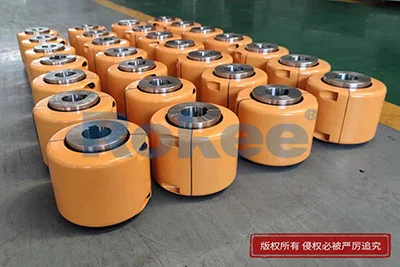
Elastic couplings, by contrast, are designed to address the limitations of rigid couplings, offering a flexible and resilient solution for power transmission in PU sandwich panel equipment. An elastic coupling transmits torque or other loads by means of an elastic component, which is typically made from materials such as rubber, polyurethane, or elastomeric compounds, or integrally formed metal elastomers cut from metal round bars. Commonly used materials for elastic couplings include aluminum alloy, stainless steel, and engineering plastics, which are chosen for their strength, flexibility, and resistance to wear and corrosion. The elastic component of the coupling allows it to flex under load, absorb shocks and vibrations, and compensate for minor misalignments between shafts, including angular, parallel, and axial misalignments. This flexibility is crucial in PU sandwich panel production lines, where precise alignment is challenging due to the high-speed operation, thermal expansion of components, and continuous load changes.
The integration of elastic couplings into PU sandwich panel equipment has a direct and profound impact on production capacity, enabling a doubling of output in many cases. This transformation is driven by several key mechanisms, each addressing a critical bottleneck in traditional production lines. One of the primary ways elastic couplings enhance production capacity is by reducing unplanned downtime. In traditional lines using rigid couplings, unplanned downtime is a major issue, often caused by component failures resulting from misalignment, shock, and vibration. Bearings, shafts, and motor components wear out quickly under these conditions, leading to frequent breakdowns that can halt production for hours or even days. Elastic couplings absorb shocks and vibrations, preventing them from being transmitted to the motor and other critical components. This reduces the wear and tear on these parts, extending their service life and minimizing the frequency of breakdowns. Additionally, the ability of elastic couplings to compensate for misalignments eliminates the need for frequent re-alignment of shafts, which is a time-consuming process that disrupts production. With elastic couplings, the equipment can operate continuously for longer periods, significantly increasing the effective production time and thus the overall output.
Another key mechanism through which elastic couplings double production capacity is by improving the speed and efficiency of the production line. PU sandwich panel equipment operates at variable speeds, with the speed of the conveyor belts, roll forming rollers, and foaming machine directly affecting the production rate. Rigid couplings impose limitations on the maximum operating speed of the equipment because they cannot absorb the vibrations and shocks generated at high speeds, which can lead to instability and component failure. Elastic couplings, however, can dampen vibrations even at high speeds, allowing the equipment to operate at higher rotational speeds without compromising stability or safety. This increase in operating speed directly translates to a higher production rate, as more panels can be produced per unit of time. For example, a production line that previously operated at a speed of 3-5 meters per minute can be increased to 6-10 meters per minute with the integration of elastic couplings, effectively doubling the production capacity. Moreover, elastic couplings ensure that the torque is transmitted smoothly and efficiently from the motor to the various components, reducing power loss and improving the overall energy efficiency of the equipment. This means that the motor can operate more efficiently, providing the necessary power to drive the equipment at higher speeds without excessive energy consumption.
The precision and consistency of the production process are also enhanced by elastic couplings, which contribute to the doubling of production capacity by reducing waste and rework. PU sandwich panel production requires precise control over various parameters, including the thickness of the metal facers, the density and distribution of the PU foam, and the cutting length of the panels. Any inconsistency in these parameters can result in defective panels that must be discarded or reworked, reducing the overall production efficiency. Elastic couplings help maintain the precision of the production process by ensuring smooth and stable power transmission. The flexible nature of the coupling eliminates sudden jolts or fluctuations in torque, which can cause variations in the speed of the conveyor belts, roll forming rollers, or foaming machine. This stability ensures that the metal facers are formed with consistent dimensions, the PU foam is injected uniformly, and the panels are cut to the exact set length. As a result, the number of defective panels is significantly reduced, minimizing waste and rework and allowing more of the production time to be dedicated to producing high-quality panels. This reduction in waste directly increases the effective production capacity, as more of the raw materials and production time are converted into finished products.
Furthermore, elastic couplings improve the maintainability of PU sandwich panel equipment, reducing the time and labor required for maintenance and further contributing to increased production capacity. Traditional rigid couplings require frequent inspection and re-alignment, which involves shutting down the equipment and disassembling the coupling, a process that is both time-consuming and labor-intensive. Elastic couplings, on the other hand, require minimal maintenance. Their elastic components are designed to be durable and long-lasting, and they do not require frequent re-alignment. In the event that the elastic component needs to be replaced, the process is simple and quick, often requiring only basic tools and minimal downtime. This reduced maintenance time means that the equipment can be back in operation faster, minimizing the loss of production time. Additionally, the reduced wear and tear on other components (such as bearings and shafts) due to the shock-absorbing properties of elastic couplings means that these components also require less frequent replacement, further reducing maintenance costs and downtime.
The practical implications of doubling production capacity with elastic couplings are significant for manufacturers of PU sandwich panels. In a market where demand is growing rapidly, the ability to produce more panels in less time gives manufacturers a competitive edge, allowing them to meet customer orders more quickly and capture a larger share of the market. Increased production capacity also leads to economies of scale, as the fixed costs of production (such as labor, energy, and equipment depreciation) are spread over a larger number of units, reducing the per-unit production cost. This cost reduction can be passed on to customers in the form of lower prices, further enhancing the manufacturer’s competitiveness, or retained as increased profit margins. Moreover, the improved reliability and efficiency of the equipment reduce the risk of production delays, which can damage a manufacturer’s reputation and lead to lost customers. By minimizing downtime and ensuring consistent production, manufacturers can build trust with their customers and establish long-term relationships.
In addition to the immediate benefits of increased production capacity, elastic couplings also offer long-term advantages for PU sandwich panel manufacturers. The extended service life of equipment components due to reduced wear and tear means that manufacturers can defer the cost of replacing expensive equipment, such as motors, bearings, and roll forming machines. This reduces capital expenditure and improves the overall return on investment (ROI) of the production line. Furthermore, the improved energy efficiency of the equipment reduces energy consumption, lowering operational costs and contributing to sustainability efforts. As global attention to environmental sustainability grows, manufacturers that can reduce their energy consumption and carbon footprint are better positioned to meet regulatory requirements and consumer demand for eco-friendly products. Elastic couplings also contribute to a safer working environment by reducing noise and vibrations, which can improve the comfort and safety of workers operating the equipment. Reduced noise and vibrations can also minimize the risk of work-related injuries, further reducing operational costs associated with worker compensation and downtime.
It is important to note that the successful integration of elastic couplings into PU sandwich panel equipment requires careful selection and installation. The choice of an appropriate elastic coupling depends on several factors, including the torque requirements of the equipment, the operating speed, the environmental conditions (such as temperature and humidity), and the specific alignment challenges of the production line. Manufacturers should work with experienced engineers to select the right type and size of elastic coupling for their specific equipment, ensuring that it is compatible with the motor and other components. Proper installation is also crucial to maximize the performance of the elastic coupling. During installation, care should be taken to ensure that the shafts are aligned as closely as possible (within the compensation range of the coupling), and that the coupling is properly secured to prevent slippage or damage. Regular inspection of the elastic coupling is also recommended to check for signs of wear or damage to the elastic component, ensuring that it is replaced before it fails and causes downtime.
In conclusion, the integration of elastic couplings into PU sandwich panel equipment represents a significant technological advancement that can double production capacity while improving product quality, reducing downtime, and lowering operational costs. By addressing the limitations of traditional rigid couplings, elastic couplings provide a flexible, resilient, and efficient solution for power transmission in PU sandwich panel production lines. Their ability to absorb shocks and vibrations, compensate for shaft misalignments, improve operating speed, and reduce maintenance requirements directly contributes to increased production efficiency and output. For manufacturers of PU sandwich panels, this innovation offers a competitive edge in a growing market, enabling them to meet customer demand more effectively, reduce costs, and improve their long-term profitability. As the construction and industrial sectors continue to evolve, the use of elastic couplings in PU sandwich panel equipment is likely to become increasingly widespread, driving further advancements in production efficiency and sustainability.
Rokee is a professional manufacturer of industrial couplings in china, designing and customizing a wide range of drive shaft coupling products for customers worldwide. Submit your coupling drawings or technical specifications, and we can customize coupling products for you.
Coupling Categories


Links:
- Calibration Weight
- Digital Viscometer
- Carpas Industriales
- Exhibition Tent
- Industrial Cardan Shaft
- PU Sandwich Panel Machine
- PIR Sandwich Panel Line
- Sandwich Panel Machine
- Sandwich Panel Production Line
- PU Sandwich Panel Line
- Sandwich Panel Line
- Flexible Couplings Manufacturer In China
- Elastic Couplings Manufacturer In China