Elastic Coupling Shows Advantages of Precision Transmission Of Sandwich Panel Machine

In the modern manufacturing industry, the sandwich panel machine plays an indispensable role in the production of building materials, with its operational efficiency and product quality directly affecting the development of the construction and related industries. As a core component in the transmission system of sandwich panel machines, the coupling undertakes the key task of transmitting power between the motor and various functional mechanisms, such as the uncoiling system, roll forming system, lamination system, and cutting system. Among various types of couplings, the elastic coupling has gradually become the preferred choice for sandwich panel machines due to its unique structural design and excellent transmission performance, especially in terms of precision transmission, which effectively solves many pain points faced by traditional couplings in practical applications and provides a strong guarantee for the stable and efficient operation of sandwich panel machines. The precision transmission of sandwich panel machines is the core requirement for ensuring the consistency of product specifications, the flatness of panel surfaces, and the uniformity of core material bonding. Any deviation in the transmission process will lead to defects such as uneven thickness of sandwich panels, misalignment of edge cutting, and insufficient bonding strength, which not only reduces product qualification rate but also increases production costs and affects market competitiveness. Elastic couplings, through their special structural design and material selection, effectively optimize the precision transmission effect, make up for the deficiencies of traditional rigid couplings, and gradually become an indispensable core component in the transmission system of modern sandwich panel machines.
To understand the advantages of elastic couplings in the precision transmission of sandwich panel machines, it is first necessary to clarify the working characteristics of sandwich panel machine and the core requirements for the transmission system. A sandwich panel machine is a complex integrated production equipment that involves multiple continuous processes, including the uncoiling of surface materials, roll forming, core material feeding, lamination, curing, and fixed-length cutting. Each process requires the coordinated operation of multiple mechanisms, and the power generated by the motor needs to be transmitted to each executive component accurately and stably to ensure that the entire production line operates synchronously. In the actual production process, the sandwich panel machine is often affected by various factors, such as installation errors, mechanical vibration, thermal expansion and contraction of components during long-term operation, and slight displacement of the equipment base, which will lead to relative deviations between the driving shaft and the driven shaft in the transmission system. If a rigid coupling is used, which has no ability to compensate for deviations, these small displacements will cause additional stress on the transmission shaft, bearings, and other components, resulting in increased wear, reduced transmission precision, and even mechanical failures in severe cases. In addition, the production process of sandwich panels has high requirements for the stability of power transmission. For example, in the roll forming process, the surface material needs to be pressed into a predetermined shape through the rotation of the roller, which requires the transmission system to provide a stable and uniform torque to avoid uneven stress on the surface material, resulting in wrinkles or deformation. In the lamination process, the surface material and the core material need to be bonded under a certain pressure and speed, and the stability of the transmission speed directly affects the bonding effect and the flatness of the panel surface. Therefore, the transmission system of the sandwich panel machine not only needs to have high transmission efficiency but also must ensure high precision and stability, which puts forward higher requirements for the performance of the coupling.
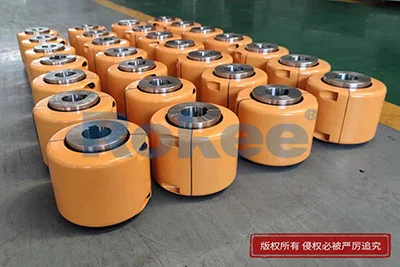
Elastic couplings have inherent advantages in meeting the precision transmission requirements of sandwich panel machines, which are mainly reflected in their unique structural design and excellent performance characteristics. Unlike rigid couplings that are rigidly connected, elastic couplings are equipped with elastic components between the two halves of the coupling, which can realize flexible connection between the driving shaft and the driven shaft. These elastic components are usually made of high-performance materials such as polyurethane, rubber, or metal elastic bodies, which have good elasticity and fatigue resistance, and can effectively absorb vibration and compensate for relative deviations between shafts. In the precision transmission process of sandwich panel machines, this elastic compensation function plays a key role. First of all, in terms of deviation compensation, elastic couplings can effectively compensate for radial, angular, and axial deviations between the driving shaft and the driven shaft caused by installation errors, mechanical vibration, and thermal expansion. For example, during the long-term operation of the sandwich panel machine, the motor and the roller mechanism will generate a certain amount of heat, leading to thermal expansion of the transmission shaft, which will cause axial displacement between the shafts. The elastic components of the elastic coupling can be deformed appropriately to absorb this displacement, avoiding the generation of additional stress and ensuring the stability of the transmission system. At the same time, due to the installation error of the equipment or the slight deformation of the frame, there may be radial or angular deviations between the driving shaft and the driven shaft. The elastic coupling can also compensate for these deviations through the elastic deformation of its own components, ensuring that the power is transmitted smoothly and accurately, and avoiding the impact on the transmission precision caused by the deviation.
Secondly, in terms of vibration absorption and noise reduction, elastic couplings also show obvious advantages, which further ensures the precision of transmission. During the operation of the sandwich panel machine, the motor and various rotating mechanisms will generate a certain amount of vibration. If this vibration is not effectively absorbed, it will be transmitted to the entire transmission system, leading to unstable operation of the equipment, reduced transmission precision, and even affecting the service life of the components. The elastic components in the elastic coupling can act as a buffer, absorb and dissipate the vibration generated during the operation of the equipment, reduce the impact of vibration on the transmission system, and make the transmission process more stable. At the same time, the absorption of vibration also helps to reduce the noise generated during the operation of the equipment, creating a better working environment. For example, in the cutting process of the sandwich panel machine, the cutting knife needs to work at a constant speed to ensure the flatness of the cutting surface. If the transmission system generates large vibration, it will cause the cutting knife to shake, resulting in uneven cutting, burrs on the edge of the panel, and other defects. The elastic coupling can effectively absorb the vibration generated by the motor and the cutting mechanism, ensure that the cutting knife operates at a stable speed, and improve the cutting precision and product quality.
In addition, the elastic coupling has the characteristics of zero backlash and high torque rigidity, which is another key factor to ensure the precision transmission of the sandwich panel machine. Backlash refers to the relative rotation gap between the two halves of the coupling when the direction of rotation changes. For the sandwich panel machine, especially in the processes that require frequent positive and negative rotation, such as the adjustment of the roller mechanism and the reversing of the conveying system, the existence of backlash will lead to a delay in the transmission response, affect the synchronization of the equipment operation, and further reduce the transmission precision. The elastic coupling adopts an integrated molding design or a precise assembly structure, which can realize zero backlash transmission, ensure that the torque is transmitted synchronously when the direction of rotation changes, and avoid the impact of backlash on the transmission precision. At the same time, the elastic coupling has high torque rigidity, which means that when transmitting torque, the deformation of the coupling itself is very small, ensuring that the speed and torque transmitted to each executive component are consistent with the set value, and avoiding the reduction of transmission precision caused by the deformation of the coupling. For example, in the roll forming process of the sandwich panel machine, the roller needs to maintain a constant rotation speed to ensure that the surface material is formed uniformly. The high torque rigidity of the elastic coupling can ensure that the torque transmitted to the roller is stable, and the rotation speed of the roller does not change due to the deformation of the coupling, thus ensuring the forming precision of the surface material.
The material selection of elastic couplings also provides a strong guarantee for their precision transmission performance in sandwich panel machines. Different types of elastic couplings use different materials according to their application scenarios, but they all focus on ensuring the stability and durability of transmission. For example, some elastic couplings use high-strength aluminum alloy as the hub material, which is not only light in weight but also has good corrosion resistance and wear resistance, ensuring the stability of the coupling during long-term operation. The elastic components are made of high-performance polyurethane materials, which have good elasticity, fatigue resistance, and oil resistance, and can maintain stable performance in harsh working environments such as high temperature and oil pollution. In addition, some elastic couplings use stainless steel materials, which further improve the torque-bearing capacity and rigidity, and are suitable for the transmission scenarios of large-tonnage sandwich panel machines. The reasonable selection of materials not only ensures the service life of the elastic coupling but also ensures the stability of its precision transmission performance, making it able to adapt to the long-term continuous operation needs of sandwich panel machines.
In practical applications, the advantages of elastic couplings in the precision transmission of sandwich panel machines have been fully verified. Taking a medium-sized sandwich panel production line as an example, before replacing the elastic coupling, the production line used a rigid coupling. Due to the installation error and mechanical vibration, the transmission system often had problems such as unstable operation, large vibration, and low transmission precision, resulting in the qualification rate of sandwich panels being only about 85%. After replacing the elastic coupling, the deviation compensation function of the elastic coupling effectively made up for the installation error and the displacement caused by thermal expansion, the vibration absorption performance reduced the impact of mechanical vibration on the transmission system, and the zero backlash and high torque rigidity ensured the accuracy and stability of power transmission. After the transformation, the qualification rate of sandwich panels increased to more than 98%, the number of equipment failures was reduced by more than 70%, the maintenance cost of the equipment was greatly reduced, and the production efficiency was increased by about 15%. This practical case fully shows that the elastic coupling can effectively improve the precision transmission effect of the sandwich panel machine, reduce production costs, and improve product quality and production efficiency.
In addition to the above advantages, the elastic coupling also has the characteristics of simple installation and maintenance, which further enhances its applicability in sandwich panel machines. The installation of elastic couplings does not require high-precision alignment, which can reduce the difficulty of installation and shorten the installation time. At the same time, the elastic coupling has a long service life and does not require frequent maintenance, only regular inspection and cleaning are needed to ensure its normal operation. This is very important for sandwich panel machines that need long-term continuous operation, as it can reduce the downtime caused by maintenance and improve the continuity and stability of production. Compared with traditional rigid couplings, which require frequent alignment and maintenance, elastic couplings save a lot of manpower and material resources, reduce production costs, and provide more convenience for the daily operation and management of the equipment.
It should be noted that although elastic couplings have many advantages in the precision transmission of sandwich panel machines, the selection of elastic couplings also needs to be based on the specific working conditions of the sandwich panel machine, such as the transmission power, rotation speed, torque, and the type and size of the deviation that needs to be compensated. Only by selecting the appropriate type and specification of elastic coupling can the best precision transmission effect be achieved. For example, for small and medium-sized sandwich panel machines with small transmission power and small deviation, a spiral groove elastic coupling can be selected, which has good elasticity and deviation compensation ability and is economical and practical. For large-tonnage sandwich panel machines with large transmission power and large torque, a parallel groove elastic coupling or a metal elastic coupling can be selected, which has higher torque rigidity and load-bearing capacity, and can meet the needs of high-precision transmission. In addition, in the process of use, attention should also be paid to the installation and adjustment of the elastic coupling to ensure that its performance can be fully exerted. For example, during installation, the alignment of the shafts should be checked as much as possible to reduce the deviation between the shafts; during operation, the working status of the elastic coupling should be regularly inspected to find and solve potential problems in time, so as to ensure the long-term stable operation of the transmission system.
With the continuous development of the sandwich panel industry, the requirements for the precision and efficiency of sandwich panel machines are getting higher and higher, which also puts forward higher requirements for the performance of the transmission system. As a key component in the transmission system, the elastic coupling, with its unique advantages in deviation compensation, vibration absorption, zero backlash, and high torque rigidity, has become an important guarantee for the precision transmission of sandwich panel machines. It not only improves the product quality and production efficiency of sandwich panel machines but also reduces the maintenance cost and equipment failure rate, bringing more economic benefits to enterprises. In the future, with the continuous progress of material science and mechanical design technology, the structure and performance of elastic couplings will be further optimized, and their application in sandwich panel machines will be more extensive and in-depth. For example, the development of new high-performance elastic materials will further improve the fatigue resistance and service life of elastic couplings; the optimization of structural design will make the deviation compensation ability and torque rigidity of elastic couplings more excellent, better meeting the needs of high-precision and high-efficiency transmission of sandwich panel machines. At the same time, with the popularization of intelligent manufacturing, elastic couplings may also be integrated with intelligent monitoring systems, realizing real-time monitoring of their working status, timely early warning of potential failures, and further improving the reliability and stability of the transmission system of sandwich panel machines.
In conclusion, the elastic coupling plays an irreplaceable role in the precision transmission of sandwich panel machines. Its unique structural design and excellent performance characteristics effectively solve the problems of deviation, vibration, and backlash in the traditional transmission system, ensure the precision and stability of power transmission, and provide a strong support for the high-quality development of the sandwich panel industry. For enterprises engaged in the production of sandwich panel machines, choosing the appropriate elastic coupling and giving full play to its advantages in precision transmission is an important way to improve product competitiveness, reduce production costs, and achieve sustainable development. In the future, with the continuous innovation and development of elastic coupling technology, it will surely bring more surprises to the precision transmission of sandwich panel machines and promote the continuous progress of the entire sandwich panel manufacturing industry.
Rokee is a professional manufacturer of industrial couplings in china, designing and customizing a wide range of drive shaft coupling products for customers worldwide. Submit your coupling drawings or technical specifications, and we can customize coupling products for you.
Coupling Categories




Links:
- Calibration Weight
- Digital Viscometer
- Carpas Industriales
- Exhibition Tent
- Industrial Cardan Shaft
- PU Sandwich Panel Machine
- PIR Sandwich Panel Line
- Sandwich Panel Machine
- Sandwich Panel Production Line
- PU Sandwich Panel Line
- Sandwich Panel Line
- Flexible Couplings Manufacturer In China
- Elastic Couplings Manufacturer In China