Efficient Operation Of Continuous PU Sandwich Panel Line Escorted By Flexible Coupling

In the modern construction and industrial insulation fields, continuous PU sandwich panel lines have become the core equipment for mass production of high-performance insulation composite panels, relying on their continuous operation capability, stable product quality and high production efficiency to meet the growing demand for energy-saving and environmentally friendly building materials. The continuous PU sandwich panel line integrates multiple processes such as raw material feeding, surface treatment, foaming, curing, cutting and stacking, and each link is closely connected, requiring the coordinated operation of various mechanical components to ensure the smooth progress of the entire production process. Among these key components, flexible couplings play an indispensable role as a bridge for power transmission and a buffer for operational stability. They quietly undertake the task of connecting power sources and functional components, effectively solving the problems of shaft misalignment, vibration and impact that are prone to occur in the operation of the production line, thus escorting the efficient, stable and long-term operation of the continuous PU sandwich panel line.
To understand the important role of flexible couplings in the continuous PU sandwich panel line, it is first necessary to clarify the operational characteristics and core requirements of the production line itself. The continuous PU sandwich panel line is an automated production system that takes surface materials such as color-coated steel plates, aluminum plates or non-woven fabrics and polyurethane (PU) as the core material, and forms a sandwich structure composite panel through continuous foaming, compounding and curing processes. The entire production process is carried out in a continuous and cyclic manner, and the production speed, material mixing accuracy, temperature control stability and mechanical operation coordination directly affect the quality of the final product and the efficiency of the production line. From the uncoiling and feeding of surface materials to the pre-treatment of the plate surface, from the precise mixing and injection of PU raw materials to the continuous foaming and curing in the temperature-controlled environment, and then to the precise cutting of the formed panel and the automatic stacking of finished products, each link requires the power transmission system to provide stable and reliable power support. Any instability in power transmission, such as shaft misalignment, vibration or impact, will lead to problems such as material deviation, uneven foaming, inconsistent panel thickness and even equipment failure, which will not only affect the product qualification rate but also increase production costs and reduce production efficiency.
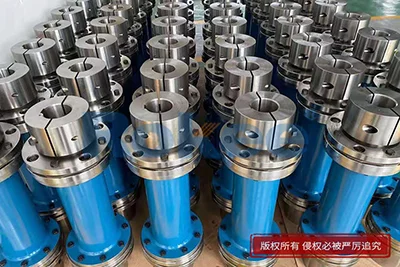
The flexible coupling is a mechanical component designed to connect two rotating shafts and transmit torque while accommodating a certain degree of misalignment and damping vibration. Unlike rigid couplings that require absolute alignment of the two shafts, flexible couplings have a certain degree of flexibility and buffering performance, which can effectively compensate for the angular, parallel and axial misalignment that may occur between the shafts during the operation of the production line. In the continuous PU sandwich panel line, the power transmission system involves multiple equipment such as motors, reducers, conveyor rollers, mixing pumps and cutting machines. Due to factors such as installation errors, thermal expansion during operation, mechanical wear and material stress, it is difficult to maintain absolute alignment between the shafts of these equipment for a long time. If a rigid coupling is used, the misalignment between the shafts will generate large additional forces, which will not only increase the wear of bearings, shafts and other components but also transmit vibration to the entire production line, leading to unstable operation of the equipment and affecting the production quality. The flexible coupling, by virtue of its unique structural design, can absorb and compensate for these misalignments, reduce the additional stress generated by misalignment, protect the mechanical components from damage, and ensure the smooth transmission of power.
In the continuous PU sandwich panel line, the flexible coupling is widely used in various key power transmission links, and its role is particularly prominent in the core equipment of the production line. For example, in the feeding system of the production line, the uncoiling machine and the conveyor roller need to maintain a stable speed synchronization to ensure that the surface material is smoothly unfolded and conveyed without deviation or wrinkling. The flexible coupling connects the motor and the conveyor roller, which can not only transmit torque stably but also compensate for the slight misalignment between the motor shaft and the conveyor roller shaft caused by installation or wear, ensuring that the conveyor speed is uniform and consistent. In the PU foaming system, the mixing pump needs to work at a stable speed to ensure that the polyol and isocyanate raw materials are mixed in a precise ratio and injected into the gap between the upper and lower surface materials evenly. The flexible coupling between the motor and the mixing pump can absorb the vibration generated by the high-speed operation of the pump, avoid the vibration affecting the mixing accuracy, and at the same time compensate for the axial displacement caused by the thermal expansion of the pump during operation, ensuring the stable operation of the mixing pump and the accuracy of raw material mixing. In the cutting system, the cutting machine needs to have high-speed and stable rotation performance to ensure that the formed PU sandwich panel is cut neatly and the length is accurate. The flexible coupling connects the motor and the cutting blade, which can dampen the vibration generated during the cutting process, reduce the noise of the equipment, and at the same time compensate for the slight misalignment between the motor shaft and the cutting blade shaft, ensuring the cutting precision and avoiding the occurrence of burrs or uneven cutting on the panel surface.
The vibration damping performance of the flexible coupling is another important guarantee for the efficient operation of the continuous PU sandwich panel line. During the operation of the production line, various mechanical equipment will generate a certain amount of vibration due to high-speed rotation, gear meshing, material impact and other factors. If these vibrations are not effectively damped, they will be transmitted to the entire production line, leading to loose connections between equipment components, increased wear, and even affecting the stability of the production process. For example, in the foaming curing zone, the temperature needs to be maintained at a stable level to ensure the full foaming and curing of the PU raw material. If the vibration of the equipment is too large, it will affect the stability of the temperature control system, lead to uneven temperature distribution in the curing zone, and further cause problems such as uneven density of the PU core, poor bonding between the core material and the surface material, and reduced structural strength of the panel. The flexible coupling can absorb and dampen the vibration generated by the equipment through its own elastic components, reduce the transmission of vibration between the equipment, and create a stable operating environment for the production line. At the same time, the vibration damping performance of the flexible coupling can also reduce the noise generated during the operation of the production line, improve the working environment of the operators, and reduce the impact of noise on the surrounding environment.
In addition to compensating for misalignment and damping vibration, the flexible coupling also has the advantages of shock absorption and overload protection, which can further improve the reliability and safety of the continuous PU sandwich panel line. In the production process, the production line may encounter sudden load changes, such as the blockage of the conveyor belt by foreign objects, the sudden increase of the cutting resistance, or the abnormal operation of the mixing pump. These sudden load changes will generate a large impact force, which may damage the motor, reducer, bearings and other key components if not effectively buffered. The flexible coupling can absorb the impact force generated by the sudden load change through its own elastic deformation, reduce the impact on the power transmission system, and play a role in overload protection. For example, when the cutting machine encounters a hard foreign object during the cutting process, the cutting resistance will suddenly increase, and the flexible coupling will deform elastically to absorb the impact force, avoiding the motor being burned out or the cutting blade being damaged due to overload. This kind of overload protection function can effectively reduce the failure rate of the production line, reduce the maintenance cost, and ensure the continuous operation of the production line.
The selection and maintenance of flexible couplings also have an important impact on the efficient operation of the continuous PU sandwich panel line. Due to the different working conditions and load requirements of different links in the production line, it is necessary to select the appropriate type and specification of flexible couplings according to the actual situation. For example, in the links with high torque and large misalignment, such as the connection between the motor and the reducer, gear-type flexible couplings or grid-type flexible couplings with strong torque transmission capacity and good misalignment compensation performance can be selected; in the links with high precision requirements and small vibration, such as the connection between the motor and the mixing pump, diaphragm-type flexible couplings or Oldham couplings with high transmission precision and good vibration damping performance can be selected. At the same time, the material of the flexible coupling should also be selected according to the working environment of the production line. For example, in the environment with high temperature and humidity, flexible couplings made of corrosion-resistant and high-temperature-resistant materials should be selected to ensure their service life and performance stability.
Regular maintenance of flexible couplings is an important measure to ensure their long-term stable operation and extend their service life. During the operation of the continuous PU sandwich panel line, the maintenance personnel should regularly check the working status of the flexible coupling, including checking whether there is wear, deformation or damage to the elastic components, whether the connection bolts are loose, whether there is oil leakage or abnormal noise. For the flexible couplings with lubrication requirements, the lubricating oil should be replaced regularly to ensure the lubrication effect between the components, reduce wear, and improve the transmission efficiency. If any abnormal situation is found, it should be handled in a timely manner, such as replacing the worn elastic components, tightening the loose bolts, or replacing the entire flexible coupling if necessary. Through regular maintenance, the failure rate of the flexible coupling can be effectively reduced, the stability of the power transmission system can be ensured, and the efficient operation of the entire production line can be maintained.
The application of flexible couplings in the continuous PU sandwich panel line not only improves the operational stability and production efficiency of the production line but also reduces the production cost and extends the service life of the equipment. In the actual production process, many production enterprises have verified the important role of flexible couplings through practice. For example, some enterprises found that after replacing the rigid couplings with flexible couplings in the feeding system and foaming system of the production line, the deviation rate of the surface material was reduced by more than 30%, the uneven foaming rate of the PU core was reduced by nearly 25%, and the equipment failure rate was reduced by more than 40%, which greatly improved the product qualification rate and production efficiency. At the same time, the service life of the motor, reducer, bearings and other key components was also extended by 20% to 30%, reducing the maintenance cost and equipment replacement cost of the enterprise.
With the continuous development of the construction and industrial insulation industry, the requirements for the production efficiency and product quality of the continuous PU sandwich panel line are getting higher and higher. The flexible coupling, as a key component to ensure the efficient operation of the production line, will also develop in the direction of higher precision, better performance and longer service life. In the future, with the continuous improvement of material science and mechanical design technology, the structural design of flexible couplings will be more optimized, the performance will be more stable, and they will be able to adapt to more complex working conditions of the production line. For example, the development of flexible couplings with intelligent monitoring functions can realize real-time monitoring of their operating status, such as temperature, vibration and wear, and send early warning signals in time when abnormalities occur, which is convenient for maintenance personnel to handle in a timely manner, further improving the reliability and intelligence level of the production line.
In conclusion, the continuous PU sandwich panel line, as the core equipment for the production of insulation composite panels, its efficient and stable operation is crucial to the development of enterprises. The flexible coupling, with its unique functions of misalignment compensation, vibration damping, shock absorption and overload protection, has become an indispensable key component in the production line. It effectively solves the problems of shaft misalignment, vibration and impact in the operation of the production line, protects the mechanical equipment from damage, ensures the stability of the production process and the quality of products, and reduces the production cost and maintenance cost of enterprises. Therefore, in the design, operation and maintenance of the continuous PU sandwich panel line, sufficient attention should be paid to the selection and application of flexible couplings, and appropriate types of flexible couplings should be selected according to the actual working conditions, and regular maintenance should be carried out to give full play to their role, so as to escort the efficient, stable and long-term operation of the continuous PU sandwich panel line, and promote the sustainable development of the construction and industrial insulation industry.




Links:
- Calibration Weight
- Digital Viscometer
- Carpas Industriales
- Exhibition Tent
- Industrial Cardan Shaft
- PU Sandwich Panel Machine
- PIR Sandwich Panel Line
- Sandwich Panel Machine
- Sandwich Panel Production Line
- PU Sandwich Panel Line
- Sandwich Panel Line
- Flexible Couplings Manufacturer In China
- Elastic Couplings Manufacturer In China