Flexible Coupling Catalog

Modern mechanical power transmission systems rely heavily on reliable connecting components to maintain consistent rotational motion and torque transfer between independent rotating shafts, and flexible couplings stand out as one of the most indispensable foundational mechanical parts in full-spectrum industrial transmission scenarios. In actual mechanical operation, perfect coaxial alignment between driving shafts and driven shafts can never be permanently maintained. Minor installation deviations during equipment assembly, thermal expansion and contraction caused by long-term operating temperature fluctuations, structural deformation under continuous dynamic load, and slight foundation displacement of mechanical bases will all lead to unavoidable parallel offset, angular deflection and axial displacement between paired shafts. Rigid connecting components that pursue complete rigidity and zero deformation cannot adapt to these objective displacements, which will generate huge additional reaction force on shaft bearings, gearboxes and motor output ends, accelerate the wear of core mechanical components, shorten the overall service life of transmission equipment, and even trigger unexpected shutdown failures under sudden load impact. Flexible couplings are designed to solve these inherent pain points of shaft connection, integrating basic torque transmission, misalignment compensation, vibration damping and impact buffering into a single mechanical component, and building a stable and protective buffer link for the entire closed-loop transmission system. This catalog elaborates on the working mechanism, core performance characteristics, classification and structural differences, application scenario matching logic, installation and maintenance specifications, and future optimization development trends of flexible couplings, providing comprehensive and professional reference for mechanical design engineers, equipment maintenance personnel and system integrators to select and apply flexible transmission connecting components.
The core working logic of all flexible couplings originates from controlled elastic deformation of internal components, which distinguishes them fundamentally from rigid shaft connectors. Every flexible coupling completes three core synchronous tasks during continuous rotating operation without interfering with normal power transmission. Firstly, it stably transmits continuous torque and rotational speed from the active power end to the passive load end without obvious power loss or rotational speed hysteresis. Unlike traditional rigid connectors that rely on overall rigid extrusion to transmit power, flexible couplings adopt segmented matching structures, and power is transferred through elastic extrusion, meshing linkage or flexible traction between internal components, ensuring uninterrupted power output even when two connected shafts produce relative displacement. Secondly, it automatically compensates for three common types of shaft misalignment throughout the operating cycle. Angular misalignment refers to the angle deviation between the center lines of two shafts that are not completely parallel; parallel misalignment means the horizontal offset of two shaft center lines while keeping the rotation angle consistent; axial misalignment is the reciprocating linear displacement of two shafts along the rotation direction caused by thermal expansion. The built-in flexible structure of couplings can produce reversible micro-deformation corresponding to the displacement amplitude, offsetting abnormal stress generated by shaft misalignment in real time without transmitting these destructive forces to motors, reducers and load equipment. Thirdly, the flexible medium inside couplings converts instantaneous impact energy and torsional vibration energy generated by equipment startup, sudden load change, alternating cyclic load and unstable operation into elastic potential energy through deformation, and releases the energy slowly and evenly during the reset process of flexible components. This passive vibration damping mechanism effectively suppresses high-frequency vibration transmission along the transmission chain, reduces operating noise of the whole machine, and avoids fatigue damage of mechanical parts caused by long-term alternating vibration stress.
According to different flexible implementation modes and internal structural forms, flexible couplings can be divided into two major categories: material-flexing flexible couplings and mechanical-flexing flexible couplings, each with unique structural advantages, performance limitations and applicable working condition boundaries, which determines their targeted application directions in industrial transmission systems. Material-flexing couplings realize flexible compensation and vibration damping purely through the elastic deformation of integral flexible materials, without any movable clearance or relative sliding parts inside the overall structure. The flexible core components are mostly made of high-elasticity polymer materials or thin metal elastic sheets with uniform fatigue resistance. During operation, all displacement compensation and vibration buffering depend on the tensile, compression and shear deformation of the elastic material itself. This type of coupling features an entirely sealed internal structure, zero abrasion loss during operation, no need for lubrication maintenance throughout the service cycle, and excellent ability to suppress high-frequency micro-vibration. Meanwhile, it maintains accurate synchronous rotation of two shafts with almost no rotation backlash, making it highly suitable for precision transmission scenarios requiring strict rotation synchronization. However, restricted by the material properties of elastic components, material-flexing couplings have limited bearing capacity for heavy impact loads and large-amplitude misalignment, and their working temperature range is constrained by the temperature resistance limit of elastic materials; excessive high or low ambient temperature will change the hardness and elastic modulus of flexible materials, thus weakening compensation and vibration damping performance.
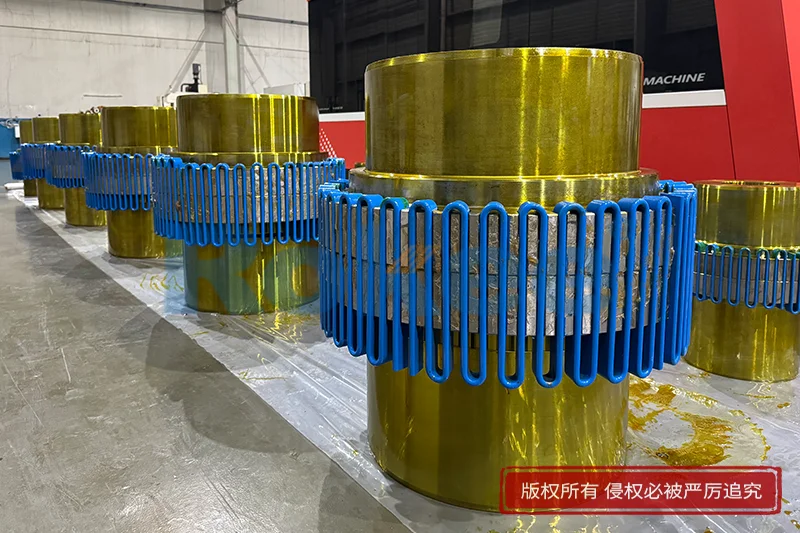
Mechanical-flexing flexible couplings achieve flexible adaptation through reserved structural gaps and relative movable fit between rigid metal components, without relying on material deformation for flexibility. The internal structure adopts mutually matched metal tooth parts, chain assemblies or grid structures, and small relative sliding and rolling between metal components absorb shaft misalignment and impact load during rotation. This structural design enables mechanical-flexing couplings to bear ultra-large torque and heavy cyclic impact loads, adapt to extremely harsh working environments with wide temperature changes, dust pollution and humid corrosion, and realize long-term stable operation under large-amplitude shaft displacement. Compared with material-flexing products, their prominent advantages lie in stronger overload resistance and wider environmental adaptability. Nevertheless, relative movement between internal metal components will inevitably produce slight friction and wear, and regular lubrication maintenance is required to reduce wear and extend service life. In addition, structural clearances will produce tiny rotation backlash during forward and reverse switching of equipment, so this series of couplings are not suitable for high-precision servo transmission systems that require zero backlash and ultra-stable rotation accuracy. The clear difference between the two structural categories helps engineering personnel quickly narrow down selection ranges according to on-site working condition parameters, avoiding performance mismatch caused by blind selection.
In practical engineering selection, besides structural classification, multiple key operating parameters need to be comprehensively evaluated to match the most suitable flexible coupling for specific transmission systems, covering operating speed range, torsional stiffness level, allowable misalignment value, vibration damping demand and cyclic load frequency. Operating speed is a basic screening indicator: high-speed rotating transmission systems such as high-speed fans and centrifugal pumps require couplings with balanced overall structure and low centrifugal force increment during high-speed rotation, avoiding additional vibration caused by unbalanced coupling components. Torsional stiffness reflects the anti-deformation ability of couplings under torque load. Transmission systems with strict rotation angle synchronization requirements need couplings with high torsional stiffness to prevent angular deviation caused by torsional deformation; while equipment with frequent impact loads needs low torsional stiffness to obtain better buffer effects through sufficient elastic deformation. The maximum allowable misalignment parameter directly corresponds to on-site installation and operating deviation. For equipment with difficult high-precision shaft alignment and obvious thermal deformation during operation, couplings with larger comprehensive misalignment compensation capacity should be prioritized. Moreover, matching must be carried out combined with load characteristics: uniform and stable static load scenarios focus on long-term fatigue resistance of couplings, while alternating dynamic load and frequent startup-stop scenarios pay more attention to impact resistance and cyclic deformation stability of flexible components.
Reasonable installation and standardized daily maintenance are critical to giving full play to the comprehensive performance of flexible couplings and extending their overall service life, even for high-performance coupling products with excellent design and manufacturing accuracy. During installation, although flexible couplings have inherent misalignment compensation capability, excessive shaft offset beyond the rated allowable range will still cause accelerated fatigue damage of flexible components and sharp increase of bearing load. Therefore, basic shaft alignment calibration is still required before installation to control shaft misalignment within the optimal working interval recommended by structural design. In the assembly process, uniform fastening force must be guaranteed for all connecting fasteners; asymmetric fastening torque will lead to eccentric stress on the coupling body, inducing abnormal vibration during operation. For material-flexing couplings, collision and extrusion of internal elastic parts should be avoided during installation to prevent irreversible damage to elastic structures before formal operation. For mechanical-flexing couplings, complete filling of lubricating grease inside movable gaps is required during initial assembly to reduce initial running-in wear of metal matching surfaces.
Daily routine maintenance cycles vary according to working environment severity. For clean indoor working conditions with stable temperature, low load and low vibration, regular visual inspection every six months is sufficient to check for surface aging, crack damage and fastener loosening of coupling components. For harsh working sites such as outdoor open-air environments, dust-filled production workshops and corrosive gas environments, inspection cycles need to be shortened appropriately. Maintenance personnel should focus on checking surface aging and shear cracks of elastic components for material-flexing couplings, and replace damaged flexible parts in a timely manner to avoid sudden fracture and transmission interruption. For mechanical-flexing couplings, regular replenishment of lubricating media and cleaning of internal worn metal debris are core maintenance items; deteriorated lubricants will lose friction reduction and anti-wear effects, leading to sharp wear of internal movable structures and reduced overall transmission efficiency. In addition, abnormal vibration and noise signals during equipment operation are important early warning indicators for coupling failure. Sudden increase of transmission vibration or periodic abnormal noise usually indicates excessive misalignment, fatigue failure of flexible elements or insufficient internal lubrication, and targeted inspection and adjustment should be carried out immediately to avoid cascading damage to the entire transmission system.
Flexible couplings cover almost all medium and low-speed to high-speed mechanical transmission scenarios across industrial sectors, showing strong scenario adaptability in diversified production and manufacturing fields. In fluid conveying equipment including various water pumps and oil pumps, frequent pressure fluctuation of fluid medium will generate periodic impact load on transmission shafts, and shaft displacement caused by motor heating is common during long-term continuous operation. Flexible couplings effectively buffer fluid impact vibration and compensate thermal axial displacement, protecting pump body bearings and motor output shafts from fatigue damage. In material processing equipment such as mixers and crushers, transmission systems bear heavy alternating impact loads all the time, and mechanical-flexing couplings with high torque resistance are widely applied to maintain stable power transmission under heavy load conditions. In precision automated processing equipment such as numerical control machine tools and automated production lines, high-precision synchronous rotation is the core demand, so backlash-free material-flexing couplings are adopted to ensure accurate motion transmission and guarantee processing dimensional accuracy of workpieces. In large-scale fan and ventilation equipment operating stably for a long time, couplings suppress high-frequency vibration generated by fan blade rotation, prevent vibration from transmitting to motor and fixed support structures, and reduce overall operating noise of equipment. Beyond conventional industrial equipment, flexible couplings also play a key role in mobile mechanical transmission systems, where vibration from walking mechanisms and uneven ground excitation bring continuous dynamic displacement to transmission shafts, and flexible connecting structures stabilize power transmission while isolating mechanical vibration.
With the continuous upgrading of intelligent manufacturing and high-efficiency energy-saving mechanical equipment, the iterative development direction of flexible couplings is gradually clear, focusing on lightweight structure optimization, wider extreme environment adaptability, intelligent state perception and higher transmission efficiency. In terms of structural optimization, integrated integrated design is replacing traditional split assembly structures, reducing overall component volume and rotational inertia while maintaining equivalent torque transmission capacity, which is more suitable for compact and miniaturized modern mechanical equipment. In terms of material upgrading, new composite elastic materials and high-strength alloy metals are being applied to coupling production, improving fatigue resistance, high and low temperature resistance and corrosion resistance of flexible components, enabling couplings to work stably in ultra-low temperature cold storage environments, high-temperature industrial heating environments and weak corrosive gas environments for a long time. In terms of intelligent iteration, built-in miniature sensing modules are being combined with coupling structures to monitor real-time operating parameters including operating temperature, vibration amplitude and deformation displacement of flexible components during operation. The system can realize automatic early warning of abnormal misalignment, fatigue aging and lubrication failure, matching the operation and maintenance mode of intelligent unmanned production workshops. At the same time, further reduction of power transmission loss is also a key research direction, optimizing internal deformation paths of flexible structures to minimize energy consumption generated by elastic deformation while retaining sufficient misalignment compensation and vibration damping performance, helping the whole mechanical transmission system achieve higher energy utilization efficiency.
As a core connecting component bridging power sources and load equipment, flexible couplings are often overlooked in mechanical system design, but their operating performance directly determines the long-term operating stability, maintenance cost and overall service life of the entire transmission chain. Unlike standardized mechanical parts with single performance, flexible couplings need accurate matching with working condition parameters including load type, rotating speed, misalignment degree, ambient temperature and vibration intensity. Blind selection of overly high-specification couplings will increase unnecessary equipment procurement cost and structural space occupation, while undersized couplings will face premature failure risk under actual operating load. A comprehensive understanding of structural differences, performance advantages, installation specifications and application boundaries of different flexible couplings helps build a more robust, efficient and low-maintenance mechanical transmission system. With the continuous progress of mechanical manufacturing technology and material science, flexible couplings will continue to evolve towards higher precision, stronger durability and intelligent monitoring, providing more reliable basic connection guarantees for the upgrading of global industrial mechanical transmission equipment.
Rokee is a professional manufacturer of industrial couplings in china, designing and customizing a wide range of drive shaft coupling products for customers worldwide. Submit your coupling drawings or technical specifications, and we can customize coupling products for you.
Coupling Categories



Links:
- Calibration Weight
- Digital Viscometer
- Carpas Industriales
- Exhibition Tent
- Industrial Cardan Shaft
- PU Sandwich Panel Machine
- PIR Sandwich Panel Line
- Sandwich Panel Machine
- Sandwich Panel Production Line
- PU Sandwich Panel Line
- Sandwich Panel Line
- Flexible Couplings Manufacturer In China
- Elastic Couplings Manufacturer In China