Flexible Coupling Optimizes Transmission Stability Of PIR Sandwich Panel Production Line

The continuous and efficient operation of PIR sandwich panel production lines relies fundamentally on the reliability and stability of the entire mechanical transmission system, which serves as the core power delivery backbone connecting all key processing units and ensuring consistent production rhythm and product forming quality. PIR sandwich panels, as high-performance thermal insulation and structural building materials, require strict control over every production link from raw material feeding, continuous foaming and composite pressing, surface layer laminating to fixed-length cutting and finished product conveying. Any slight fluctuation, intermittent power supply or mechanical vibration in the transmission process will directly affect the dimensional accuracy, bonding firmness, surface flatness and overall structural uniformity of the finished sandwich panels, leading to unqualified products, increased production waste and frequent unplanned equipment downtime. In the actual industrial production environment, traditional rigid transmission connection structures have long been unable to adapt to the complex operating conditions of PIR sandwich panel production lines. These rigid connection methods cannot cope with inevitable shaft misalignment generated by equipment installation deviations, thermal deformation of mechanical components during long-term high-load operation, structural deflection under continuous dynamic load and minor mechanical wear after long-term service. Such uncompensated misalignment and operating stress will generate periodic mechanical impact, continuous vibration and additional torque load in the transmission link, which not only accelerates the wear and aging of bearings, gearboxes, drive shafts and other core transmission components, shortens the overall service life of production equipment, but also causes unstable operation of key processing equipment, disrupts the synchronization coordination between front and rear production processes, and ultimately seriously restricts the continuous production efficiency and stable product quality of the entire PIR sandwich panel production line. As a key flexible transmission component designed to balance efficient torque transmission and mechanical deformation compensation, flexible coupling has become an indispensable core configuration for optimizing the transmission system of modern PIR sandwich panel production lines, effectively solving various transmission pain points caused by rigid connection limitations, realizing long-term stable and low-vibration power transmission of the entire production line, and laying a solid mechanical foundation for high-quality, high-efficiency and low-consumption continuous production of PIR sandwich panels.
The working characteristics and process layout of PIR sandwich panel production line determine that the transmission system has extremely high requirements for synchronization, shock resistance and deformation adaptability, and each production link is closely linked through coordinated transmission operation without any allowable transmission delay or running jitter. The entire production line covers multiple functional sections including raw material unwinding and feeding unit, polyurethane continuous foaming injection unit, double-layer steel plate continuous conveying and pre-pressing unit, high-temperature curing and composite forming unit, fixed-length accurate cutting unit and finished product automatic stacking and conveying unit. Each functional section is driven by independent power motors and connected through intermediate transmission shafts and auxiliary transmission components to realize synchronous matching operation according to the set production speed and process parameters. In the actual production process, the production line needs to maintain a continuous and stable operating speed for a long time, and frequent start-stop, speed regulation and load fluctuation operations are often required according to different production specifications and production schedule arrangements. Under such dynamic operating conditions, the drive shafts of motors, gearboxes and driven equipment at all levels are prone to different degrees of angular misalignment, parallel offset and axial displacement. These subtle deviations are unavoidable objective phenomena in mechanical equipment operation, caused by initial installation accuracy errors, thermal expansion and contraction of metal components during long-term continuous operation, slight structural deformation of the equipment frame under long-term load, and natural wear of rotating parts after long-term cyclic operation. Rigid connection structures used in traditional transmission systems fix the relative position of each drive shaft in a completely rigid state, lacking any flexible buffer and deformation compensation capability. Once misalignment and displacement occur, all additional mechanical stress, vibration impact and torque deviation will be directly concentrated on the connecting parts and core transmission components, forming periodic alternating load in the transmission link. This alternating load will not only cause obvious vibration and noise during the operation of the production line, making the running speed of each processing unit unstable and unable to maintain precise process synchronization, but also lead to uneven feeding of raw materials, inconsistent composite pressing pressure, inaccurate cutting positioning and other problems in the production process of PIR sandwich panels, resulting in unqualified product thickness deviation, weak bonding between core material and surface steel plate, foaming voids and other quality defects, greatly increasing the rate of production defective products and rework volume.
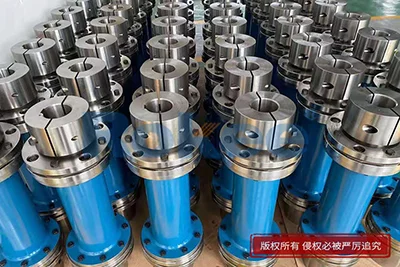
Flexible coupling fundamentally changes the rigid transmission mode of the traditional production line transmission system, relying on its unique structural design and flexible material characteristics to achieve multiple core functions such as efficient torque transmission, multi-dimensional misalignment compensation, vibration damping and shock absorption, and mechanical stress buffering, comprehensively improving the overall transmission stability of the PIR sandwich panel production line. Different from rigid connecting parts that only pursue fixed connection and single power transmission, flexible coupling is ingeniously designed with elastic flexible elements inside, which can effectively tolerate and compensate for angular misalignment, parallel misalignment and axial displacement between the driving shaft and driven shaft generated during the operation of the production line. When the production line is running normally or undergoing speed regulation and start-stop switching, the flexible elements inside the coupling can rely on their own elastic deformation to absorb and offset various minor position deviations and mechanical displacements, avoiding the generation of additional transmission stress and concentrated load caused by shaft misalignment. At the same time, the flexible structure of the coupling can effectively dampen the mechanical vibration generated by motor operation, gear meshing and equipment load fluctuation in the transmission process, isolate the vibration transmission between adjacent transmission units, prevent the vibration of a single processing unit from spreading to the entire production line, and ensure that each key processing equipment of the PIR sandwich panel production line can run smoothly at a constant speed without jitter and speed fluctuation. In the frequent start-stop and load switching stages of the production line, flexible coupling can also play an excellent shock absorption and buffer role, effectively absorbing the instantaneous impact torque generated during equipment start-up and load change, avoiding instantaneous impact damage to motors, gearboxes and other precision transmission equipment, making the power output and load bearing process more gentle and stable, and realizing seamless and smooth switching of the production line operating state.
The application of flexible coupling in each key transmission node of PIR sandwich panel production line has brought obvious optimization effects on transmission stability, and the improvement effect covers the whole process from raw material input to finished product output, effectively solving various unstable hidden dangers in traditional transmission operation. In the raw material unwinding and feeding link of the production line, stable and constant-speed conveying of steel coil and foam raw materials is the premise to ensure the uniform thickness and consistent raw material ratio of subsequent sandwich panels. The transmission system of the unwinding and feeding unit needs to maintain low-speed stable operation and frequent micro-speed adjustment according to the production process. In the past, rigid transmission connections often caused feeding jitter and intermittent conveying due to slight shaft misalignment, resulting in uneven raw material feeding amount and unstable conveying speed, which directly led to inconsistent thickness of PIR sandwich panel core materials and poor surface flatness. After adopting flexible coupling for transmission optimization, the misalignment and vibration problems of the feeding transmission shaft are effectively solved, the feeding conveying process maintains continuous and stable operation, the raw material conveying speed and feeding accuracy are significantly improved, and the foundation is laid for the consistent specifications of subsequent finished products. In the core foaming and composite pressing forming link of PIR sandwich panels, the synchronization accuracy and operating stability of the upper and lower pressing rollers and the conveying transmission system are directly related to the bonding quality and forming effect of the core foam material and the surface steel plate. This processing link requires extremely high synchronization of the front and rear transmission equipment, and any transmission speed difference or running vibration will lead to insufficient pressing pressure, uneven foaming density and degumming between layers of the sandwich panel. Flexible coupling effectively compensates for the thermal deformation and running misalignment of the pressing roller transmission shaft during high-temperature pressing operation, eliminates the speed fluctuation and vibration jitter of the pressing roller during operation, ensures the synchronous and stable operation of the composite pressing unit, makes the foaming reaction and composite bonding process proceed in a stable mechanical environment, and significantly improves the bonding firmness and internal structural uniformity of PIR sandwich panels.
In the fixed-length cutting and finished product conveying link of the production line, transmission stability directly determines the cutting dimensional accuracy and finished product stacking neatness of PIR sandwich panels, and also affects the subsequent packaging and transportation efficiency of products. The fixed-length cutting unit needs to achieve high-precision positioning and fixed-speed cutting operation, and the finished product conveying unit needs to maintain stable and continuous conveying to avoid finished product collision and position deviation. The rigid transmission structure is prone to transmission delay and vibration impact during high-speed operation and cutting instantaneous load change, resulting in inaccurate cutting size, irregular cutting section and offset conveying position of finished products. After applying flexible coupling, the transmission impact and vibration during cutting operation are effectively buffered and eliminated, the positioning accuracy and cutting stability of the cutting equipment are significantly improved, the dimensional error of finished sandwich panels is controlled within a reasonable range, and the finished product conveying process is smooth and orderly without jitter and offset. In addition, the long-term stable operation advantage of flexible coupling also reduces the mechanical wear and failure probability of the entire transmission system of the production line. Under the protection of flexible coupling, bearings, gearboxes, drive shafts and other vulnerable transmission components no longer bear excessive alternating stress and impact load, the service life of key equipment is greatly prolonged, the frequency of equipment maintenance and parts replacement is significantly reduced, the unplanned downtime caused by transmission system failure is effectively avoided, and the overall continuous operation rate and production capacity of the PIR sandwich panel production line are steadily improved.
In the long-term production and operation process of PIR sandwich panel production lines, the optimization value of flexible coupling for transmission stability is not only reflected in the improvement of equipment operating performance and production efficiency, but also in the continuous stabilization of product quality and the reduction of comprehensive production operating costs. The stable transmission environment created by flexible coupling enables all process parameters in the production process of PIR sandwich panels to be maintained within the optimal set range for a long time, avoiding product quality fluctuations caused by transmission instability, effectively reducing the defective product rate and rework rate in the production process, and improving the qualified rate and yield of finished products. For production enterprises, the reduction of defective products means the reduction of raw material waste and energy consumption, and the improvement of production line operation stability means the reduction of equipment maintenance costs and downtime losses, which brings tangible economic benefits while optimizing production quality. At the same time, with the continuous upgrading of the construction material industry's requirements for the quality and performance of PIR sandwich panels, the production process of sandwich panels is developing towards higher precision, higher efficiency and more continuous automation. The transmission system, as the basic guarantee for production process upgrading, needs to have higher stability and reliability. Flexible coupling, as a mature and efficient transmission optimization component, can well adapt to the future development trend of PIR sandwich panel production lines, meet the higher transmission stability requirements of automated and intelligent production lines, and provide reliable mechanical transmission support for the continuous upgrading and high-quality development of sandwich panel production technology.
In conclusion, flexible coupling plays an irreplaceable key role in optimizing the transmission stability of PIR sandwich panel production lines, effectively making up for the inherent defects of traditional rigid transmission structures, solving various transmission instability problems such as shaft misalignment, mechanical vibration, impact load and stress concentration in the operation of production lines. By realizing multi-dimensional misalignment compensation, efficient vibration damping and shock absorption, and stable power synchronous transmission, flexible coupling ensures the stable and coordinated operation of all key processing links of PIR sandwich panel production lines, significantly improves production continuity and product forming quality, reduces equipment maintenance pressure and comprehensive production costs. In the modern production and manufacturing of PIR sandwich panels that pursue high efficiency, high quality and low consumption, rational application and scientific configuration of flexible coupling in the transmission system of production lines has become an important technical means to improve the overall operation level of equipment, stabilize product quality and enhance the core production competitiveness of enterprises. With the continuous progress of mechanical transmission technology and the continuous improvement of sandwich panel production process standards, flexible coupling will continue to exert its unique transmission optimization advantages, escort the long-term stable and efficient operation of PIR sandwich panel production lines, and promote the high-quality and sustainable development of the entire thermal insulation building material manufacturing industry.




Links:
- Calibration Weight
- Digital Viscometer
- Carpas Industriales
- Exhibition Tent
- Industrial Cardan Shaft
- PU Sandwich Panel Machine
- PIR Sandwich Panel Line
- Sandwich Panel Machine
- Sandwich Panel Production Line
- PU Sandwich Panel Line
- Sandwich Panel Line
- Flexible Couplings Manufacturer In China
- Elastic Couplings Manufacturer In China