High-quality Flexible Coupling Helps The Upgrading Of PIR Sandwich Panel Production Line

The continuous advancement of modern construction industrialization and green building concepts has driven the rapid iterative upgrading of the entire supporting building material manufacturing industry, and PIR sandwich panels, as core thermal insulation and structural integrated materials for low-carbon buildings, cold storage engineering, industrial factory buildings and special enclosure structures, have seen surging market demand for high-precision, high-stability and long-service-life finished products in recent years. The core competitiveness of PIR sandwich panel products is not only reflected in the formula ratio of internal thermal insulation core materials and the surface treatment quality of metal panels, but also closely linked to the continuous and stable operation level of the entire automated production line. In the actual production and manufacturing process of PIR sandwich panels, the production line involves multiple sets of interconnected mechanical transmission equipment, including raw material unwinding equipment, core material foaming and compounding integrated devices, continuous rolling and shaping units, fixed-length cutting systems and finished product conveying and stacking equipment. All these functional modules rely on efficient and reliable power transmission between rotating shafts and mechanical components to maintain coordinated operation. Even subtle transmission deviation, vibration impact or instantaneous torque fluctuation in any link will directly affect the overall compounding uniformity of PIR core materials, the bonding firmness between core materials and metal panels, the dimensional accuracy of finished panel cutting and the surface flatness of products, and in severe cases, it will also cause frequent wear and damage of key production equipment components, lead to unplanned production line shutdowns, greatly reduce production efficiency, and increase comprehensive operation and maintenance costs for manufacturing enterprises. In the context of the current industry’s general trend of eliminating backward low-efficiency production capacity and promoting intelligent, high-efficiency and low-consumption production line upgrading and transformation, high-quality flexible couplings, as inconspicuous but core basic transmission components in mechanical systems, have become an indispensable key support for the performance optimization and overall upgrading of PIR sandwich panel production lines, undertaking the important mission of stabilizing transmission operation, reducing equipment loss, optimizing production rhythm and improving finished product quality consistency.
Different from simple single mechanical processing equipment, the PIR sandwich panel production line is a typical continuous automated assembly line production system with long transmission chains, multiple connecting equipment and complex operating working conditions. Each production link is closely linked and mutually restricted, and there is no independent intermittent operation space. Once the power transmission of any front-end or back-end equipment fails or operates abnormally, the entire production process will be forced to stop, resulting in material waste, production cycle delay and additional startup and debugging costs. In the traditional supporting configuration of early PIR sandwich panel production lines, most production line equipment adopted rigid connection structures for power transmission and shaft connection. Although rigid connection can achieve basic torque transmission in a short period of time under ideal installation and operating conditions, it has obvious inherent defects in long-term continuous industrial production and complex on-site working environments. During the long-term operation of the production line, affected by many factors such as equipment installation foundation settlement, mechanical component aging and wear, thermal deformation of equipment body caused by long-time high-load operation, and slight position deviation caused by daily production vibration, various misalignment problems will inevitably occur between the connecting shafts of different transmission equipment, including radial displacement, axial displacement and angular deviation. Rigid connection structures cannot compensate for these natural and unavoidable misalignment deviations at all. All deviation stress, vibration impact and torque fluctuation will be directly concentrated on the connecting shafts, bearings and key transmission parts of the equipment itself, resulting in intensified friction and wear of mechanical parts, increased equipment operating load, and continuous expansion of transmission errors. These negative impacts will be directly transmitted to the PIR sandwich panel forming and compounding process link, leading to unstable feeding speed of metal panels and PIR foaming raw materials, uneven foaming density of the core material, inconsistent bonding thickness between the core material and the surface panel, and dimensional errors of finished products beyond the standard range. In the long run, production enterprises not only have to bear the high cost of frequent replacement of worn mechanical parts and regular maintenance and debugging of equipment, but also face the problems of unstable product quality, low qualified rate of finished products and weak market competitiveness, which seriously restrict the standardized production scale expansion and high-quality development of enterprises.
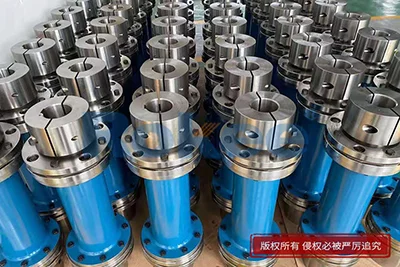
High-quality flexible couplings fundamentally solve various pain points existing in the rigid transmission connection of traditional PIR sandwich panel production line by virtue of their unique structural design and excellent mechanical comprehensive performance. As a professional mechanical connecting component specially used for connecting two rotating shafts and transmitting torque and rotational power in mechanical transmission systems, flexible couplings are different from rigid connecting parts in core functional attributes. They not only maintain efficient and stable continuous transmission of torque and power during the operation of the production line, but also have excellent displacement compensation capability, which can effectively accommodate and automatically compensate for radial, axial and angular misalignment deviations between connecting shafts caused by equipment installation errors, foundation changes, thermal deformation and long-term operation wear and tear. This core compensation function avoids the rigid extrusion and concentrated stress between transmission shafts and mechanical components caused by misalignment, disperses the mechanical load generated during equipment operation, and greatly reduces the friction loss and mechanical fatigue wear of key parts such as bearings and shafts of production line equipment. At the same time, high-quality flexible couplings also have outstanding vibration damping and shock absorption effects. The continuous operation of PIR sandwich panel production line will inevitably generate mechanical vibration and instantaneous impact load during equipment startup, shutdown and switching of production operating conditions. These vibrations and impact forces are easy to propagate along the rigid transmission chain, affecting the stable operation of the entire production line and the precision of the product forming process. Flexible couplings can effectively absorb and buffer these vibration energies and instantaneous impact forces through their own elastic structural characteristics, block the transmission of vibration between front and rear connected equipment, keep the operating state of each production equipment module stable and consistent, and create a stable and reliable mechanical operation environment for the precise compounding, foaming and forming of PIR sandwich panels.
The application value of high-quality flexible couplings in the upgrading of PIR sandwich panel production lines runs through the whole process from raw material input, intermediate processing and compounding to finished product cutting and output, and plays a positive role in optimizing every key production link of the production line. In the raw material unwinding and preliminary conveying stage of the production line, metal color steel coils and PIR foaming raw materials need to be transported stably and quantitatively by special conveying and unwinding equipment. The stable operation of this link directly determines the uniformity of subsequent raw material distribution and the continuity of feeding. The application of flexible couplings ensures that the power transmission of unwinding and conveying equipment is stable and uniform, avoids the phenomenon of uneven feeding speed and intermittent material supply caused by transmission jitter and shaft misalignment, ensures that the feeding amount of metal panels and foaming raw materials always maintains a stable and consistent state, and lays a solid foundation for the uniform foaming and tight bonding of subsequent PIR core materials. In the core foaming and composite bonding forming stage, which is the most critical core process link of PIR sandwich panel production, the production line equipment needs to maintain a constant operating speed and stable pressure state. Any slight transmission speed fluctuation and mechanical vibration will lead to uneven mixing of PIR foaming materials, inconsistent foaming reaction speed, unstable core material density, and weak bonding between the core material and the metal panel, resulting in easy degumming and deformation of finished panels in later use. High-quality flexible couplings stabilize the power transmission of foaming and composite equipment, eliminate speed fluctuation and vibration interference in the transmission process, ensure that the composite pressure and operating speed during panel forming are always maintained within the optimal process range, make the foaming reaction of PIR core materials more sufficient and uniform, the bonding interface between the core material and the surface panel tighter and firmer, and effectively improve the structural stability and durability of finished sandwich panels.
In the subsequent rolling shaping and fixed-length cutting links of the production line, the dimensional accuracy and shape flatness of PIR sandwich panels are the core indicators of product quality inspection. The rolling equipment needs to perform continuous and uniform rolling shaping on the initially compounded sandwich panels to ensure the consistent thickness and flatness of the panels, while the cutting equipment needs to complete fixed-length precise cutting according to the production setting standards to ensure that the dimensional error of each batch of finished panels is controlled within a reasonable range. The stable operation of rolling and cutting equipment depends entirely on the precise coordination and synchronous operation of the transmission system. The flexible coupling effectively solves the problem of asynchronous operation of equipment caused by transmission misalignment and vibration, ensures that the rolling speed and cutting propulsion speed are accurate and stable, avoids panel surface wrinkles, uneven thickness and cutting size deviation caused by transmission jitter, makes the appearance quality and dimensional accuracy of finished PIR sandwich panels fully meet the high-standard market demand, and greatly improves the qualified rate of finished products and product consistency. In the final finished product conveying and stacking link, flexible couplings ensure the stable operation of conveying and stacking equipment, avoid panel collision, scratch and stacking disorder caused by equipment operation jitter, protect the appearance integrity of finished products, and improve the overall neatness and packaging efficiency of finished product storage and transportation.
In addition to directly improving product quality and production stability, the application of high-quality flexible couplings in the upgrading of PIR sandwich panel production lines also brings significant comprehensive benefits in reducing equipment operation and maintenance costs and extending the service life of production line equipment. Traditional rigid transmission connection will cause long-term concentrated wear of bearings, shafts and other key parts of the production line equipment, resulting in frequent equipment failures, regular replacement of parts and long-term shutdown maintenance, which not only increases the direct procurement cost of mechanical accessories for production enterprises, but also causes huge indirect economic losses such as production interruption and order delay. After adopting high-quality flexible couplings, the displacement compensation and vibration damping functions effectively reduce the mechanical stress and wear of key transmission components of the equipment, greatly reduce the failure rate of production line mechanical equipment, extend the maintenance cycle of equipment and the overall service life of the production line. Enterprises do not need to invest a lot of manpower and material resources in frequent equipment maintenance and parts replacement, and the downtime loss caused by equipment failure is greatly reduced. At the same time, the installation and later maintenance of high-quality flexible couplings are more convenient and efficient, without complex installation procedures and frequent calibration and debugging work. The overall operation and maintenance difficulty of the production line is reduced, the management efficiency of production equipment is improved, and the comprehensive operating cost of the production line is effectively optimized and controlled.
With the continuous deepening of the transformation and upgrading of the building material manufacturing industry, the PIR sandwich panel manufacturing industry is gradually moving towards high-precision production, intelligent management and green low-carbon operation. The market has higher and higher requirements for the quality stability, production efficiency and environmental protection and energy-saving level of PIR sandwich panel products, and the traditional extensive production mode and backward production line supporting configuration can no longer meet the current industry development and market competition needs. The upgrading and transformation of PIR sandwich panel production line is not only the replacement and iteration of large-scale main equipment, but also the systematic optimization and upgrading of various basic supporting transmission components. As the core basic component to ensure the stable and efficient operation of the production line transmission system, high-quality flexible coupling has become an important starting point for the systematic upgrading of PIR sandwich panel production line. It not only solves many inherent problems in the operation of traditional production lines from the source, stabilizes the production process, improves product quality and production efficiency, but also reduces the comprehensive operation cost of enterprises, enhances the overall operation reliability and market anti-risk ability of the production line.
In the future, as the production automation and intelligence level of the PIR sandwich panel industry continues to improve, the operating speed and production precision requirements of the production line will be further improved, and the operating working conditions of the transmission system will be more stringent. The role of high-quality flexible couplings in the production and manufacturing system of PIR sandwich panels will become more prominent. Manufacturing enterprises should pay more attention to the matching application and performance optimization of basic transmission components in the process of production line upgrading, take high-quality flexible couplings as an important part of production line performance upgrading, give full play to its advantages of displacement compensation, vibration damping and stable transmission, continuously optimize the operation state of the production line, promote the overall production level of PIR sandwich panels to be continuously improved, produce higher-quality and more stable green building thermal insulation materials for the market, and help the entire building material manufacturing industry achieve high-quality and sustainable development in the wave of industrial upgrading and green transformation.


Links:
- Calibration Weight
- Digital Viscometer
- Carpas Industriales
- Exhibition Tent
- Industrial Cardan Shaft
- PU Sandwich Panel Machine
- PIR Sandwich Panel Line
- Sandwich Panel Machine
- Sandwich Panel Production Line
- PU Sandwich Panel Line
- Sandwich Panel Line
- Flexible Couplings Manufacturer In China
- Elastic Couplings Manufacturer In China