Stainless Steel Diaphragm Coupling

Stainless steel diaphragm coupling stands as a core flexible transmission component widely adopted in modern industrial mechanical systems, serving the critical function of connecting two rotating shafts to transmit rotational torque while compensating for various installation and operational deviations between shaft ends. Unlike traditional rigid couplings that lack adaptive flexibility and elastic couplings relying on non-metallic flexible elements, this all-metal transmission structure leverages the controllable elastic deformation characteristics of precision-processed stainless steel diaphragms to achieve efficient, stable and durable power transmission, making it highly adaptable to high-speed, high-precision, high-stability and harsh-environment working scenarios. Its unique structural design and material properties enable it to overcome multiple inherent defects of conventional coupling products, including elastomer aging, friction component wear, regular lubrication dependence and excessive transmission vibration, thus becoming an indispensable key component in medium and high-end mechanical transmission fields.
The basic working mechanism of stainless steel diaphragm coupling centers on the elastic deformation of stainless steel diaphragm groups, with the entire torque transmission and displacement compensation process completed purely through metal elastic changes without any sliding friction parts or vulnerable non-metallic accessories. In actual operation, the rotational torque output by the driving equipment is first transferred from the driving shaft to the coupling hub, then evenly transmitted to the multi-layer stainless steel diaphragm group through circumferentially distributed high-strength fasteners. The thin and tough diaphragm structure undergoes micro elastic deformation under torque load, realizing continuous and stable torque transmission to the intermediate sleeve or driven hub, and finally completing power output to the driven shaft. During this process, any misalignment generated by installation errors, equipment operation vibration, thermal expansion and mechanical wear will be automatically absorbed and compensated by the elastic deformation of the diaphragm group, including angular deviation, axial displacement and parallel radial offset between the two shafts. This passive adaptive compensation mechanism effectively avoids additional mechanical stress and reaction load on the shaft system, bearings and equipment body caused by shaft misalignment, ensuring the smooth and efficient operation of the entire transmission system.
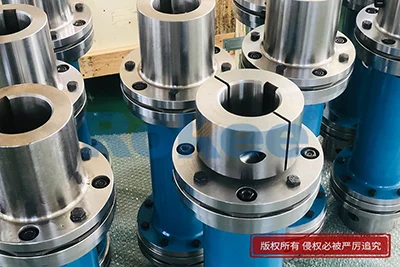
The structural composition of stainless steel diaphragm coupling is precise and compact, mainly consisting of stainless steel diaphragm groups, metal hubs, connecting sleeves and high-strength fastening components, with all core functional parts made of high-quality stainless steel materials to ensure overall structural consistency and performance stability. The diaphragm group, as the core flexible and load-bearing component, is composed of multiple superposed thin stainless steel diaphragms processed with precision cutting and grinding technology. The laminated diaphragm structure can disperse stress concentration effectively, balance internal stress during deformation, and improve the overall fatigue resistance and deformation uniformity compared with a single thick diaphragm. The metal hubs and intermediate sleeves adopt integrated forging and precision machining processes, with high structural rigidity and dimensional accuracy, which can ensure accurate positioning and stable connection with the shaft ends, avoiding rotational clearance and transmission lag in the power transmission process. All fastening parts are matched with high-precision hardware components with excellent tensile strength and fatigue resistance, which can maintain stable clamping force under long-term high-speed rotation and alternating load conditions, preventing loose connection and transmission failure caused by mechanical vibration.
The excellent comprehensive performance of stainless steel diaphragm coupling stems from the superior physical and chemical properties of stainless steel materials and optimized structural design, endowing it with irreplaceable advantages in industrial transmission scenarios. First of all, it achieves zero-clearance torque transmission and ultra-high transmission efficiency. The all-metal rigid matching structure eliminates the elastic lag and clearance play common in rubber and plastic flexible couplings, realizing synchronous and accurate speed and torque transmission with extremely low power loss. This high-precision transmission feature makes it fully applicable to precision mechanical systems that require strict speed control and motion accuracy, ensuring the consistency and repeatability of equipment operation.
Secondly, the product has outstanding environmental adaptability and corrosion resistance. Stainless steel materials possess excellent resistance to oxidation, acid and alkali corrosion, and oil medium erosion, enabling the coupling to operate stably in various harsh working environments including humid, dusty, chemically corrosive and high-cleanliness scenarios. It can maintain stable working performance in a wide temperature range, avoiding performance degradation, aging failure or structural deformation caused by extreme temperature changes, which is far superior to non-metallic flexible couplings that are prone to aging, hardening and cracking under high temperature, low temperature or long-term environmental erosion.
In terms of operational stability and vibration reduction, stainless steel diaphragm coupling shows remarkable advantages. The metal diaphragm group can absorb and weaken the vibration and impact generated during equipment operation through micro elastic deformation, effectively reducing the vibration amplitude of the shaft system and lowering operating noise. The flexible deformation of the diaphragm can buffer instantaneous impact load and alternating torque, disperse peak stress of the transmission system, and reduce the dynamic load on equipment bearings and support structures, thereby significantly reducing equipment operation noise and improving the overall stability of the mechanical system. Different from gear couplings that produce meshing friction noise and severe wear during operation, the diaphragm coupling has no relative sliding friction between internal parts during operation, realizing wear-free operation and low-noise transmission throughout the whole service cycle.
Maintenance-free operation is another prominent core advantage of stainless steel diaphragm coupling. Benefiting from its all-metal wear-free transmission structure, the product does not require lubricating oil, grease or any lubrication medium during long-term operation, completely eliminating the maintenance work of regular oil injection, oil change and lubrication system inspection required by traditional mechanical couplings. This maintenance-free feature not only greatly reduces daily operation and maintenance costs and labor investment, but also avoids equipment pollution and environmental contamination caused by lubricant leakage, making it particularly suitable for industries with ultra-high cleanliness requirements such as food processing, pharmaceutical manufacturing and precision electronic production. Meanwhile, the absence of vulnerable wearing parts greatly reduces the probability of sudden equipment failure, improves the continuous operation capacity of mechanical equipment, and is very suitable for automated production lines and long-term uninterrupted operating units.
In terms of misalignment compensation capability, stainless steel diaphragm coupling has excellent comprehensive adaptive performance. It can efficiently compensate for angular, axial and radial composite misalignment generated in equipment installation and operation, with larger allowable deformation range and smaller additional reaction force than traditional coupling products. When compensating for shaft offset, the elastic deformation of the diaphragm is uniform and controllable, and the additional stress generated on the shaft system is extremely low, which will not cause bending deformation or accelerated wear of the shaft and bearings. This efficient and low-load compensation effect can well adapt to the shaft position deviation caused by equipment foundation settlement, thermal expansion and cold contraction of mechanical parts, and long-term operational fatigue deformation, ensuring the long-term stable operation of the transmission system.
The fatigue resistance and service life of stainless steel diaphragm coupling are also far better than most traditional coupling products. Stainless steel materials have excellent mechanical fatigue resistance and structural stability, and the laminated diaphragm structure optimized by stress design can withstand millions of times of alternating torque and cyclic deformation without fatigue cracking or structural failure. Under standard working conditions, its service cycle is several times that of elastic couplings and gear couplings, effectively reducing the frequency of equipment shutdown maintenance and part replacement, improving the overall operation efficiency of industrial production, and reducing the comprehensive operating cost of mechanical equipment.
Relying on the above comprehensive performance advantages, stainless steel diaphragm coupling has been widely applied in numerous high-end industrial fields and precision mechanical equipment. In the field of power machinery, it is commonly used in high-speed rotating equipment such as turbines, fans and compressors, adapting to high-speed and high-stability power transmission requirements and ensuring the safe and efficient operation of large power equipment. In precision manufacturing industry, it is applied to precision machine tools, servo transmission systems and automated processing equipment, providing accurate torque and speed transmission guarantee for precision processing and intelligent production, and effectively improving the processing accuracy and product qualification rate of mechanical equipment.
In the chemical, petroleum and new energy industries, where working conditions are harsh and corrosion resistance is highly required, stainless steel diaphragm coupling relies on its excellent corrosion resistance and environmental adaptability to operate stably in corrosive medium environments, solving the problem of easy failure of ordinary couplings in harsh chemical working conditions. In the food, pharmaceutical and biological engineering industries with high cleanliness standards, its maintenance-free and pollution-free operation characteristics fully meet the industry's clean production requirements, avoiding product contamination risks caused by lubricant leakage and part wear debris. In addition, it also plays an important role in environmental protection equipment, transportation machinery and precision testing instruments, providing reliable transmission support for various high-precision and high-stability mechanical systems.
In the actual selection and application process, the performance of stainless steel diaphragm coupling is closely related to structural parameters such as diaphragm thickness, lamination quantity and outer diameter size. Different structural configurations can adapt to different torque bearing ranges and rotation speed levels. Diaphragm groups with more lamination layers and optimized thickness design have stronger deformation compensation ability and better vibration damping effect, while maintaining high torsional rigidity to ensure no distortion and lag in high-precision transmission. Reasonable structural parameter matching can make the coupling achieve the best balance between load-bearing capacity, misalignment compensation performance and dynamic stability, so as to meet the differentiated working condition requirements of different mechanical equipment.
In terms of installation and use, stainless steel diaphragm coupling has strong operability and tolerance. Although it belongs to high-precision transmission parts, its excellent misalignment compensation performance reduces the precision requirement for installation accuracy appropriately. During equipment assembly, it can tolerate reasonable installation deviation within the allowable range, and automatically correct and compensate for minor shaft misalignment through its own elastic deformation, greatly reducing the difficulty and time cost of equipment installation and debugging. After installation and commissioning, the coupling can operate stably for a long time without frequent parameter inspection and adjustment, which is very suitable for large-scale industrial production and unattended automatic equipment operation scenarios.
With the continuous upgrading of modern industrial manufacturing technology and the continuous improvement of mechanical equipment's requirements for transmission accuracy, stability and reliability, stainless steel diaphragm coupling is playing an increasingly important role in the industrial transmission field. Its all-metal wear-free structure, high-precision transmission performance, excellent environmental adaptability and zero-maintenance operation characteristics perfectly fit the development trend of modern industrial equipment towards high efficiency, precision, intelligence and low energy consumption. Compared with traditional coupling products, it can effectively improve the operation stability and service life of mechanical transmission systems, reduce equipment failure rate and comprehensive operation and maintenance costs, and create higher economic benefits for industrial production.
In conclusion, stainless steel diaphragm coupling, as a high-performance flexible transmission component, integrates the advantages of high precision, high stability, corrosion resistance, fatigue resistance and maintenance-free operation. Its unique working principle and structural design make it break through the performance bottlenecks of traditional coupling products, and it can adapt to complex and diverse industrial working conditions and high-precision transmission scenarios. With the continuous progress of material technology and structural optimization design, the comprehensive performance of stainless steel diaphragm coupling will be further improved, and its application scope in high-end equipment manufacturing and modern industrial fields will be continuously expanded, becoming an indispensable basic component to support the stable and efficient operation of modern mechanical systems.



Links:
- Calibration Weight
- Digital Viscometer
- Carpas Industriales
- Exhibition Tent
- Industrial Cardan Shaft
- PU Sandwich Panel Machine
- PIR Sandwich Panel Line
- Sandwich Panel Machine
- Sandwich Panel Production Line
- PU Sandwich Panel Line
- Sandwich Panel Line
- Flexible Couplings Manufacturer In China
- Elastic Couplings Manufacturer In China