Flexible Chain Coupling
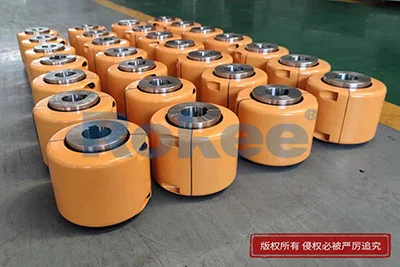
In the complex operating logic of modern mechanical transmission systems, the connection components between rotating shafts undertake the core task of power transmission, and their structural rationality and operational stability directly determine the overall operating efficiency and service life of mechanical equipment. As a vital type of flexible transmission component, flexible chain coupling has gradually become an indispensable key part in medium and low-speed heavy-duty transmission scenarios by virtue of its unique hinged chain structure, excellent displacement compensation capability and simple assembly logic. Different from rigid coupling that relies on rigid overall structure for force transmission and elastic coupling that depends on elastic deformation of non-metallic components to buffer vibration, flexible chain coupling realizes flexible power transmission through the meshing cooperation between chain and sprocket components, and balances the dual demands of structural rigidity and motion flexibility in the working process. This paper conducts an in-depth exploration on the structural composition, internal working mechanism, core performance advantages, application adaptation conditions, wear failure causes and optimization improvement directions of flexible chain coupling, and comprehensively analyzes its application value and development potential in modern industrial mechanical systems.
The basic structural composition of flexible chain coupling follows the minimalist mechanical design concept, and the overall structure is compact with fewer matching parts, which lays a solid foundation for its convenient installation and stable operation. The main body of the coupling is composed of two symmetrical sprocket hubs and an annular flexible chain. The sprocket hubs distributed on both sides have integrated tooth-shaped structures on the outer circumference, and the tooth profile parameters are precisely matched with the internal pitch and structural size of the chain to ensure seamless meshing during operation. The chain is mostly designed with double-row roller structure, and each chain section forms an independent hinged unit through the cooperation of pin shaft, sleeve and roller. This hinged connection mode enables each chain section to produce a small range of angular deflection during movement, which endows the coupling with basic flexible motion characteristics. In order to adapt to different installation space and load conditions, the outer side of the coupling can be equipped with a protective cover made of metal or high-strength polymer materials. The protective cover can effectively isolate external dust, moisture and corrosive media, and maintain a stable lubrication environment inside the coupling. There is no complex fastening structure or precision elastic auxiliary parts inside the whole coupling, and the modular component design makes the disassembly and replacement process more convenient. It is not necessary to carry out large-scale displacement adjustment on the connected driving shaft and driven shaft during daily assembly and maintenance, which effectively reduces the technical threshold and time cost of equipment maintenance.
The internal working mechanism of flexible chain coupling is based on the mechanical meshing transmission principle and hinged flexible deformation characteristics. When the mechanical equipment is started, the driving shaft drives one side of the sprocket hub to rotate synchronously, and the sprocket teeth apply tangential driving force to the chain rollers in the meshing area. The force is transmitted to the other side of the sprocket hub through the continuous circulation of the chain, so as to realize the synchronous rotation of the driven shaft and complete the efficient transmission of torque and rotational speed. In the ideal installation state where the two connected shafts are completely coaxial, the chain runs smoothly along the sprocket tooth trajectory, and the stress distribution of each chain section is uniform without additional shear and torsional load. However, in actual industrial production scenarios, limited by processing errors of mechanical parts, installation deviation of equipment, foundation settlement and thermal deformation of components during operation, the coaxiality of the driving shaft and the driven shaft is difficult to maintain in an absolute ideal state, and different degrees of axial displacement, radial deviation and angular deflection will inevitably occur. At this time, the hinged structure between the chain sections of the flexible chain coupling can play a flexible adjustment role. The mutual rotation between the pin shaft and the sleeve allows the chain to produce adaptive bending and offset deformation within a certain range, which automatically compensates for the installation deviation and operation displacement between the two shafts. This passive compensation mechanism avoids the generation of additional alternating stress between the shafts and the coupling, and fundamentally reduces the vibration and friction loss caused by shaft misalignment.
Compared with other common coupling types in the mechanical transmission field, flexible chain coupling has distinctive comprehensive performance advantages in structural design and operational characteristics. In terms of displacement compensation capability, it can tolerate a certain range of radial offset and angular deflection between shafts, and the compensation limit is significantly higher than that of ordinary rigid flange coupling and sleeve coupling. Although the compensation accuracy is slightly lower than that of high-precision diaphragm coupling, it has obvious advantages in heavy-load working conditions and harsh industrial environments. In terms of load adaptability, the internal metal chain structure has excellent mechanical strength and rigidity, which can bear continuous heavy torque and intermittent impact load. The local contact extrusion between the chain rollers and the sprocket teeth can disperse the instantaneous impact force generated by equipment start-up and load fluctuation, avoiding the instantaneous stress concentration inside the transmission component. In terms of transmission efficiency, the meshing friction between the metal chain and the sprocket belongs to rolling friction in essence, and the friction coefficient is low under good lubrication conditions. The power loss during the transmission process is far lower than that of the friction type flexible coupling with non-metallic elastic components, and the effective transmission efficiency can remain at a high level for a long time. In addition, the overall weight of the flexible chain coupling is light, the space occupation is small, and it has good compatibility with various types of transmission shafts. It can be applied to horizontal installation, vertical installation and inclined installation without additional structural transformation, which greatly expands its application scope.
The material selection and surface treatment process of each component of flexible chain coupling are key factors affecting its service life and operational stability. The chain plate and pin shaft of the chain are usually made of high-quality carbon structural steel or low-alloy structural steel. After overall quenching and tempering heat treatment, the internal metallographic structure of the material is optimized, which not only ensures high tensile strength and fatigue resistance, but also avoids brittle fracture under impact load. The outer surface of the chain roller and the inner wall of the sleeve are processed by carburizing and quenching. The high-hardness surface layer can resist abrasive wear caused by friction and particle impact, while the tough core structure can buffer the alternating shear force during meshing transmission. The sprocket hub is mostly made of alloy steel with good hardenability. After precision turning and tooth surface finishing, the tooth surface roughness is controlled at a low level to reduce meshing friction resistance. In order to improve the environmental adaptability of the coupling, the metal surface is usually treated with anti-oxidation and anti-corrosion processes such as blackening and galvanizing. These treatment measures can form a dense protective film on the metal surface, effectively isolating humid air, industrial wastewater and corrosive gas, and reducing the oxidation corrosion rate of components in harsh working environments. The reasonable material matching and processing technology make the flexible chain coupling maintain stable mechanical properties in a wide temperature range, and will not have obvious performance attenuation due to ambient temperature changes.
In actual industrial operation, the operating state of flexible chain coupling is affected by multiple environmental and mechanical factors, and different working conditions will produce differentiated effects on its performance. In terms of rotational speed adaptation, flexible chain coupling is more suitable for medium and low-speed transmission systems. When operating at an excessively high rotational speed, the chain will generate large centrifugal force in the circulating movement, which increases the meshing clearance between the chain and the sprocket, causes unstable vibration and noise, and accelerates the wear of the tooth surface and the chain hinge. In terms of load characteristics, it performs excellently in constant load and intermittent impact load scenarios. The metal chain structure can resist long-term heavy load torsion, and the flexible hinge can absorb part of the impact energy, avoiding rigid damage to internal components. In harsh working environments such as mine processing and building materials production, there are a large number of hard dust particles in the air. The closed protective cover structure of the coupling can prevent dust from entering the meshing gap, and the high-hardness metal components can resist abrasive wear of particles, showing stronger environmental adaptability than rubber elastic coupling. In humid and watery working conditions such as water conservancy machinery and marine auxiliary equipment, the anti-corrosion treatment on the metal surface can delay the rusting process of components and ensure the continuity of transmission work. However, it should be noted that flexible chain coupling is not suitable for high-precision transmission scenarios requiring strict coaxiality and low vibration, and it is difficult to meet the ultra-high stability requirements of precision instruments and high-speed servo equipment.
Wear and fatigue damage are the main failure forms of flexible chain coupling in the service cycle, and the causes of damage can be summarized into three dimensions: mechanical friction, environmental corrosion and improper operation. The most common wear part is the meshing contact area between the chain roller and the sprocket tooth surface. Long-term rolling friction will cause gradual wear on the tooth profile and the roller surface, resulting in increased meshing clearance, unstable transmission operation and obvious vibration and noise. The hinge gap between the pin shaft and the sleeve inside the chain is also a vulnerable wear area. The reciprocating rotation friction between metal components will cause uniform wear of the contact surface, which increases the flexibility of the chain and leads to loose overall structure. In terms of corrosion damage, when the coupling works in a humid and corrosive medium for a long time, the unprotected metal gap is easy to accumulate moisture and corrosive substances, resulting in electrochemical corrosion on the metal surface, forming rust pits and oxide layers, reducing the mechanical strength of components. Improper operation and maintenance are important human-induced damage factors. Insufficient lubrication will directly increase the friction coefficient between metal contact surfaces, accelerate abrasive wear; excessive installation deviation will make the chain bear unbalanced lateral force for a long time, causing local stress concentration and chain plate fatigue fracture; irregular start and stop actions will generate instantaneous peak torque, which will cause impact damage to the meshing structure and shorten the service life.
Lubrication maintenance is an essential link to maintain the stable performance of flexible chain coupling and extend its service life. A reasonable lubrication system can form a continuous oil film between the friction pairs such as chain hinge and meshing tooth surface. The oil film can isolate direct contact between metal surfaces, reduce friction resistance and wear loss, and at the same time take away the friction heat generated during high-intensity operation to avoid thermal deformation of components caused by local high temperature. For couplings working at medium and low rotational speeds with stable load, regular grease filling can meet the lubrication demand. The high-viscosity grease can adhere to the metal surface for a long time to form a stable protective oil layer. For transmission equipment with continuous operation and heavy load, circulating thin oil lubrication is more suitable. The flowing lubricating oil has better heat dissipation performance, which can efficiently export the accumulated heat inside the coupling and keep the working temperature within a reasonable range. In the daily maintenance process, it is necessary to regularly check the tightness of the protective cover and the sealing performance of the gap to prevent lubricating oil leakage and external impurities from entering. It is also necessary to regularly clean the dust and oxide deposits on the coupling surface, observe the wear degree of the chain and sprocket teeth, and replace the severely worn components in a timely manner. Scientific maintenance measures can make the comprehensive service life of flexible chain coupling reach several times that of unmaintained products.
With the continuous upgrading of modern industrial manufacturing technology, the optimization design of flexible chain coupling is gradually developing towards lightweight, high wear resistance and intelligent adaptation. In terms of structural optimization, through finite element simulation technology, the stress distribution of the coupling under different load states is analyzed, the redundant structural size of the sprocket hub is reduced on the premise of ensuring mechanical strength, and the lightweight design is realized to reduce the centrifugal inertia during operation. The chain hinge structure is optimized by improving the contact curvature of the pin shaft and the sleeve, reducing the local stress concentration at the hinge gap, and improving the fatigue resistance of the chain. In terms of material upgrading, new alloy materials with higher hardness and toughness are applied to key friction components. By adjusting the proportion of alloy elements, the wear resistance and corrosion resistance of the material are further improved, adapting to more extreme industrial environments. In terms of surface processing technology, vacuum ion plating and laser strengthening treatment are used to replace traditional anti-corrosion processes. The high-density strengthening layer formed on the metal surface has stronger wear resistance and oxidation resistance. At the same time, combined with the sealing structure optimization of the protective cover, a fully closed dust-proof and oil-proof working space is built for the coupling, which further reduces the external interference to the operating state.
Flexible chain coupling has a wide range of mature application cases in multiple industrial fields, showing excellent engineering application value. In mineral processing and mining machinery, it is applied to transmission systems such as crushers and material elevators. These equipments often work in dusty and vibrating environments with unstable load changes. The flexible chain coupling can tolerate installation deviation caused by foundation vibration and equipment settlement, and buffer the impact vibration generated by material crushing, ensuring the continuous and stable operation of the transmission system. In building materials and chemical industry production, it is used for the transmission connection of mixing equipment and conveyor machinery. The internal corrosive raw materials and dust pollutants in the production workshop have low damage to the high-strength metal structure of the coupling, and the simple disassembly structure is convenient for daily cleaning and maintenance of the equipment. In agricultural machinery and transportation equipment, the coupling is applied to agricultural processing machinery and short-distance conveying equipment. Its low manufacturing difficulty and convenient replacement characteristics reduce the overall use cost of mechanical equipment, and the strong environmental adaptability can cope with complex outdoor working conditions such as mud and dust. In addition, in the auxiliary transmission system of water conservancy and power equipment, the flexible chain coupling relies on its stable torque transmission capability to complete the power connection of medium and low-speed rotating equipment, providing reliable basic guarantee for the normal operation of the system.
In the comparative analysis with other mainstream coupling products, the application positioning of flexible chain coupling in the mechanical transmission system can be clearly defined. Elastic couplings represented by pin couplings rely on non-metallic elastic components to realize vibration damping and deviation compensation, but their elastic components are easy to aging and damage under high temperature and heavy load conditions, with short service life and poor environmental adaptability. Diaphragm couplings and gear couplings belong to high-precision flexible couplings, which have excellent coaxiality maintenance capability and high transmission efficiency, but their complex processing technology leads to high manufacturing difficulty, and they are not suitable for low-precision heavy-duty working conditions with serious environmental pollution. Rigid couplings have high transmission rigidity and low energy loss, but they cannot compensate for installation deviation, and the internal stress generated by shaft misalignment is easy to cause fatigue damage of equipment. In contrast, flexible chain coupling balances the advantages of simple structure, low maintenance cost, certain vibration damping capability and strong environmental adaptability. Although it has deficiencies in high-speed and high-precision transmission scenarios, it has irreplaceable competitive advantages in medium and low-speed heavy-load, dusty and corrosive harsh working conditions.
In the context of the continuous development of intelligent manufacturing and industrial automation, the market demand for flexible chain coupling is still steadily rising, and its future development direction is more clear. On the one hand, with the popularization of intelligent monitoring technology, sensors will be embedded in the coupling structure to collect real-time data such as operating vibration, temperature and torque. The operating state of the coupling is judged through data analysis, so as to realize early warning of wear failure and scientific maintenance scheduling, and reduce the unexpected shutdown loss of equipment. On the other hand, aiming at the performance defects of traditional chain couplings in high-speed operation, the structural dynamic balance optimization will be carried out. By improving the chain motion trajectory and reducing centrifugal vibration, the applicable speed range of the coupling will be expanded, and the application boundary in the industrial field will be broadened. In addition, in line with the development trend of green manufacturing, the coupling will adopt low-energy-consumption friction materials and degradable lubricants to reduce energy loss and environmental pollution during operation, and realize the coordinated development of mechanical performance and environmental protection performance.
To sum up, flexible chain coupling, as a typical mechanical flexible transmission component, realizes efficient torque transmission and adaptive deviation compensation through simple and reliable chain-sprocket meshing structure. Its unique structural characteristics endow it with excellent load resistance, environmental adaptability and convenient maintenance performance, which can well meet the transmission demands of medium and low-speed heavy-duty mechanical equipment in complex industrial environments. This paper systematically sorts out its structural composition, working mechanism, performance advantages, failure causes and application scenarios, and clarifies the application advantages and development limitations of flexible chain coupling in different working conditions. With the continuous progress of material processing technology and structural optimization design, the comprehensive performance of flexible chain coupling will be further improved, and its application scope in the industrial field will be more extensive. In the future industrial mechanical transmission system, flexible chain coupling will continue to rely on its cost-effective advantages and stable working performance to become an important basic component supporting the safe and efficient operation of various mechanical equipment, and make continuous contributions to the stable development of modern manufacturing industry.


Links:
- Calibration Weight
- Digital Viscometer
- Carpas Industriales
- Exhibition Tent
- Industrial Cardan Shaft
- PU Sandwich Panel Machine
- PIR Sandwich Panel Line
- Sandwich Panel Machine
- Sandwich Panel Production Line
- PU Sandwich Panel Line
- Sandwich Panel Line
- Flexible Couplings Manufacturer In China
- Elastic Couplings Manufacturer In China