PU Sandwich Panel Production Line Adapts Flexible Coupling To Improve Efficiency

In the modern industrial production landscape, the demand for PU sandwich panels continues to grow steadily due to their excellent thermal insulation, sound absorption, lightweight structure, and high mechanical strength, making them indispensable in fields such as building construction, cold chain logistics, clean room manufacturing, and industrial facility renovation. As the market demand expands and production standards become more stringent, manufacturers are constantly seeking ways to optimize production processes, improve operational efficiency, and reduce operational costs while ensuring product quality consistency. Among the various technical improvements, the adaptation of flexible couplings in PU sandwich panel production lines has emerged as a key measure to enhance overall operational efficiency, addressing long-standing challenges such as equipment wear, operational instability, and production bottlenecks that have plagued traditional production lines.
Before delving into the application of flexible couplings, it is necessary to understand the basic working principle and operational characteristics of a PU sandwich panel production line. A complete PU sandwich panel production line is a complex integrated system that integrates material processing, mixing, foaming, forming, curing, cutting, and stacking processes, relying on the coordinated operation of multiple mechanical components to achieve continuous and automated production. The core process involves feeding surface materials (such as color steel plates, aluminum foil, or non-woven fabrics) into the production line, preprocessing them to ensure surface cleanliness and flatness, then conveying them to the foaming zone where polyurethane raw materials (mixed with polyol, isocyanate, curing agents, and other additives in precise proportions) are injected between the two surface layers. Under controlled temperature and pressure conditions, the polyurethane raw materials undergo foaming and polymerization reactions to form a dense, uniform foam core, which bonds tightly with the surface materials to form a composite sandwich structure. After foaming, the semi-finished panels enter the curing zone to complete the strength formation, then are cut into standard sizes by automatic cutting equipment, and finally stacked and packaged for storage or transportation.
In this continuous production process, the transmission system plays a crucial role as the "nerve center" of the entire production line, responsible for transmitting power from motors to various key equipment, including feeding rollers, conveying belts, mixing heads, foaming machines, curing ovens, and cutting tools. The stability and efficiency of power transmission directly affect the synchronization of each production link, the consistency of product quality, and the overall operational efficiency of the line. Traditional PU sandwich panel production lines often adopted rigid couplings in their transmission systems, which are designed to lock two shafts together rigidly, ensuring no relative movement between them and achieving high torque transmission. However, rigid couplings have inherent limitations that make them difficult to adapt to the complex operational environment of PU sandwich panel production lines, ultimately becoming a bottleneck restricting production efficiency.
Rigid couplings require precise alignment between the motor shaft and the driven shaft during installation; any angular, parallel, or axial misalignment can cause excessive stress on the shafts, bearings, and other components, leading to increased wear and tear. In PU sandwich panel production, the production line operates continuously for long periods, and factors such as temperature changes (especially in the curing zone, where high temperatures can cause thermal expansion of mechanical components), vibration generated by equipment operation, and slight foundation settlement can easily lead to shaft misalignment. When rigid couplings are used, this misalignment cannot be compensated, resulting in uneven power transmission, increased equipment vibration, and even abnormal noise. Over time, this not only accelerates the wear of bearings, shafts, and other key parts but also affects the stability of the production process—for example, uneven feeding speed caused by unstable transmission can lead to uneven thickness of surface materials, and inconsistent mixing head rotation speed can result in uneven foaming of the polyurethane core, leading to product defects such as poor bonding, uneven density, and reduced mechanical strength. In addition, rigid couplings transmit vibrations and shocks directly from the motor to the driven equipment, which can damage sensitive components such as the mixing head and cutting tool, increasing the frequency of equipment failure and unplanned downtime, thereby reducing overall production efficiency.
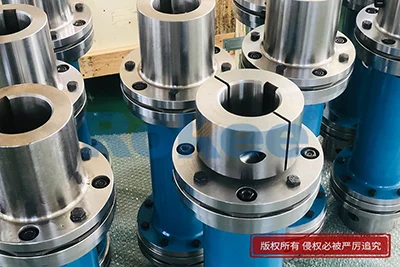
To address these issues, more and more manufacturers are adapting flexible couplings in their PU sandwich panel production lines. A flexible coupling is a mechanical device used to connect two shafts while allowing a certain degree of misalignment and torsional flexibility, achieving smooth power transmission through its elastic components. Unlike rigid couplings, flexible couplings can compensate for axial, radial, and angular misalignments between shafts, absorb vibrations and shocks, and protect connected equipment from damage, thereby improving the stability and efficiency of the transmission system. The application of flexible couplings in PU sandwich panel production lines is not a simple replacement of components but a systematic optimization of the transmission system, which integrates with the characteristics of each production link to maximize operational efficiency.
One of the key advantages of flexible couplings in PU sandwich panel production lines is their ability to compensate for shaft misalignment, which effectively solves the problem of equipment wear caused by misalignment in traditional production lines. Flexible couplings achieve misalignment compensation through the deformation of their elastic components, which can be made of materials such as rubber, polyurethane, or metal membranes. These elastic components allow for a certain range of displacement between the connected shafts, absorbing the misalignment caused by thermal expansion, vibration, or foundation settlement without transferring excessive stress to the shafts and bearings. In the feeding section of the production line, for example, the feeding rollers are driven by a motor through a flexible coupling. Due to the long-term operation of the rollers, slight axial or radial misalignment may occur, but the flexible coupling can compensate for this misalignment in real time, ensuring that the feeding speed remains stable. This stability prevents uneven feeding of surface materials, which is crucial for ensuring the uniform thickness of the final PU sandwich panel. Similarly, in the foaming section, the mixing head is driven by a motor through a flexible coupling; the flexible coupling can compensate for the misalignment caused by the vibration of the mixing head during high-speed rotation, ensuring that the mixing head rotates stably and uniformly, thereby ensuring the uniform mixing of polyurethane raw materials and the consistency of the foam core density. This not only reduces product defects but also reduces the need for manual adjustment and maintenance, saving labor costs and improving production efficiency.
Another important role of flexible couplings in improving production efficiency is their ability to absorb vibrations and shocks, reducing equipment failure rates and unplanned downtime. In PU sandwich panel production lines, multiple pieces of equipment operate simultaneously, generating a large amount of vibration—for example, the motor of the foaming machine, the operation of the curing oven, and the cutting of the panels all produce vibrations. These vibrations, if not absorbed, can be transmitted to the entire transmission system, leading to loosening of components, increased wear, and even equipment failure. Flexible couplings use their elastic components to absorb and dampen these vibrations, isolating the motor from the driven equipment and reducing the impact of vibrations on the entire system. For instance, the motor of the conveying belt is connected to the conveyor roller through a flexible coupling; when the conveying belt is loaded with semi-finished panels, it may generate sudden shocks, but the flexible coupling can absorb these shocks, preventing them from being transmitted to the motor and the conveyor roller, thereby protecting the motor and extending the service life of the conveying belt. This vibration absorption capacity significantly reduces the frequency of equipment failure, shortens unplanned downtime, and ensures the continuous operation of the production line. In traditional production lines using rigid couplings, equipment failure due to vibration is common, leading to frequent production interruptions; after adapting flexible couplings, the failure rate of key equipment can be reduced by more than 30%, and the average continuous operation time of the production line can be extended by 20% to 30%, greatly improving overall production efficiency.
In addition to compensating for misalignment and absorbing vibrations, flexible couplings also improve the efficiency of the PU sandwich panel production line by enhancing the synchronization of each production link. The production of PU sandwich panels requires strict synchronization between different links—for example, the feeding speed of surface materials must match the foaming speed of polyurethane, and the curing speed must be coordinated with the cutting speed. Any asynchrony between these links can lead to production bottlenecks, such as the accumulation of semi-finished products in the foaming zone or the curing zone, reducing production efficiency. Flexible couplings have excellent torque transmission performance, ensuring that power is transmitted smoothly and stably from the motor to the driven equipment, maintaining consistent speed and torque. This stable power transmission ensures that each link of the production line operates in synchronization, eliminating production bottlenecks. For example, in the cutting section, the cutting tool is driven by a motor through a flexible coupling; the flexible coupling ensures that the cutting tool rotates at a constant speed, matching the conveying speed of the semi-finished panels, thereby achieving precise cutting without causing damage to the panels or waste of materials. In addition, flexible couplings have a fast response speed, which can quickly adjust the speed and torque according to changes in production demand, adapting to the adjustment of production parameters such as panel thickness and size. This flexibility allows the production line to quickly switch between different product specifications, reducing the time required for equipment adjustment and improving the adaptability and efficiency of the production line.
The adaptation of flexible couplings also brings significant benefits in terms of equipment maintenance and operational costs. Traditional rigid couplings require frequent inspection and maintenance to ensure precise alignment between shafts; any misalignment must be corrected in a timely manner, which requires a lot of manual labor and time. In contrast, flexible couplings have a simple structure, easy installation, and minimal maintenance requirements. Their elastic components can absorb misalignment and vibration, reducing the wear of shafts, bearings, and other components, thereby extending the service life of the equipment and reducing the frequency of component replacement. For example, the elastic components of flexible couplings can be replaced quickly and easily when they are worn, without the need for disassembling the entire transmission system, which saves maintenance time and labor costs. In addition, the use of flexible couplings reduces the vibration and noise of the production line, creating a more comfortable working environment for operators, reducing the risk of work-related injuries, and improving work efficiency. Over the long term, the adaptation of flexible couplings can reduce the overall operational costs of the production line by 15% to 25%, including maintenance costs, component replacement costs, and labor costs, while improving production efficiency, bringing significant economic benefits to manufacturers.
It is worth noting that the adaptation of flexible couplings in PU sandwich panel production lines requires reasonable selection and installation according to the specific characteristics of the production line. Different types of flexible couplings have different performance characteristics, such as torque transmission capacity, misalignment compensation range, and vibration absorption capacity, which need to be matched with the actual operational conditions of the production line. For example, in the high-torque transmission links such as the foaming machine and curing oven, metal membrane flexible couplings with high torque transmission capacity and good high-temperature resistance should be selected; in the low-torque, high-precision links such as the cutting tool and feeding roller, polyurethane elastic couplings with good flexibility and precision should be selected. In addition, during installation, the alignment of the shafts should be adjusted as much as possible to ensure that the misalignment is within the compensation range of the flexible coupling, so as to maximize the performance of the flexible coupling. At the same time, regular inspection and maintenance of the flexible couplings should be carried out, including checking the wear of elastic components, the tightness of connections, and the lubrication status, to ensure their long-term stable operation.
In the context of the continuous development of industrial automation and intelligence, the technical transformation of PU sandwich panel production lines is an inevitable trend. The adaptation of flexible couplings, as a simple, effective, and cost-efficient technical improvement measure, has become an important part of the transformation. By solving the problems of equipment wear, operational instability, and production bottlenecks caused by traditional rigid couplings, flexible couplings significantly improve the operational efficiency, product quality, and stability of the production line, while reducing operational costs and bringing significant economic and social benefits. With the continuous advancement of flexible coupling technology, new types of flexible couplings with better performance, higher reliability, and wider adaptability are constantly emerging, which will further promote the optimization and upgrading of PU sandwich panel production lines.
In conclusion, the adaptation of flexible couplings in PU sandwich panel production lines is a key technical measure to improve production efficiency. By compensating for shaft misalignment, absorbing vibrations and shocks, enhancing the synchronization of production links, and reducing maintenance costs, flexible couplings effectively solve the long-standing problems of traditional production lines, promoting the continuous, stable, and efficient operation of the production line. As the demand for PU sandwich panels continues to grow and production technology becomes more stringent, the application of flexible couplings will become more widespread, playing an increasingly important role in the development of the PU sandwich panel industry. Manufacturers should pay full attention to the role of flexible couplings, select and apply them reasonably according to their own production needs, and continuously optimize the transmission system to improve core competitiveness in the market.




Links:
- Calibration Weight
- Digital Viscometer
- Carpas Industriales
- Exhibition Tent
- Industrial Cardan Shaft
- PU Sandwich Panel Machine
- PIR Sandwich Panel Line
- Sandwich Panel Machine
- Sandwich Panel Production Line
- PU Sandwich Panel Line
- Sandwich Panel Line
- Flexible Couplings Manufacturer In China
- Elastic Couplings Manufacturer In China