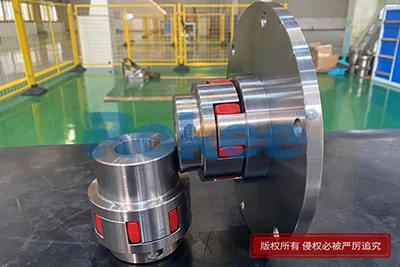
Large Torque Diaphragm Coupling

In the field of modern mechanical power transmission, the stability, efficiency and durability of torque transmission components directly determine the overall operating performance of mechanical equipment. As a core flexible transmission component, large torque diaphragm coupling has gradually become an indispensable key part of heavy-duty mechanical transmission systems by virtue of its unique elastic deformation mechanism, excellent torsional rigidity and superior misalignment compensation capability. Different from traditional rigid couplings and common elastic couplings, this type of coupling perfectly balances high-load torque transmission and flexible error compensation, solving many pain points in the operation of heavy machinery such as rigid impact, transmission deviation and component fatigue damage, and is widely used in various high-power, high-load and continuous operating mechanical scenarios. With the continuous upgrading of industrial manufacturing and the increasing demand for high-precision and high-stability mechanical transmission, the technical advantages and application value of large torque diaphragm coupling have become increasingly prominent, becoming an important guarantee for the long-term stable operation of heavy industrial equipment.
The working principle of large torque diaphragm coupling is based on the micro elastic deformation characteristics of metal diaphragm materials under load conditions. The core transmission component of the coupling is a group of precision-processed metal diaphragms, which are assembled between the driving end and driven end hubs through high-strength fasteners to form a complete transmission structure. During the equipment operation process, the torque generated by the driving shaft is transmitted to the metal diaphragm group through the connecting hub, and the diaphragm undergoes controllable micro elastic torsion deformation within the material’s elastic allowable range. This special deformation mode enables the diaphragm to efficiently transmit high torque from the outer diameter area to the inner diameter area, and then stably transfer the power to the driven shaft hub, realizing synchronous rotation and consistent power output of the driving and driven ends. Unlike flexible couplings that rely on rubber or polymer elastic parts for power transmission, the metal diaphragm of large torque diaphragm coupling only produces tiny elastic displacement during operation, without plastic deformation or material aging failure in a short cycle, which lays a solid foundation for its stable transmission of large torque loads.
In the actual operation of mechanical systems, due to machining errors, assembly deviations, equipment vibration, thermal expansion and cold contraction of components, and foundation settlement, various misalignment deviations are inevitably generated between the driving shaft and driven shaft. These deviations mainly include angular misalignment, parallel radial misalignment and axial displacement. If these misalignment problems cannot be effectively compensated, they will cause additional alternating stress on the transmission shaft and key components, leading to equipment vibration, noise increase, transmission efficiency reduction, and even premature wear and fatigue fracture of shaft parts and bearings. The large torque diaphragm coupling can perfectly solve this problem through the flexible characteristics of the metal diaphragm. When shaft misalignment occurs, the diaphragm will produce adaptive micro elastic bending and telescopic deformation, which can accurately absorb and offset various displacement deviations between the two shafts. This flexible compensation mode does not interfere with the torque transmission efficiency, nor will it generate additional transmission resistance and stress, ensuring that the power transmission process always maintains accuracy, stability and smoothness.
The structural design of large torque diaphragm coupling is scientific and rigorous, with high structural stability and load-bearing scalability. The whole coupling is mainly composed of precision metal diaphragm groups, integral forged shaft hubs, high-strength locking bolts and anti-loosening auxiliary parts, without any vulnerable non-metal elastic accessories. The diaphragm group is composed of multiple thin metal diaphragms stacked and combined. The number and thickness of diaphragms can be optimized and adjusted according to different torque load requirements, so as to adapt to various large-load transmission working conditions. The overall structure adopts a compact integrated design, which effectively reduces the axial and radial space occupation of the coupling while ensuring high torque bearing capacity, and is suitable for the limited installation space of various heavy mechanical equipment. All connecting parts adopt high-precision matching technology, and the assembly gap is strictly controlled, realizing zero-backlash torque transmission. This zero-clearance transmission feature makes the coupling have no rotation lag or power loss during operation, which is particularly suitable for mechanical systems that require high-precision power transmission and synchronous control.
One of the most prominent performance advantages of large torque diaphragm coupling is its ultra-high torsional rigidity and excellent large-load bearing capacity. In the working state, the metal diaphragm maintains high rigidity in the torsional direction, which can resist torsional deformation caused by large torque load and ensure high-precision torque transmission. Even under the impact load and alternating load conditions often encountered in heavy industrial production, the coupling can still maintain stable torsional performance without obvious torsional distortion or power attenuation. At the same time, the structural stress distribution of the diaphragm group is uniform and reasonable. The optimized diaphragm profile and assembly structure avoid local stress concentration, so that each diaphragm can evenly bear the torque load, greatly improving the overall load-bearing limit and fatigue resistance of the coupling. This enables the coupling to operate stably under long-term high-load and high-frequency alternating working conditions, and effectively avoids fatigue failure problems such as crack generation and fracture of transmission parts caused by long-term overload operation.
In terms of environmental adaptability, large torque diaphragm coupling shows far superior performance to traditional elastic couplings. Since the core transmission components are all metal materials with stable physical and chemical properties, the coupling can adapt to a wide temperature range and complex working environments. It can maintain stable mechanical performance in both high-temperature working conditions generated by long-term operation of high-power equipment and low-temperature working environments in special industrial scenarios, without softening, aging or brittle failure of elastic parts. In addition, the metal structure has good resistance to oil pollution, moisture and slight corrosion, and can work stably in harsh industrial environments such as fluid transmission workshops, chemical production sites and outdoor open-air mechanical systems. It will not be affected by environmental factors to produce performance attenuation, which greatly expands its application scope in heavy industrial fields.
The dynamic operation performance of large torque diaphragm coupling is also very outstanding, with low vibration, low noise and high operation balance. The overall structure of the coupling is symmetrical and uniform, and the precision machining and dynamic balance calibration process ensure that the coupling has excellent rotation balance during high-speed and high-load operation. There is no eccentric rotation or unbalanced vibration during power transmission, which can effectively reduce the vibration amplitude of the mechanical transmission system and suppress the generation of operating noise. For high-speed rotating equipment such as large fans, compressors and turbine power devices, this excellent dynamic balance performance can effectively improve the overall operation stability of the equipment, reduce the vibration wear of bearings, seals and other auxiliary components, and extend the service life of the whole machine. At the same time, the flexible misalignment compensation function of the diaphragm can buffer the instantaneous impact force generated during equipment start-up, stop and load switching, avoid rigid impact between transmission components, and further optimize the dynamic operation state of the mechanical system.
In terms of later operation and maintenance, large torque diaphragm coupling has significant economic and practical advantages. Benefiting from the all-metal structural design and zero vulnerable parts, the coupling does not need regular replacement of elastic accessories like rubber couplings and spring couplings in the whole service cycle. In the long-term operation process, it only needs regular simple inspection of fastening state and surface integrity, without frequent maintenance and lubrication maintenance. This maintenance-free characteristic greatly reduces the daily operation and maintenance cost of mechanical equipment, saves manual maintenance time and accessory replacement cost, and improves the operating efficiency of the production line. Moreover, the service life of large torque diaphragm coupling is far longer than that of traditional couplings under the same working conditions. Its excellent fatigue resistance and environmental adaptability enable it to adapt to long-term continuous industrial production without frequent failure and shutdown maintenance, which effectively improves the continuous operation capacity and production efficiency of mechanical equipment.
The application scenarios of large torque diaphragm coupling cover almost all heavy-duty mechanical transmission fields that require high torque, high stability and high precision. In the field of power equipment, it is widely used in the torque transmission system of large generators, steam turbines and gas turbines, providing stable power transmission guarantee for high-power power generation equipment. In the fluid machinery industry, it serves large-scale pumps, compressors and blowers, solving the problems of shaft misalignment and vibration impact in the operation of fluid transmission equipment, and ensuring the continuous and stable operation of fluid transportation systems. In heavy engineering machinery and industrial manufacturing equipment, the coupling is applied to material processing machinery, drilling equipment and large transmission test benches, adapting to the high-load and high-strength working characteristics of engineering machinery. In addition, it also plays an important role in special transmission fields such as marine power transmission and traction transmission systems, providing reliable transmission support for various high-load and complex working condition equipment.
With the continuous development of industrial intelligence and high-end manufacturing, the performance requirements for mechanical power transmission components are constantly improving, and large torque diaphragm coupling is also constantly optimized and upgraded in structural design, material application and processing technology. The continuous innovation of high-strength alloy materials further improves the torque bearing capacity and fatigue resistance of the diaphragm. The application of precision CNC machining and laser forming technology makes the diaphragm structure more precise and the stress distribution more uniform, further improving the transmission accuracy and stability. The optimized assembly and locking structure effectively avoids the loosening of fasteners during long-term operation, and further enhances the operational reliability of the coupling. These technical upgrades make large torque diaphragm coupling more adaptable to the high-standard operation requirements of modern industrial equipment, and its application advantages in high-precision, high-load and long-cycle transmission scenarios are becoming more and more prominent.
In the whole mechanical transmission system, the large torque diaphragm coupling undertakes the important task of connecting power components and realizing efficient and stable torque transmission. Its unique flexible rigid transmission mechanism not only ensures the high-efficiency output of large torque, but also effectively eliminates the adverse effects of shaft misalignment and equipment vibration on the transmission system, playing a key role in protecting mechanical components, improving transmission efficiency and reducing equipment failure rate. Compared with other types of couplings, it has irreplaceable comprehensive advantages in load-bearing capacity, transmission accuracy, environmental adaptability and maintenance economy. In the future, with the continuous progress of industrial technology and the expansion of heavy industry scenarios, large torque diaphragm coupling will be further popularized and applied in more professional fields, and continuously empower the high-efficiency and stable operation of modern heavy mechanical equipment with its superior transmission performance and reliable structural quality.
Rokee is a professional manufacturer of industrial couplings in china, designing and customizing a wide range of drive shaft coupling products for customers worldwide. Submit your coupling drawings or technical specifications, and we can customize coupling products for you.
Coupling Categories




Links:
- Calibration Weight
- Digital Viscometer
- Carpas Industriales
- Exhibition Tent
- Industrial Cardan Shaft
- PU Sandwich Panel Machine
- PIR Sandwich Panel Line
- Sandwich Panel Machine
- Sandwich Panel Production Line
- PU Sandwich Panel Line
- Sandwich Panel Line
- Flexible Couplings Manufacturer In China
- Elastic Couplings Manufacturer In China