Single Membrane Coupling

Single membrane coupling is a high-precision flexible transmission component designed for mechanical shaft connection, relying on the elastic deformation of a single integral metal diaphragm to transmit torque and compensate for shaft misalignment. As a core type of metallic flexible coupling, it stands out from traditional coupling structures with its ultra-compact configuration, zero transmission clearance, and maintenance-free operation. Unlike multi-membrane structures that adopt stacked diaphragm combinations, this coupling uses a single high-strength stainless steel diaphragm as the only elastic load-bearing element, simplifying the overall assembly structure while maintaining excellent torsional rigidity and operational stability. It can effectively adapt to tiny axial displacement, angular deflection, and minor radial offset between driving and driven shafts during equipment operation, solving the transmission jitter and wear problems caused by shaft misalignment. Widely applicable to medium and high-speed precision mechanical transmission scenarios, it avoids the defects of lubrication dependence, short service life, and low precision of traditional flexible couplings, becoming a key component in modern precision transmission systems.
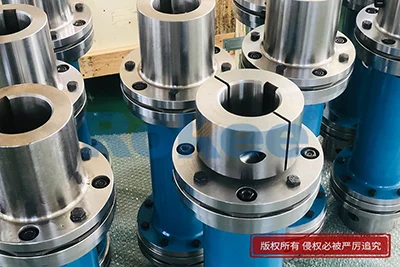
The structural composition of single membrane coupling is refined and streamlined, with every part designed to balance transmission efficiency, structural stability, and space adaptability. The core functional component is a single-piece thin metal diaphragm with uniform thickness and precise machining accuracy, which undergoes special heat treatment and surface strengthening processes to ensure stable elastic performance and fatigue resistance under long-term cyclic load. The diaphragm is clamped and fixed between two symmetrical hub flanges through high-precision fastening bolts, forming an integrated transmission structure without redundant auxiliary parts. The hub parts are processed with high dimensional accuracy to ensure tight coaxial matching with the connecting shaft, eliminating assembly gaps that may cause transmission errors. Compared with multi-membrane couplings that require multiple diaphragm stacking and spacer assembly, the single-membrane structure greatly reduces the overall volume and weight of the coupling, resulting in extremely low rotational inertia. This structural simplicity not only optimizes the dynamic response of the transmission system but also reduces assembly complexity, enabling quick installation and alignment in narrow mechanical installation spaces. Meanwhile, the integral forming design of the diaphragm avoids the loose failure risk of stacked structures, laying a solid foundation for long-term stable operation.
The working principle of single membrane coupling is based on the elastic mechanical properties of metal materials, realizing non-rigid synchronous torque transmission and automatic misalignment compensation. In the operating state, the driving shaft drives the active hub to rotate synchronously, and the torque is uniformly transmitted to the edge of the single diaphragm through the fastening bolts. Driven by torque load, the metal diaphragm produces controllable micro elastic deformation, which transfers the rotational power from the outer edge to the inner ring of the diaphragm, and finally drives the driven hub and the connected driven shaft to rotate synchronously. During this power transmission process, the elastic deformation characteristics of the single diaphragm can automatically offset various tiny misalignments generated during mechanical operation. When axial displacement occurs between the two shafts, the diaphragm produces telescopic elastic deformation along the axial direction to buffer displacement stress; when there is a small angular deflection, the diaphragm adapts to the angle difference through surface bending deformation; for slight radial offset, its uniform elastic strain can balance the radial force deviation. This pure elastic deformation transmission mode realizes zero-clearance power transmission, ensuring high synchronization of shaft rotation and effectively suppressing vibration and impact in the transmission process.
Single membrane coupling possesses unique performance advantages that make it irreplaceable in precision transmission fields, with prominent manifestations in transmission accuracy, operational stability and environmental adaptability. First of all, it achieves zero-backlash torque transmission due to the integral rigid-flexible combined structure, without the rotation hysteresis and position deviation common in gear and sleeve couplings, which can maintain extremely high transmission precision even during long-term high-speed operation. Secondly, the all-metal structural design eliminates the need for lubricating grease or other auxiliary lubricants, completely avoiding performance degradation and equipment pollution caused by lubricant aging, volatilization and leakage, and realizing full-life maintenance-free operation. In terms of dynamic performance, the low-inertia structural design enables it to respond quickly to speed changes and start-stop signals, which is very suitable for servo control and precision positioning equipment that requires high dynamic response. In addition, the high-strength metal diaphragm has excellent fatigue resistance and structural stability, and can maintain stable elastic performance in a wide temperature range and various working environments, free from the aging and deformation problems of rubber elastic elements. It also has good vibration damping and impact resistance, which can absorb tiny vibration generated by equipment operation and protect the shaft system and precision components from impact damage.
Despite its simple structure, single membrane coupling has distinct application limitations and applicable working condition boundaries, which are key factors to be considered in equipment matching. Restricted by the single-layer elastic structure, its misalignment compensation capacity is relatively limited compared with multi-membrane coupling products. It can only adapt to micro axial, angular and radial misalignment, and is not suitable for mechanical systems with large shaft offset or severe operation deflection. Excessive misalignment will cause excessive local stress on the diaphragm, leading to accelerated fatigue wear and even sudden fracture failure. In terms of load adaptability, the single-diaphragm structure is more suitable for medium and low torque and stable load working conditions, and is not ideal for heavy-duty impact load and frequent overload operation scenarios, as instantaneous impact torque is easy to cause irreversible plastic deformation of the diaphragm. In terms of speed performance, although it has low rotational inertia, the single-layer diaphragm will produce slight centrifugal deformation under ultra-high speed operation, which affects transmission stability. Therefore, it is mostly used in medium and conventional high-speed transmission systems, and special structural optimization is required for ultra-high speed equipment. Clarifying these limitations can effectively avoid improper selection and improve the matching degree between the coupling and the operating conditions.
The installation and debugging process of single membrane coupling focuses on precision alignment, which directly determines its transmission performance and service life. Before installation, all connecting parts need to be cleaned thoroughly to remove machining burrs, dust and oil stains, ensuring the flatness and tightness of the contact surface between the diaphragm and the flange hub. The coaxiality of the driving and driven shafts must be precisely calibrated in advance, and the offset and deflection errors should be controlled within the allowable micro range of the single diaphragm structure, so as to avoid excessive stress on the diaphragm after installation. During assembly, the fastening bolts need to be tightened symmetrically and gradually in a cross sequence to ensure uniform stress on the diaphragm surface, preventing local stress concentration caused by uneven bolt preload. After preliminary installation, it is necessary to conduct idle running debugging, observe the operation stability of the coupling, check for abnormal vibration and noise, and re-calibrate the shaft alignment if abnormal conditions occur. In daily use, regular complex maintenance is not required, but periodic visual inspection is needed to check for diaphragm deformation, bolt looseness and surface fatigue cracks. Scientific installation and standardized inspection can maximize the service life of the coupling and maintain long-term high-precision transmission performance.
Single membrane coupling is widely applied in multiple precision mechanical transmission fields, relying on its superior comprehensive performance and compact structural advantages. In precision automation equipment such as servo transmission systems, precision positioning platforms and robotic transmission mechanisms, its zero-backlash transmission and high dynamic response characteristics ensure the accurate execution of equipment positioning and motion commands, meeting the high-precision operation requirements of automated production. In light industrial and food processing machinery, the maintenance-free and pollution-free all-metal structure avoids lubricant contamination, complying with the clean operation requirements of food and light industrial production environments. In chemical and pharmaceutical mechanical equipment, its good temperature resistance and corrosion resistance enable it to operate stably in slightly harsh working environments such as variable temperature and micro-corrosion. In addition, it is also commonly used in instrument testing equipment, small precision fans and pump transmission systems, providing stable and efficient shaft connection guarantee for various medium-speed, low-offset and high-precision mechanical equipment.
With the continuous upgrading of modern precision manufacturing technology, the optimization and application prospect of single membrane coupling are constantly expanding. At present, the performance optimization of single membrane coupling mainly focuses on diaphragm material upgrading and structural micro-optimization. The application of new high-strength alloy materials further improves the fatigue resistance, temperature resistance and structural toughness of the diaphragm, expanding its adaptable load range and service life. Precision laser processing and fine surface treatment technology make the diaphragm thickness distribution more uniform and the elastic deformation more stable, further improving transmission accuracy and misalignment compensation stability. In terms of application expansion, with the rapid development of precision intelligent equipment and miniaturized mechanical systems, the compact and low-inertia advantages of single membrane coupling make it more adaptable to miniaturized and integrated mechanical transmission trends. In the future, with the continuous innovation of material science and processing technology, single membrane coupling will break through part of the existing performance limitations, be applied to more diversified precision transmission scenarios, and provide more reliable basic component support for the upgrading of modern mechanical transmission systems.


Links:
- Calibration Weight
- Digital Viscometer
- Carpas Industriales
- Exhibition Tent
- Industrial Cardan Shaft
- PU Sandwich Panel Machine
- PIR Sandwich Panel Line
- Sandwich Panel Machine
- Sandwich Panel Production Line
- PU Sandwich Panel Line
- Sandwich Panel Line
- Flexible Couplings Manufacturer In China
- Elastic Couplings Manufacturer In China