Elastic Coupling Escort For Efficient Operation Of Sandwich Panel Machine

In the modern industrial production landscape, the sandwich panel machine plays an indispensable role in the manufacturing of building materials, with its operational efficiency directly determining the production capacity, product quality and economic benefits of enterprises. As a core component in the transmission system of sandwich panel machines, the elastic coupling may not be the most eye-catching part, but it undertakes the crucial mission of connecting power sources and functional components, transmitting torque stably, and protecting the entire equipment from potential damage. Its performance and reliability are closely linked to the smooth operation of the sandwich panel machine, becoming an invisible "escort" for the efficient and stable production of the equipment. Understanding the working principle, functional advantages, application characteristics and maintenance methods of elastic couplings in sandwich panel machines is of great significance for improving production efficiency, reducing equipment failure rates and extending the service life of the entire production line.
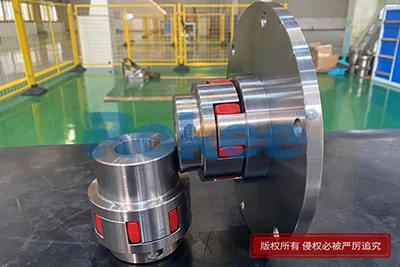
A coupling is a mechanical device used to connect two shafts together at their ends for the purpose of transmitting power, and the elastic coupling stands out among various types of couplings due to its unique flexible transmission characteristics. Unlike rigid couplings that achieve forced synchronous connection between shafts, elastic couplings realize flexible transmission through built-in elastic elements, which can not only transmit torque stably but also compensate for the misalignment between shafts, absorb shock loads and reduce vibration transmission. This flexible design makes elastic couplings particularly suitable for the working environment of sandwich panel machines, which often face complex working conditions such as variable loads, frequent start-stop and slight shaft misalignment during the production process. The sandwich panel machine is a continuous automatic production line integrating mechanism, electrical control, hydraulic system and other technologies, consisting of decoiler, roll forming system, foaming system, cutting system, stacking system and other components. Each component needs to maintain coordinated operation, and the elastic coupling, as the connection hub between the motor and each functional component, ensures the smooth transmission of power between different parts, making the entire production line operate in a coordinated and efficient manner.
The core function of the elastic coupling in the sandwich panel machine is to transmit torque stably and efficiently. The production process of sandwich panels involves multiple links such as uncoiling of surface materials, roll forming, foaming, laminating and cutting, each of which requires a stable power supply to ensure the accuracy and consistency of the production process. The motor, as the power source of the sandwich panel machine, outputs torque that needs to be transmitted to various functional components such as the decoiler, roll forming roller and cutting device through the coupling. The elastic coupling achieves tight connection between the motor shaft and the driven shaft through its elastic elements and hub structure, ensuring that the torque is transmitted without obvious loss. Compared with rigid couplings, the elastic coupling does not produce forced rigid constraints during torque transmission, which reduces the stress conduction between the shaft systems and adapts to the changes of working conditions such as multi-speed and multi-load of the sandwich panel machine. Whether it is the low-speed and high-torque operation during the roll forming process or the high-speed operation during the cutting process, the elastic coupling can maintain stable torque transmission, ensuring that each component of the equipment can obtain the required power support, thereby ensuring the stability of the production rhythm and the consistency of product quality.
Compensating for shaft misalignment is another important function of the elastic coupling that is crucial for the operation of the sandwich panel machine. During the installation and operation of the sandwich panel machine, due to factors such as installation accuracy, foundation settlement, equipment operation deformation and temperature changes, it is inevitable that there will be misalignment between the motor shaft and the driven shaft of each functional component, which may be radial offset, angular tilt or axial movement. If such misalignment cannot be effectively compensated, it will lead to increased vibration of the shaft system, accelerated wear of bearings and other components, increased noise during equipment operation, and even serious failures such as shaft breakage and component damage in severe cases, which will interrupt the production process and cause huge economic losses. The elastic elements of the elastic coupling, such as rubber, polyurethane or metal diaphragms, can absorb the stress caused by such misalignment through their own deformation, effectively offset the impact of radial offset, angular tilt and axial movement, reduce the requirements for installation accuracy, reduce additional losses during equipment operation, and extend the service life of shaft systems, bearings and other components. Different types of elastic couplings have different focuses on misalignment compensation capabilities. For example, beam couplings are suitable for occasions requiring angular misalignment and parallel offset compensation, while diaphragm couplings have better compensation capabilities for axial movement, which can be flexibly selected according to the specific working conditions of the sandwich panel machine.
Shock absorption and vibration reduction are important protective functions of elastic couplings, which can effectively protect the sandwich panel machine from damage caused by impact and vibration. During the operation of the sandwich panel machine, the start-up of the motor, the sudden change of load, the braking of the equipment and the foaming reaction of raw materials will all generate impact loads. At the same time, the operation of each rotating component will also produce vibration. If these impacts and vibrations are directly transmitted to the shaft system and functional components of the equipment, it will damage precision parts, affect the stability of equipment operation, reduce the accuracy of product processing, and even cause safety hazards. The elastic elements of the elastic coupling can absorb and dissipate impact energy, alleviate the impact of impact loads on the shaft system and equipment, and at the same time weaken the transmission of vibration, reduce the noise during equipment operation, and create a more stable operating environment. In the working conditions of heavy load, high-frequency start-stop or frequent positive and negative rotation of the sandwich panel machine, this shock absorption and vibration reduction effect is particularly obvious. It can effectively avoid the damage of core equipment such as motors, reducers and functional components due to excessive impact, reduce the number of equipment failure shutdowns, and improve production efficiency. In addition, when the equipment is overloaded, the elastic elements of some elastic couplings will undergo plastic deformation or fracture, which plays a role of overload protection, preventing the shaft system and core equipment from being damaged due to excessive torque.
The adaptability of elastic couplings to complex working environments also provides important support for the stable operation of sandwich panel machines. The production site of sandwich panels often has harsh environmental conditions, such as high temperature, humidity, dust, oil pollution and other factors, which will have a negative impact on the operation of equipment components. High-quality elastic couplings can adapt to such complex environments by selecting oil-resistant, corrosion-resistant, high-temperature resistant elastic materials and main body materials. For example, elastic couplings using stainless steel as the main body material and polyurethane as the elastic element have good corrosion resistance and high-temperature resistance, which can maintain stable transmission performance in humid and high-temperature production environments without frequent maintenance. In addition, the elastic coupling has the characteristics of simple structure and convenient installation. It does not require complex calibration procedures during installation, which can save installation time and improve the efficiency of equipment commissioning. At the same time, its compact structure occupies a small space, which is suitable for the limited installation space of the transmission system of the sandwich panel machine, and can be flexibly installed in various positions of the equipment.
The selection of elastic couplings suitable for sandwich panel machines is the premise to ensure their efficient operation. When selecting elastic couplings, it is necessary to comprehensively consider the working parameters of the sandwich panel machine, such as rated power, operating speed, torque range, shaft diameter, and the type and degree of shaft misalignment, as well as the environmental conditions of the production site. First of all, the torque capacity of the elastic coupling should match the rated torque of the motor and the load requirements of the equipment. If the torque capacity of the selected coupling is too small, it will lead to overload damage of the coupling; if it is too large, it will cause unnecessary waste and increase the overall weight of the equipment. Secondly, the misalignment compensation capacity of the coupling should be compatible with the actual misalignment of the equipment. For the sandwich panel machine with large shaft misalignment, a coupling with strong misalignment compensation capacity should be selected to ensure the stable operation of the equipment. In addition, the material of the coupling should be selected according to the environmental conditions. For example, in the production environment with more dust and oil pollution, a coupling with good sealing performance and wear resistance should be selected; in the high-temperature environment, a coupling with high-temperature resistant elastic elements should be selected. At the same time, the operating speed of the coupling should also be considered to ensure that the coupling can operate stably within the rated speed range without resonance or excessive vibration.
Scientific and standardized daily maintenance is an important means to extend the service life of elastic couplings and ensure the efficient operation of sandwich panel machines. The daily maintenance of elastic couplings should follow the principle of "prevention first, precise detection and timely treatment", through regular inspection, cleaning, lubrication and adjustment, to effectively reduce the failure rate of couplings. First of all, the operating state of the coupling should be monitored regularly. The vibration value of the coupling should be measured with a vibration detector every week, and compared with the baseline data of the equipment during normal operation. If the vibration speed exceeds 4.5mm/s, the cause should be investigated in time. The surface temperature of the coupling should be detected with an infrared thermometer every day. Under the environment of 25℃, the normal working temperature of the coupling should not exceed 70℃. If the temperature rise rate exceeds 5℃ per minute, the machine should be shut down immediately for inspection. During the operation of the equipment, attention should also be paid to listening to the sound of the coupling. If periodic impact sound, friction sound or other abnormal noises are heard, it is necessary to judge whether it is caused by the fracture of elastic elements, metal wear or misalignment, and deal with it in time.
The appearance inspection of the elastic coupling is also an important part of daily maintenance. It is necessary to regularly check whether the bolts and connecting parts of the coupling are loose, whether the anti-loosening devices such as spring washers and lock washers are invalid, and whether the anti-loosening marks are misaligned. At the same time, check whether the fit between the key and the keyway is tight, and whether there is wear gap. Generally, the gap should not exceed 0.05mm, and there should be no relative sliding when manually turning the shaft. For the elastic elements of the coupling, it is necessary to check their state regularly. For rubber or polyurethane elastic elements, check whether there are cracks, hardening, deformation or degumming. If the crack depth exceeds 1mm, they should be replaced in time. For metal elastic elements such as diaphragms and serpentine springs, check whether there are cracks, rust, wrinkles or thickness wear. If the wear of the diaphragm exceeds 10%, it should be replaced. In addition, it is necessary to regularly remove the oil, dust and metal debris on the surface and gaps of the coupling, which can be blown with compressed air or wiped with a soft cloth to avoid impurities accelerating wear or affecting heat dissipation. In humid and corrosive environments, anti-rust grease should be applied to metal parts to prevent corrosion.
The maintenance of elastic elements and lubrication management are also key links in the maintenance of elastic couplings. The replacement cycle of elastic elements should be determined according to the material and working conditions. Generally, rubber elastic elements should be replaced every 2 to 5 years, and shortened to 1 to 2 years under high-impact working conditions. Metal elastic elements such as diaphragms can be extended to 5 to 8 years if there is no obvious wear, but cracks should be checked every year. When replacing elastic elements, it is necessary to ensure that the axial gap between the two half-couplings meets the design requirements. For example, the gap of plum couplings is generally 2 to 5mm, so as to avoid premature wear caused by excessive extrusion. For couplings with multiple sets of elastic elements, they should be replaced as a whole to avoid uneven load caused by inconsistent elasticity of new and old elements. For some types of elastic couplings that require lubrication, such as toothed elastic couplings, the state of lubricating grease should be checked every 3 to 6 months. If it dries or agglomerates, it should be replaced in time. The filling amount should be 1/3 to 1/2 of the cavity volume, and lithium-based grease with a temperature resistance of 20℃ to 120℃ is recommended. For non-contact elastic couplings such as diaphragm couplings and bellows couplings, lubrication is not required, but it is necessary to avoid lubricating grease polluting the elastic elements, especially rubber parts.
The alignment calibration of the elastic coupling is also an important part of maintenance. Although the elastic coupling has a certain compensation capacity, long-term misalignment will accelerate the wear of elements. It is recommended to use a laser alignment instrument to detect the alignment of the coupling every six months. For elastic sleeve pin couplings, the radial deviation should not exceed 0.1mm; for diaphragm couplings, the radial deviation should not exceed 0.05mm. The angular deviation of elastic elements should not exceed 1°, and that of high-precision diaphragm couplings should not exceed 0.5°. If the alignment deviation exceeds the allowable value due to factors such as equipment foundation settlement, the position of the shaft system should be readjusted in time to ensure the normal operation of the coupling. In addition, a maintenance account should be established to record the inspection time, detection data, maintenance content and operators each time, so as to facilitate the traceability of the equipment state. At the same time, spare parts such as elastic elements and bolts of key equipment should be reserved. Rubber parts should be stored in a cool and dry place to avoid direct sunlight, and the spare parts should be consistent with the original model, especially the hardness and dimensional tolerance of the elastic elements, which should be matched.
In the actual operation of the sandwich panel machine, common faults of elastic couplings include wear or damage of elastic elements, loosening of bolts, misalignment of shafts, abnormal vibration and noise, etc. For these faults, targeted treatment measures should be taken in time. If the elastic element is worn or damaged, it should be replaced with a new elastic element of the same model in time to avoid affecting the torque transmission and shock absorption effect. If the bolt is loose, it should be tightened according to the design torque, and the anti-loosening device should be checked and replaced if necessary. For the misalignment of the shaft, the laser alignment instrument should be used to re-calibrate the shaft system to ensure that the misalignment is within the allowable range. If there is abnormal vibration and noise, it is necessary to check whether the elastic element is damaged, whether the bolt is loose, whether the alignment is accurate, and other factors, and eliminate the fault in time to avoid further damage to the equipment. In addition, during the operation of the equipment, it is necessary to avoid overload operation, which can effectively reduce the damage of the elastic coupling and extend its service life.
With the continuous development of industrial automation, the performance requirements of sandwich panel machines are getting higher and higher, which also puts forward higher requirements for the performance of elastic couplings. In the future, elastic couplings will develop in the direction of high precision, high torque, corrosion resistance, high temperature resistance and long service life, to better adapt to the development needs of sandwich panel machines. At the same time, with the application of intelligent monitoring technology, the operating state of elastic couplings can be monitored in real time, and potential faults can be warned in advance, which can further reduce the failure rate of equipment and improve production efficiency. For enterprises using sandwich panel machines, strengthening the understanding and attention to elastic couplings, selecting suitable couplings, and doing a good job in daily maintenance and fault treatment can not only ensure the efficient and stable operation of the equipment but also reduce production costs and improve market competitiveness.
In conclusion, the elastic coupling, as a key component in the transmission system of the sandwich panel machine, undertakes the important functions of torque transmission, misalignment compensation, shock absorption and vibration reduction, and overload protection. Its performance and reliability directly affect the operational efficiency, product quality and service life of the sandwich panel machine. By understanding the working principle and functional advantages of elastic couplings, selecting suitable products according to actual needs, and carrying out scientific and standardized daily maintenance and fault treatment, we can give full play to the role of elastic couplings, ensure the efficient and stable operation of sandwich panel machines, and provide a strong guarantee for the healthy development of enterprises. In the increasingly fierce market competition, the importance of elastic couplings as the "escort" of sandwich panel machines will become more and more prominent, creating greater value for the production and development of enterprises.
Rokee is a professional manufacturer of industrial couplings in china, designing and customizing a wide range of drive shaft coupling products for customers worldwide. Submit your coupling drawings or technical specifications, and we can customize coupling products for you.
Coupling Categories


Links:
- Calibration Weight
- Digital Viscometer
- Carpas Industriales
- Exhibition Tent
- Industrial Cardan Shaft
- PU Sandwich Panel Machine
- PIR Sandwich Panel Line
- Sandwich Panel Machine
- Sandwich Panel Production Line
- PU Sandwich Panel Line
- Sandwich Panel Line
- Flexible Couplings Manufacturer In China
- Elastic Couplings Manufacturer In China