Flexible Tyre Coupling

Flexible tyre coupling is a versatile and high-performance mechanical transmission component widely applied in modern industrial power transmission systems. Designed to connect rotating shafts of different mechanical equipment, it primarily relies on the elastic deformation of rubber tyre elements to achieve backlash-free torque transmission while delivering exceptional vibration damping and misalignment compensation capabilities. Unlike rigid couplings that require precise shaft alignment and lack buffering functions, this flexible coupling can effectively accommodate axial, radial, and angular shaft deviations generated during equipment operation. It efficiently absorbs instantaneous impact loads and torsional vibrations produced during startup, operation, and shutdown processes, protecting core mechanical components from fatigue damage and excessive mechanical stress. Featuring a simple and compact structural design, convenient installation and disassembly, and maintenance-free operation in most service scenarios, it has become an indispensable component in various medium and low-speed power transmission equipment, balancing stable power output and long-term operational reliability of mechanical systems.
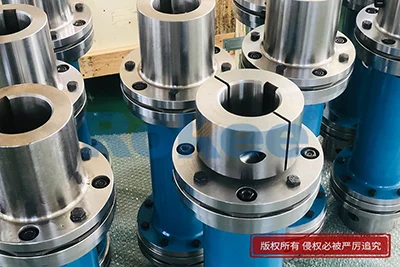
The basic structural composition of flexible tyre coupling is simple and scientific, mainly consisting of elastic rubber tyre bodies and paired metal half-coupling flanges that cooperate with each other to complete power transmission work. The core functional component is the vulcanized rubber tyre element, which is processed with special elastic formulas to maintain stable toughness and deformation recovery performance under long-term alternating loads. The tyre-shaped elastic structure is tightly assembled between two metal flanges, forming an integrated transmission structure without complex intermediate transmission parts or meshing structures. This unique structural design eliminates the structural clearance existing in traditional gear and jaw couplings, realizing completely backlash-free torque transmission and ensuring continuous and stable power output even during frequent forward and reverse rotation switching. The metal flanges adopt high-strength structural materials to guarantee rigid connection with equipment shafts, while the rubber tyre undertakes all flexible buffering and displacement compensation tasks. The separation of rigid connection and flexible buffering functions enables the coupling to maintain structural stability under normal operating conditions and exert excellent adaptive adjustment performance when shaft misalignment occurs.
The core working principle of flexible tyre coupling centers on the elastic torsional shear deformation of rubber tyre elements, which realizes organic integration of torque transmission and operational buffering. During equipment operation, the driving shaft drives one metal flange to rotate, and the torque is stably transmitted to the driven flange and the connected driven shaft through the friction and elastic traction of the rubber tyre. When the connected two shafts produce relative displacement due to installation errors, equipment foundation settlement, or long-term operational wear, the rubber tyre will generate mild torsional, tensile, and compressive deformation adaptively. This flexible deformation can perfectly offset axial stretching deviation, radial offset, and angular deflection between shafts, avoiding additional mechanical stress and friction loss caused by forced alignment of rigid transmission structures. In addition, the rubber material has inherent damping characteristics, which can convert the mechanical vibration and impact energy generated by equipment speed fluctuation and load mutation into tiny elastic deformation energy and consume it gradually. This working mechanism fundamentally suppresses the transmission of torsional vibration between equipment, reducing the overall vibration amplitude and operating noise of the transmission system.
Flexible tyre coupling stands out among various flexible transmission components due to its outstanding multi-directional misalignment compensation capability, which far exceeds that of conventional elastic couplings. In actual industrial operation, it is difficult to achieve absolute precise alignment of two connected shafts during equipment installation, and minor shaft displacement will inevitably occur with the extension of service time and changes in operating conditions. Traditional couplings can only tolerate extremely small shaft deviations, and slight misalignment will lead to severe component wear, shaft distortion, and even equipment operational failure. In contrast, the special annular tyre structure of flexible tyre coupling provides a large flexible deformation space, allowing it to adapt to simultaneous deviations in axial, radial, and angular directions without generating additional restraining force on the shaft system. Even in complex working environments where multiple misalignment states coexist, the coupling can still maintain normal power transmission without affecting the operating efficiency of mechanical equipment. This excellent adaptive performance greatly reduces the precision requirements for equipment installation and debugging, and effectively avoids frequent equipment shutdowns and maintenance caused by shaft misalignment faults.
Superior vibration damping and shock absorption performance is another core advantage of flexible tyre coupling, making it highly adaptable to variable load and impact working conditions. Most industrial mechanical equipment will face instantaneous impact loads during startup, sudden shutdown, and load switching, and long-term torsional vibration will occur during continuous operation. These unstable mechanical impacts are the main causes of fatigue damage to shafts, bearings, and other core components, shortening the service life of the entire transmission system. The high-elasticity rubber tyre element of the coupling has excellent energy absorption and damping effects, which can instantly buffer instantaneous impact forces and weaken high-frequency torsional vibrations in the transmission process. Different from metal elastic components that easily produce resonance and fatigue loss, rubber materials can effectively isolate vibration transmission between the driving end and the driven end, preventing vibration from spreading to the whole equipment structure. This not only optimizes the operating stability of the equipment but also reduces mechanical noise generated by vibration friction, improving the overall operating environment of industrial production equipment.
Flexible tyre coupling has remarkable practical advantages in installation, maintenance and service life, meeting the efficient and low-cost operation needs of modern industrial equipment. Its overall structure is simple and modular, with no complicated parts or precision transmission structures, resulting in extremely low failure rates in daily operation. The integrated rubber tyre element requires no lubrication, refueling or regular calibration maintenance, completely avoiding the maintenance workload and operational risks caused by lubricant deterioration and leakage. The assembly and disassembly process is extremely convenient; the radial assembly design allows operators to complete replacement and debugging work without moving the connected motors, pumps and other main equipment, greatly improving maintenance efficiency and reducing equipment downtime. In terms of service life, the specially formulated rubber material has excellent wear resistance, aging resistance and fatigue resistance, and can maintain stable elastic performance for a long time under continuous cyclic deformation. Even in long-term high-frequency operation scenarios, it is not easy to produce deformation failure and performance attenuation, realizing long-term stable service and reducing the comprehensive operating cost of mechanical transmission systems.
With its comprehensive and balanced performance, flexible tyre coupling is widely applicable to various medium and low-speed, variable-load industrial transmission scenarios, covering multiple fields of mechanical production. It is highly suitable for conventional power transmission equipment such as conveying machinery, stirring equipment, fans and water pumps, which often face minor shaft displacement and frequent load changes during operation. In light industrial and general mechanical equipment, it can effectively stabilize power output and reduce equipment failure rates caused by vibration and misalignment. It also performs well in some moderately harsh working environments, where special rubber formulas can resist conventional environmental erosion and maintain stable structural elasticity. For mechanical systems that require frequent forward and reverse rotation switching, its backlash-free transmission feature can eliminate the impact and wear caused by rotation direction switching, ensuring the accuracy and stability of power transmission. Thanks to its strong environmental adaptability and scenario compatibility, it can meet the diversified power transmission needs of different mechanical equipment, providing reliable basic guarantee for the stable operation of industrial production lines.
Although flexible tyre coupling has numerous performance advantages, it also has applicable limitations that need reasonable attention in practical selection and use, ensuring optimal matching with working conditions. Restricted by the material characteristics of rubber elements, its bearing capacity is lower than that of metal rigid couplings and high-strength gear couplings, so it is not suitable for ultra-high torque and heavy-load extreme working conditions. In long-term high-load operation, the torsional deformation of the rubber tyre will cause slight changes in axial dimension and produce tiny additional axial force on the shaft system, which needs to be considered in the design of high-precision transmission systems. In addition, conventional rubber materials have limited tolerance to ultra-high temperature and strong corrosive environments, and special customized structures are required for extreme working scenarios. Despite these limitations, within its applicable working range, flexible tyre coupling still shows irreplaceable comprehensive advantages in flexibility, damping performance and maintenance convenience. Reasonable selection and standardized application can maximize its service value, effectively protect mechanical equipment, reduce operational faults, and create stable and efficient operating conditions for various industrial power transmission systems.



Links:
- Calibration Weight
- Digital Viscometer
- Carpas Industriales
- Exhibition Tent
- Industrial Cardan Shaft
- PU Sandwich Panel Machine
- PIR Sandwich Panel Line
- Sandwich Panel Machine
- Sandwich Panel Production Line
- PU Sandwich Panel Line
- Sandwich Panel Line
- Flexible Couplings Manufacturer In China
- Elastic Couplings Manufacturer In China